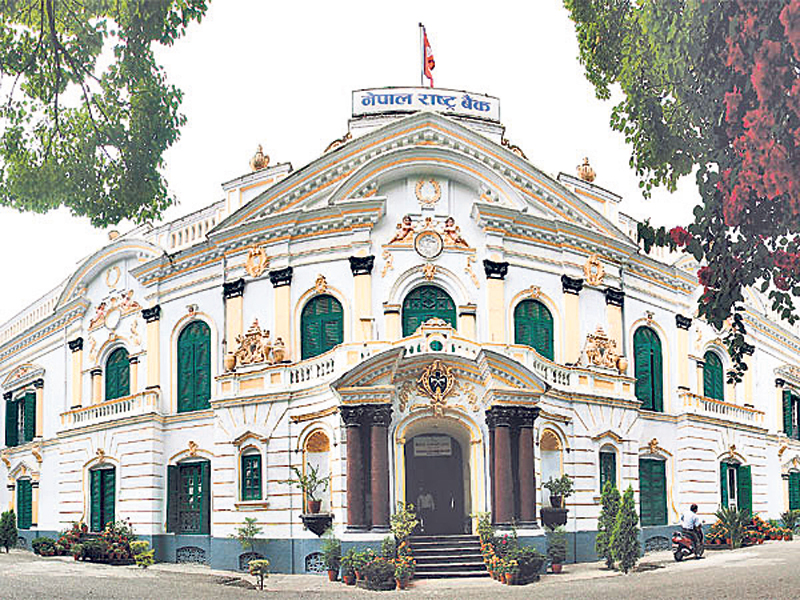
KATHMANDU, Jan 5: Nepal Rastra Bank (NRB) has projected a positive economic outlook for the current fiscal year despite banks sitting on excess liquidity and struggling to expand credit, highlighting a growing disconnect between official projections and ground realities in the financial sector.
To manage surplus liquidity and regulate interest rates, the central bank issued bonds worth Rs 25 billion on Sunday. Over the past week, the NRB mopped up a total of Rs 75 billion from the banking system.
Last Monday, the NRB received subscriptions far exceeding the offered amount. While it sought to absorb Rs 25 billion from the market, banks applied for Rs 1.22 trillion for the one-year Nepal Rastra Bank Bonds—nearly 49 times the offered volume.
Lending slows as banks focus on recovery of loans at fiscal yea...

Despite weak private-sector investment and sluggish credit expansion, the NRB has projected above-average economic growth for the current fiscal year, citing easing interest rates, subdued inflation and improvements in the external sector indicators.
“Economic growth is expected to be above average in FY 2025/26 as global fuel and food prices have declined, interest rates on loans and deposits are falling, hydroelectric power generation has increased significantly, exports and remittances have grown, foreign tourist arrivals have risen, and the construction and manufacturing sectors—previously in contraction—are expanding due to the flexible monetary,” the central bank said in its annual Economic Activities Study Report 2024/25.
The NRB further stated that economic activity would remain buoyant due to ample liquidity, the government’s push for good governance and reconstruction, and the prioritisation of large projects through the suspension of funding for small and unprepared schemes.
However, bankers have questioned the optimism, saying the projections do not reflect ground realities. A senior banker said most banks are struggling to recover bad loans despite regulatory relief measures. “The central bank has offered maximum leniency through rescheduling and refinancing facilities to improve banks’ balance sheets. In reality, the situation is weaker than what the reports suggest,” the banker told Republica on condition of anonymity.
According to NRB data, total deposits of banks and financial institutions (BFIs) have reached a record Rs 7.592 trillion, while total credit disbursement stands at Rs 5.690 trillion. As a result, the credit-deposit (CD) ratio has fallen to 74.11 percent—well below the regulatory ceiling of 90 percent—leaving BFIs with excess investable funds of around Rs 1.14 trillion.
The National Statistics Office estimates Nepal’s economic growth at 4.6 percent in FY 2024/25 at consumer prices. The agriculture, industry and services sectors are projected to contribute 25.2 percent, 12.8 percent and 62 percent to GDP, respectively.
In contrast, the World Bank has projected Nepal’s economic growth to slow to 2.1 percent in the current fiscal year, warning that growth could turn negative if political instability persists.