KATHMANDU, Jan 28: Energy sector experts have urged the government to prioritise bond-based financing over equity funding to develop large infrastructure projects, including hydropower schemes.
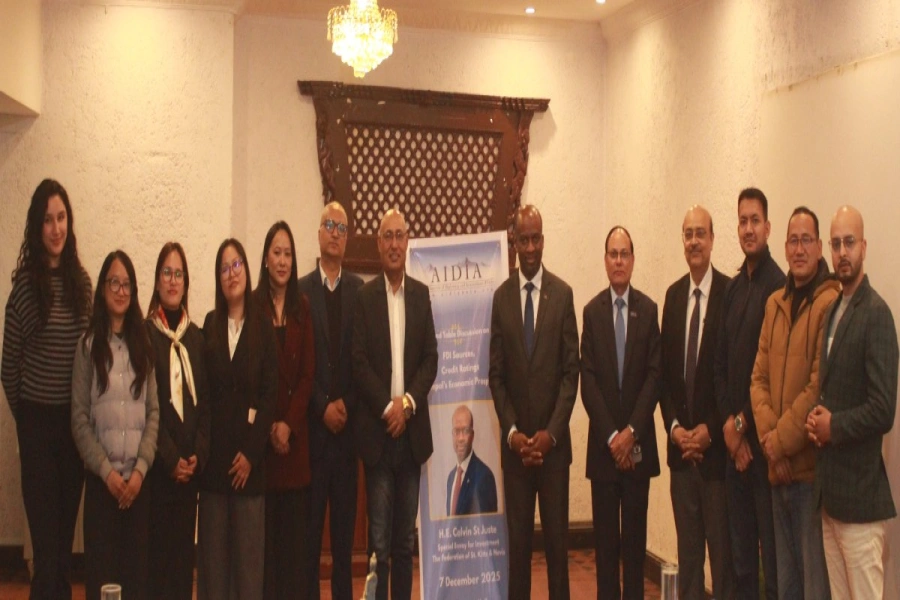
Speaking at a programme in the capital on Tuesday, analysts said the government should rely more on long-term credit instruments instead of depending largely on traditional financing models. At present, most mega projects are developed under public-private partnership (PPP) arrangements, with promoters investing equity and a portion of the cost raised through public share issuance.
Arjun Kumar Gautam, former chief executive officer of the Hydroelectricity Investment and Development Company Limited (HIDCL), said the bond market must be promoted alongside equity-based financing in the hydropower sector.
“Although institutions such as HIDCL are in place to support commercial financing, weaknesses in government mechanisms have held back the promotion of bond-based funding,” Gautam said.
Govt revising law to allow issuing infrastructure bond and blen...

The government recently finalised the financing modality for the 1,200 MW Budhi Gandaki reservoir-based hydropower project. As the project is being developed with domestic investment, the proposed model sets a 70:30 loan-to-equity ratio.
Of the estimated investment of Rs 248 billion, the government will hold an 80 percent stake in Budhi Gandaki Company Limited, the project promoter, while the Nepal Electricity Authority (NEA) will own the remaining 20 percent.
Prabal Adhikari, former deputy managing director of the NEA, said equity-based financing is less attractive to investors because it offers returns only in the long run.
He expressed concern over the repeated reliance on NEA for equity contributions in mega hydropower projects. “Overburdening NEA with equity investments could weaken its financial health,” Adhikari said, adding that investors need assurances of fixed returns, similar to bonds, to channel capital into infrastructure.
Stakeholders also highlighted weaknesses in financial assessments of most hydropower projects. Energy expert Dipak Gyawali said reservoir-based projects should be evaluated for multipurpose benefits rather than electricity generation alone.
“There is a need to quantify non-electrical benefits to maximise financial returns from such projects,” he said.
Participants also raised concerns over the lack of crowdfunding mechanisms, suboptimal use of installed capacity, tariff considerations in the Indian market, and inadequate risk assessment.
Madhu Sudan Adhikari, a member of the Electricity Regulatory Commission, said hydropower projects in Nepal suffer from poor coordination between financial, business and engineering aspects.
“Most projects focus heavily on construction, while economic optimisation receives little attention,” he said.
Adhikari added that the commission is preparing a separate directive on tariffs for storage hydropower projects.
“It will address issues related to differential tariffs, depreciation recovery and tax concessions,” he said.