

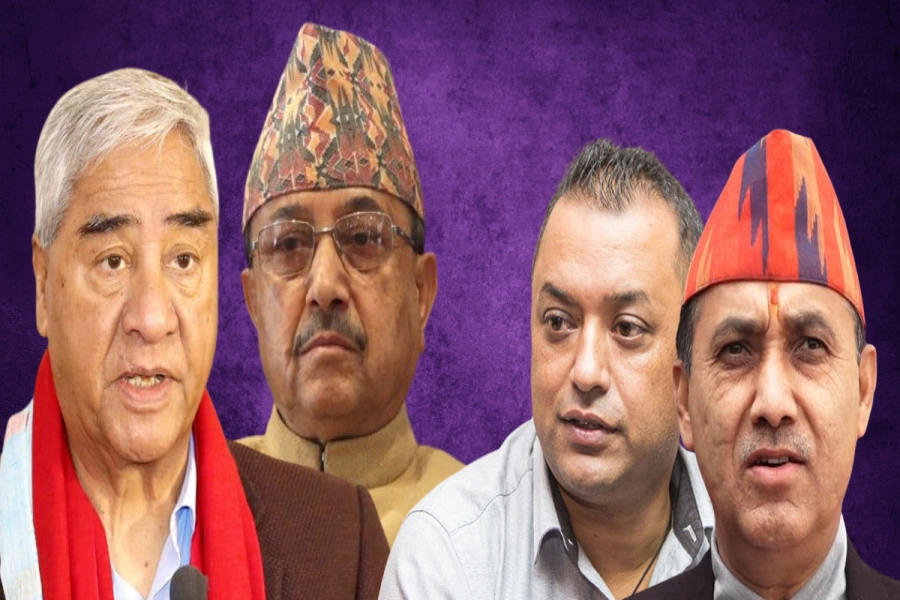
The NC faces its gravest crisis and honoring its party statute is essential to prevent imminent split and preserve its democratic legacy.
For over seven decades, the Nepali Congress (NC) has been at the forefront of Nepal’s democratic struggle. Yet today, it faces perhaps the gravest crisis in its history. Even when the king forcibly removed the party from power and imposed a ban in 1960, the existence and legitimacy of the NC were never questioned as they are now. Following the 2006 People’s Movement and the subsequent peace process, the party’s foundational character and the tendencies of its leaders had already begun to erode. After Sher Bahadur Deuba assumed the presidency, this decline accelerated further. The signs of recovery observed after the Gen-Z movement have proven largely illusory. During the movement, Deuba and his wife Arzu Rana Deuba, then Foreign Minister, faced violent attacks, and their Budhanilkantha residence was vandalized and set on fire. Upon returning from a month abroad for treatment, Deuba was widely praised when he appointed Vice-President Purna Bahadur Khadka as acting president. Ironically, Deuba was unable to sustain that respect. His pursuit of power soon dominated his actions. He sidelined the acting president and gradually turned the party into what appeared to be his personal enterprise, steering decisions to consolidate authority.
China says U.S. trade orders should respect international rules

Today, the demand for a special general convention has become a flashpoint within the NC. The rival faction led by General Secretaries Gagan Thapa and Bishwa Prakash Sharma is holding the special convention in Kathmandu on Sunday, even as leaders close to the establishment faction have rejected it outright, calling it against the party’s statutory provisions. Initially, a regular convention date was set, sidelining the special convention. Later, another date was announced after the elections. Now, as the general secretaries move to implement the provisions of the party statute, the Deuba faction has labeled this action illegal. Such resistance underscores a narrow, undemocratic approach that threatens the party’s cohesion in the wake of the House of Representatives elections scheduled for March 5. In the National Assembly elections, Deuba went further, undermining not only rules and procedures but also the morale, dedication, and commitment of party workers. Recommendations for candidates were sought from party bodies, yet in several cases, final decisions were based on names personally chosen by Deuba. Candidates deemed close to the rival faction were completely rejected in the nomination process. Such actions, if left unchecked, risk alienating loyal cadres and sparking internal revolt. This also raises questions about the democratic credentials the NC has upheld for so long.
While the party statute does not prevent anyone from serving a third term as president, Deuba’s behavior suggests he would not have stepped aside even now. There is also reason to believe he still hopes to become prime minister after the elections—a goal achievable only if the party secures widespread electoral victories. By rejecting the legacy of the Gen-Z movement and pursuing a path of personal consolidation, leaders risk being sidelined by the public. The NC can endure only by embracing change, respecting democratic principles, and following its statutes. The call for a special general convention by the general secretaries, in line with party rules, offers a chance to restore direction, momentum, and energy. Rejecting statutes, procedures, and democratic norms, as President Deuba and his team have done, is a betrayal of the party’s history and legacy. Anyone who disregards their own party’s rules cannot claim to be a true democrat. Under leadership lacking democratic character, the very legitimacy of the NC is at stake. Leaders and workers committed to principle and the party’s ideology must now decide whether to preserve this historic party or allow it to gradually disintegrate. Honoring the party statute is not just a legal necessity—it is essential to saving the NC from an imminent split.





-1782782519.webp)


