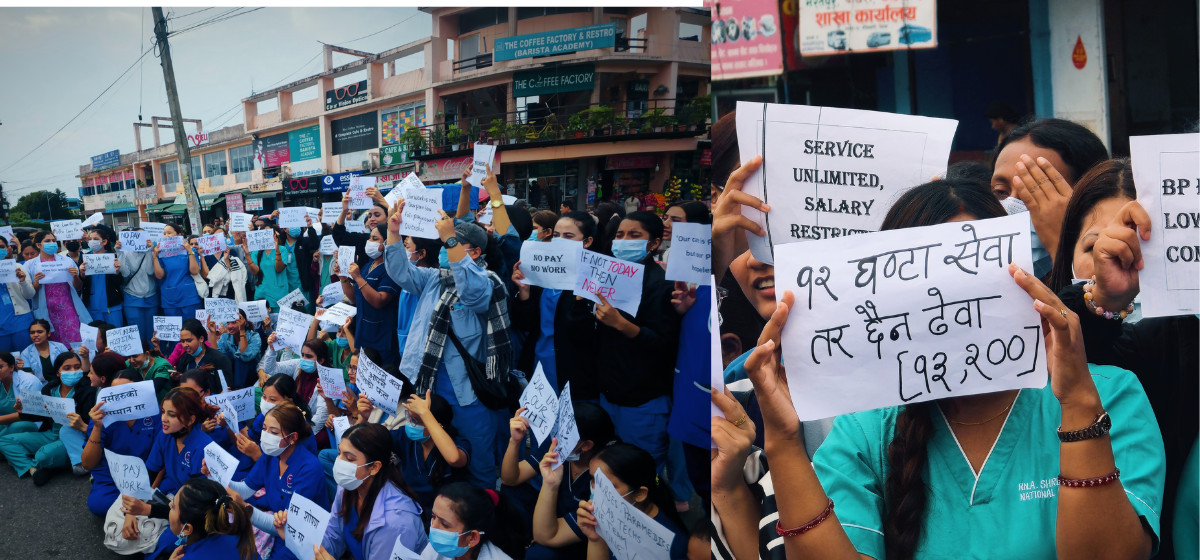
KATHMANDU, Oct 30: Health services across the country have been affected after nurses working in private hospitals and colleges went on strike, demanding equal pay, allowances and benefits as nurses employed in government health institutions.
The nurses have launched a protest with a 15-point demand that includes establishing nursing positions in schools, revising laws to ensure long-term management for nurses working in government hospitals and colleges—such as provisions for night duty, career advancement, additional services, and job security.
The government has introduced a program to assign one nurse to every school for student health checkups, and currently, each public school has one nurse hired on a contract basis.
The protest, which began two weeks ago at Gandaki Medical College and Manipal College in Pokhara, has now spread to other private hospitals, disrupting their operations.
While nurses say they are forced to work under poor pay and benefits, representatives of private hospitals and medical colleges argue that they lack the financial resources to offer government-level salaries and facilities.
Nurses threaten stringent protests

Recently, nurses from both private and government hospitals and colleges have joined the protest, also raising concerns about professional safety.
Nepal Nursing Association (NNA) President Prof Chandrakala Sharma said the association has been formally leading the movement since October 21.
On Thursday, discussions were held among representatives from the Ministry of Health, Ministry of Finance, Ministry of Industry, Ministry of Law, and both private and government hospital administrators to find a solution, but no conclusion was reached.
Due to the ongoing protest, services at several hospitals and health institutions have been disrupted. From October 21 to 28, nurses had worn black armbands during work, and since October 29, they have halted all non-emergency services for two hours every morning from 10 to 12. They say the protest will continue until their demands are met.
“Our main demand is for the government to revise the law and ensure that nurses in private hospitals and colleges receive the same pay and benefits as those in government institutions,” Sharma told Republica, “The government has introduced a school nurse program, but permanent posts have not been created. We also demand a permanent nursing position in every school.” She added that the NNA’s demands also include the appointment of nurses in factories, businesses, and other institutions to oversee workers’ health.
Dr Padam Khadka, a member of the Medical Education Commission and President of the Association of Private Health and Institutions of Nepal, said services at private hospitals have been affected by the protest. He warned that continued strikes could bring private health services to a halt.
He added that there are significant differences between private and government institutions in terms of resources, expenses, and management, and private hospitals cannot afford government-level salaries. “Our hospitals are privately funded, and these nurses haven’t passed the Public Service Commission exams,” Khadka said, “We are already providing the minimum pay and facilities. For private hospitals to match government standards, the state must first create the legal and financial foundation.”
However, NNA President Sharma argued that despite government directives requiring private health institutions to provide at least the minimum salary equivalent to government nurses, private hospitals and colleges have failed to comply.
She said nurses are forced to work long hours, including risky night shifts, without sufficient allowances or benefits. “We are not only demanding salary hikes but also fair benefits for night duties, risk allowances, exposure to infectious diseases, proper working hours, and leave facilities,” Sharma said.
She said that the nurses’ movement is not just about pay but also about respect, dignity, and justice for health workers.
In response, Prime Minister Sushila Karki’s government has formed a 14-member task force led by Additional Health Secretary Shree Krishna Shrestha to address the issue. The task force, which includes representatives from the Ministries of Health, Finance, Law, and Industry, as well as private institutions and the protesting nurses, met on Thursday to discuss possible solutions.