

Dear Nepal,
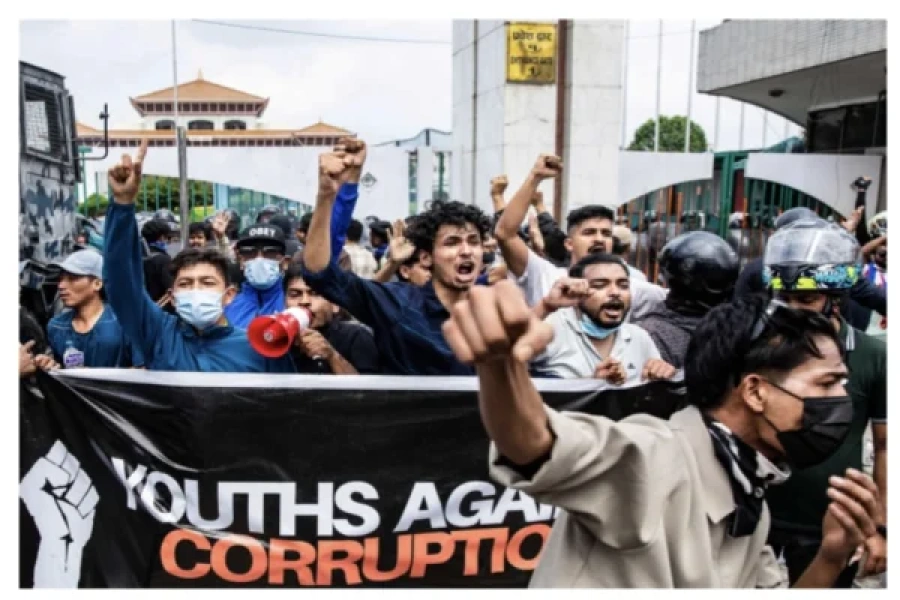
With the end of 2025 and the beginning of a new year, I write this letter, not as an observer but as someone shaped by you, in both celebration and concern. The only cause for celebration last year had been the Gen-Z uprising, which finally brought one of the country’s most unproductive political machines to its knees. Yet my deeper concern remains unresolved. The conditions that produced that uprising are still entirely intact: stagnant growth, weak institutions, and a political order that rewards power over performance. Without structural change, outrage merely resets the clock.
Left Behind in a Moving World
Around you, the world is moving, sometimes clumsily, sometimes unevenly, but relentlessly forward. To your immediate south and north, India and China continue to grow, build, and test their limits, expanding their ambitions. I acknowledge their dynamism, the rise of world-class companies, and their success in lifting millions into the middle class. What is troubling is how little urgency you have shown to absorb those lessons and summon comparable ambition. This unease is not born of fear. India and China are neighbors, not adversaries. What should unsettle us is the contrast between their momentum and our inertia, between their expanding dreams and our growing despair.
When I left Nepal in 1990, both China and India were still peripheral players in the global economy, each producing only 5–6 percent of US GDP. Three and a half decades later, their ascent has been epochal. China is now the world’s second-largest economy, with output at roughly two-thirds that of the United States. India has risen to become the world’s fourth-largest economy and is closing in on third, already at about 14 percent of US GDP. This transformation has translated into major gains in health, education, and living standards in both countries.
Nepal’s story over the same period is sobering. Relative to its two neighbors, Nepal has not merely lagged—it has fallen further behind. In 1990, Nepal’s per capita income was not dramatically different from that of China or India. Today, a Chinese citizen earns roughly five times as much as a Nepali, and an Indian about twice as much.
Under fire over expressway consultancy process, Army changes le...

This failure is especially striking given Nepal’s geography and resources. The country sits between economies that together produce about one-fifth of global GDP. Yet Nepal has failed not only to integrate into these vast markets, but even to notice their rise. Trade, investment, infrastructure, and skills development remain disconnected from the economic gravity on our borders. Being landlocked carries costs, but geography also offered opportunity. Abundant water, energy potential, and natural assets could have been levers for growth. Policy failure turned opportunity into inertia.
Living in Decline
I have called Nepal a wounded nation in this column before. The description is not wrong. History was unkind: years of isolation, squandered opportunities, fragile transitions, broken promises. Some of these lay beyond the choices of our generation; many others were self-inflicted. But wounds alone do not explain where you stand today. Many nations have suffered deeper injuries and still refused to stand still.
What sets Nepal apart today is not the wound itself, but how comfortably it has learned to live with it. Over time, delay hardened into habit. Underperformance acquired explanations. Expectations were quietly lowered through repeated failure. The emergence of other countries no longer provoked urgency or emulation; it receded into background noise. When stagnation stops unsettling a society, the damage runs deeper than income. It begins to erode ambition and hope.
I write with the perspective that comes from distance and return. I left Nepal in 1990 for Canada at a moment of great political promise. The Panchayat system had just fallen, and a multiparty interim government was in place. Like many of my generation, I left torn between two impulses—eager to study, yet worried that I might be missing Nepal’s long-promised golden years of prosperity. Those golden years never came.
You moved in circles, changing governments and rewriting promises without altering the trajectory. Over time, that pattern demanded explanation, not just reflection. This summer, as frustration with the republic intensified and debates over monarchy versus republic resurfaced, I undertook a systematic study (here) of Nepal’s trajectory from 1975 to 2024, spanning three regimes: absolute monarchy, constitutional monarchy, and the republic. I began with two confessions. I am—and remain—a staunch anti-monarchist. And I genuinely believed a republic would lift Nepal higher than any monarchy ever could.
The findings were unsettling. Across nearly every major indicator—economic performance, social outcomes, institutional quality—the republican era has performed worse than the one before it. When I finally answered the study’s central question, Is Nepal advancing, drifting, or declining?, the conclusion was unavoidable: Nepal is drifting, and dangerously so.
One conclusion from that framework was stark: Reverse the decline—or face unrest. Stagnation breeds resentment. Sooner or later, it explodes, I wrote. Then came the Gen-Z uprising. I do not claim to have predicted it, but it was inevitable. History is unforgiving to political systems that repeatedly fail their young. If Nepal’s political class continues to mistake power for legitimacy and survival for success, it will face even harder uprisings ahead.
I write now not out of detachment, but devotion, to a country I love deeply and still wish to see vibrant: a Nepal that values knowledge over noise, truth over theatrics, inclusion over exclusion, and prosperity as a shared national goal.
The Ideological Mantra
Yet stagnation has been wrapped, almost sanctified, by ideology. In speeches, street mobilization, and policy debates, slogans are elevated over outcomes; moral posturing substitutes for performance; resistance itself is mistaken for progress. Ideology has become a shelter, an elegant way to evade accountability while preserving self-justification.
But rhetoric does not build livelihoods or create jobs. Nepal has become a nation on the run. Migration is no longer an exception; it is the default life strategy for the young. Millions leave not because they lack attachment, but because the country repeatedly disappoints them. Exit has become the national dream. Joblessness is not dignity, and mass migration is not success.This is not merely an economic, political, or institutional failure; it is a civilizational risk.
And yet, none of this was inevitable.The nation you could build has never been impossible; it has been deferred by choice. With the beginning of the new year, the question is no longer what Nepal could become, but whether it still chooses to become anything more than what it is.
Dear Nepal, the year has turned. You can continue adapting to stagnation, mistaking endurance for virtue and survival for success, or finally refuse the degradation you have learned to live with. Make no mistake: nations do not awaken simply because they are poor. They awaken when wasted potential becomes intolerable, when falling behind begins to offend national pride. Anchor that pride not in imagination, but in prosperity built by institutions, skills, and competence.
Call me hopeful, but I refuse to believe that resignation is Nepal’s destiny.
(The author holds a PhD in Economics and writes on economic issues in Nepal and Canada. He can be reached at acharya.ramc@gmail.com)





-1782782519.webp)


