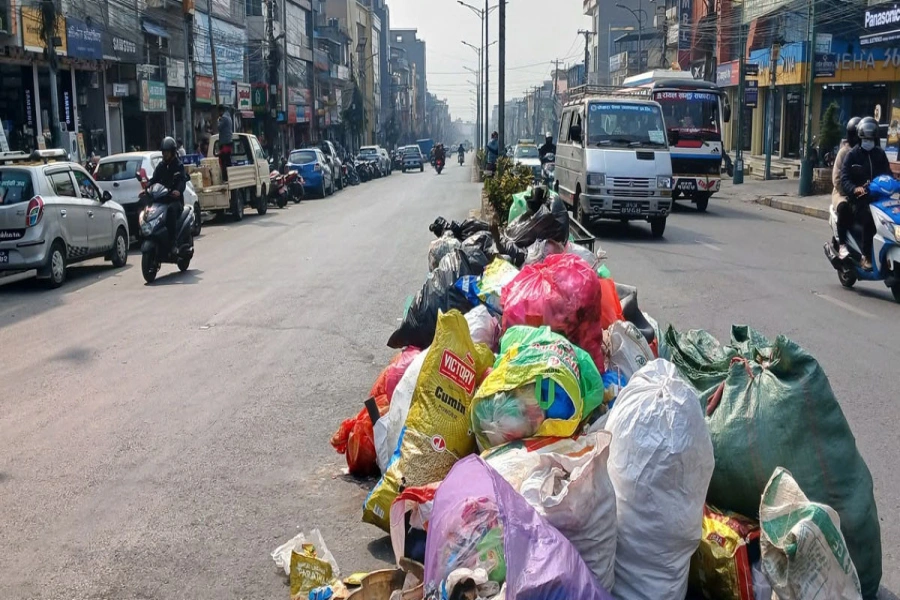
The point being that industries which recycle or reuse what we throw as garbage as raw materials doesn’t get enough of it from here. So they import it from elsewhere – like trash paper from France. Case in point was – Bhrikuti Paper Mills. [break]
So where does all the garbage from this overly polluted city go to then? Literally to waste, it seems.
***
According to a survey done by the Solid Waste Management and Resource Mobilization Center (SWMRMC) in 2008, Kathmandu Valley produces 550 tons of solid waste per day. Currently, almost all of it is being dumped at the landfill site in Sisdol, Nuwakot.
“There are 1,200 staffs working in KMC for waste collection and management,” says Rabin Man Shrestha, Chief of Environment Management Division at Kathmandu Metropolitan City (KMC).
The waste collectors and sweepers start their daily routine at 5:30 am. Some are employed at main routes or the A-class roads like the one from Sina Mangal to Tripureshwor and some are employed at community level. The sweepers repeat the routine at 1pm.
The waste collected from households is then brought to the transfer station at Teku from where it gets loaded into bigger vehicles and is transported to the landfill site at Sisdol which is almost an hour’s drive from the city.
Everyday, the waste gets dumped and piled up at Sisdol. However, this is not a solution for waste management, agrees Shrestha.
***
Dipendra Bahadur Oli, legal officer at SWMRMC, says that though the current landfill site at Sisdol has a good semi-aerobic system to minimize the waste, the operational aspect has been weak.
Leachate or the liquid waste that comes out of the landfill waste is directed in a cyclic system and the waste is minimized through aeration and evaporation system.
“Power cutoffs is one infrastructural challenge, and with the fuel prices hiking up, it’s an ardent task to convince the government for investment in generators for waste management,” Oli shares.
According to him, Sisdol has the lifespan of another two years or so, and Banchare Hill is the suggested location to build the next landfill site which will have a lifespan of about 21 years, provided the amount of waste produced everyday remains the same. The government has already demarcated 1,800 ropanis of land in the area and also approved the Environmental Impact Assessment (EIA).
However, the construction is on halt for many reasons – the prime one being lack of investment. According to an estimate made by Japan International Cooperation Agency (JICA) in 2004, the required fund for a technically sound landfill site at the location was almost Rs 1.75 billion, which by now, he says, must be almost Rs 2 billion.
“Besides, Banchare still has to be connected by proper roads and electricity access,” says Oli and adds, “The investment of two billion Rupees is no joke, and if the country can really invest so much on waste management when it has issues like poverty alleviation and starvation to deal with is another question.”
Another problem is the constant pressure and objections from the public.
“With people around the landfill site complaining against the stench from leachate management site many times, the operation has had to shut down or be shifted,” says Oli. He also cites that the Compost Plant at Teku went out of operation after the local people objected to it, as it produced a lot of noise and stench.
“We admit managerial weakness for not being able to convince people that the process is necessary. But we’re making sure that once the landfill site in Banchare is built, all the settlement near the area is shifted away.”
The construction phase at Banchare is estimated to take at least three years. So if the Sisdol landfill site runs out of its bearing capacity in two years, it’s high time for the construction at Banchare to begin. With nothing being done on that yet, Oli says they are looking into alternatives for other immediate landfill sites.
If the Valley is looking to solve the waste management problem, the focus, he says, has to be not only on the final disposal of the waste but equally on waste minimization from the very beginning.
***
“Waste is actually raw material in the wrong place,” says Oli. According to his 2008 research, 60% of the total household waste collected daily is organic or degradable and can be utilized to make compost. The 15-20% waste like paper, metal, plastic and bottle is saleable. So only the remaining percentage of the waste should be going to the final disposal site.
“If only every household segregates their waste, more than 50% of the solid waste problem is solved right there,” says Oli.
Amlesh Kumar Chaudhari, who has been working in the junkyard business at Teku for four years now, says, “We collect wastepaper from industries and sell it to factories in Bharatpur and India.”
The business, according to him, runs well and thousands of junkyard workers can live off on the paper, glass and other saleable waste in Kathmandu.
“If people sell their household wastepaper to us, we’ll definitely benefit from it and they’ll benefit as well as their garbage is gone,” says Chaudhari.
Oli confirms that the business is very profitable as the revenues collected from the taxation of the waste materials being transported to India or other neighboring countries was almost Rs 70 millions per year.
“So the materials we call waste is actually worth a lot,” he says.
***
Shrestha suggests that waste management at household level can start with the purchase of the two different colored waste bins for the segregation of organic and inorganic waste. Community Recycle Centres that collect and give incentives for the segregated waste from the community is also one of the supporting projects promoted by KMC.
The process thus can start at the household level than in community, and only the remaining waste can be sent for final disposal.
“Even in landfill sites, with proper infrastructure, we can have compost plants or biogas production set up,” says Shrestha.
Oli stresses on the social change in behavior and attitude to waste management.
“People need to realize the value of the waste, and the discrimination against people who work and contribute to the waste management like the sweepers or junkyard workers has to stop,” he says.
The Ministry of Local Development also waived tax on junkyard business operators to promote their business from the fiscal year of 2066-2067. SWMRMC is also looking to reinforce several awareness programs through media and community approach.
Chitrakar suggests that during garbage collection from households, the Ministry could set strict rules to collect only segregated organic and inorganic waste on separate days. Oli also agrees that if things have to change from the policy level, one step is to encourage people, and the other is to set penalties which have to be introduced.
***
“Waste management in Kathmandu isn’t impossible, it’s only difficult because there’s no segregation,” stresses Chitrakar.
“It’s simple. Once the waste is segregated properly, the organic waste can be made to compost; paper can be sent to paper mills like Bhrikuti; plastics can be sent to industries that make black plastic water pipes; glass bottles can be sent to bottling industries, and metals can be sent to smelters.”
Your waste can be useful. The lifespan of the landfill sites can be elongated by years or even decades.
The heaps of garbage that lie on Kathmandu’s streets can be managed. It’s not a utopian dream, it’s all possible; and all of that can start with a simple step – by segregating those unrealized and undervalued raw materials we call waste.
Related story
Waling Municipality: Making the best out of waste