

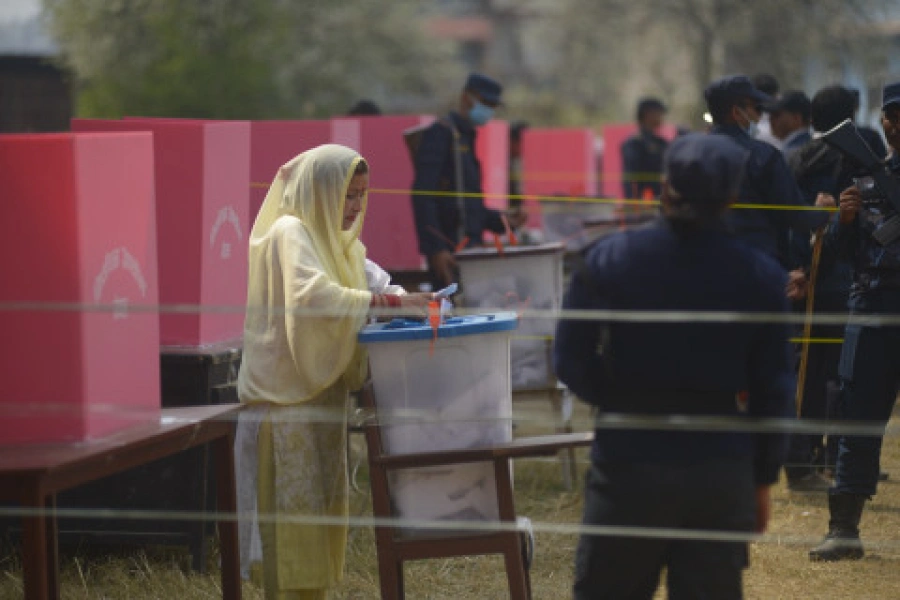
KATHMANDU, March 6: The Election Commission (EC) has estimated that only around 60 percent of registered voters cast their ballots in Thursday’s House of Representatives election, marking the lowest voter turnout in Nepal since 1991.
Nepal has held eight parliamentary elections since the restoration of democracy in 1990 including those in 1991, 1994, 1999, 2008, 2013, 2017 and 2022. The second Constituent Assembly election in 2013 recorded the highest voter turnout at 78.74 percent, when over 9.5 million of the 12.1 million registered voters cast their votes. Since then, participation has gradually declined, reflecting growing voter disengagement.
The 1991 parliamentary election following the political changes of 1990 recorded a 65.15 percent turnout, while subsequent elections saw fluctuations: 61.86 percent in 1994, 65.79 percent in 1999, 61.70 percent in the first Constituent Assembly election of 2008, and 68.67 percent in 2017.
Voter turnout lowest in 10 years in Sindhupalchowk

The EC had initially projected a 65 percent turnout for this year’s polls, but actual participation fell short of that expectation. According to former Chief Election Commissioner Ayodhi Prasad Yadav, multiple factors contributed to the low turnout.
“In several districts, including Dang and Dolakha, election boycotts were observed. At the same time, a significant number of Nepali citizens working in Gulf countries could not return home to vote due to special circumstances,” Yadav explained. “Voter awareness—that it is our right and duty to vote—was not as strong as it should have been. Even among the elite class, some did not make the effort to cast their ballots.”
Security concerns may have also played a role. Yadav noted that visible deployment of the Nepali Army and tight security arrangements across the country, widely publicized in the media, may have intimidated some voters. “Some people appeared hesitant, fearing that something might happen on their way to vote,” he said.
Another contributing factor, Yadav added, was temporary residents of Kathmandu. Many voters registered outside the city did not travel back to their polling stations, reducing turnout.
Experts say the trend also reflects broader political fatigue and growing disillusionment with traditional parties. Generational changes have further influenced participation, with younger voters increasingly detached from long-standing political structures and older voters frustrated by lack of employment opportunities, social recognition, and persistent political instability.
Yadav emphasized that political parties and candidates have a crucial role in encouraging citizens to participate in elections and boosting voter engagement. Without active outreach and meaningful engagement, he warned, future elections may continue to see declining turnout.



