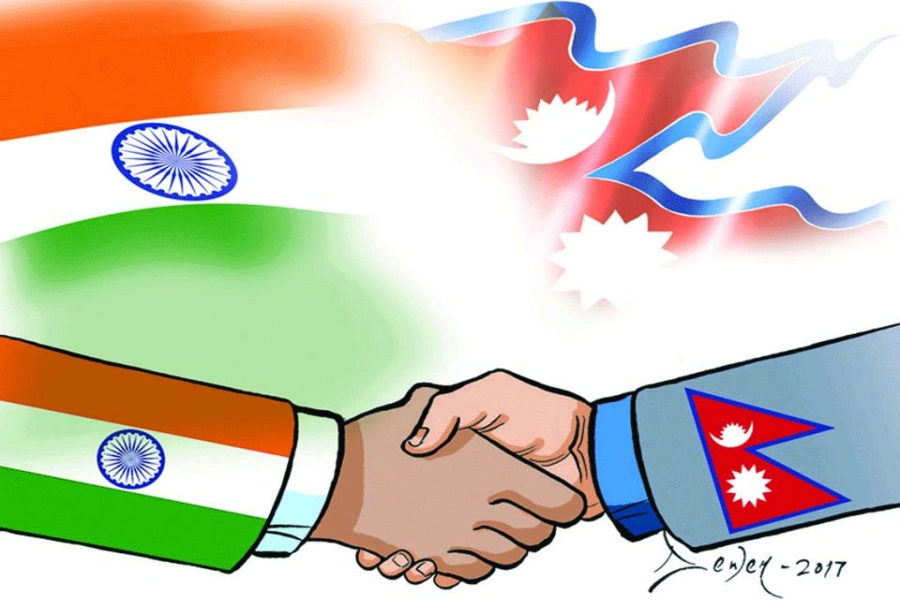
KATHMANDU, May 29: When Rabi Lamichhane embarks on a visit to New Delhi next week, it will be more significant than its brief duration suggests. His visit, according to sources, is taking place at the invitation of India’s ruling party, the BJP. Officially, it is a party-level engagement, but it comes at a critical time for Nepal–India relations, which have begun to show significant strain under the new government led by Balendra Shah and the Rastriya Swatantra Party (RSP). In diplomacy, timing often speaks louder than formal pronouncements.
Lamichhane’s visit appears aimed at easing concerns that have quietly built between Kathmandu and New Delhi in recent weeks. Prime Minister Shah’s reluctance to engage with visiting envoys, stricter customs enforcement along the Nepal–India border, and Kathmandu’s repeated diplomatic notes over Lipulekh have all contributed to confusion about the new government’s intentions for bilateral ties.
For decades, many Nepalis have criticized successive governments for being overly reliant on India. Leaders of major parties were frequently accused of viewing New Delhi’s support as politically essential. This contributed to the rise of an anti-India nationalist political culture—an outcome of perceived overdependence on India and leaders seeking external backing to remain in power. In recent years, younger generations have increasingly demanded a foreign policy grounded in dignity and equality rather than dependence.
The present administration, which came to power riding a wave of Gen Z support, is keen to respond to such sentiments. Supporters viewed Shah’s reluctance to meet ambassadors below ministerial rank as an attempt to enforce institutional discipline. That argument is sound in principle. Smaller countries also deserve recognition and protocol-based engagement. Nepal has every right to follow established procedures and assert its sovereignty over disputed areas such as Lipulekh, Kalapani, and Limpiyadhura. Even so, nationalism cannot rely solely on emotion or symbolic gestures.
Asia at a crossroads in fight against coronavirus as cases surg...

Even in contentious situations, communication must continue. While sovereignty claims are valid, the strategy used to assert them matters. When multiple strong messages are delivered in a short period without parallel diplomatic engagement, neighbors may interpret them as signaling a hardened political stance.
This appears to be happening now. India’s response so far has been relatively restrained. Despite visible concerns, New Delhi has avoided public confrontation. This moderation is a reminder that, despite periodic political friction, Nepal and India remain deeply interconnected—geography binds them in ways political rhetoric cannot quickly undo. India is Nepal’s main trading partner and a crucial transit route for third-country goods.
Nepal is heavily dependent on Indian ports, petroleum supplies, medicines, fertilizers, and electricity cooperation. Millions living near the open border maintain economic and family ties. Any disruption has immediate consequences for daily life long before it affects political leadership.
The customs enforcement issue made this clear. The administration defended stricter checks as necessary to reduce revenue leakage and smuggling. However, the immediate impact was felt mainly by border communities, who are accustomed to purchasing everyday goods across the border. Madhesh-based political parties reacted strongly, as the move disrupted long-established local economic patterns.
Similarly, Nepal’s diplomatic note on the Lipulekh corridor reflects a genuine sovereign concern. Nepal’s territorial claims are based on historical treaties and longstanding national positions. No government can ignore such issues domestically. However, border disputes between unequal neighbors require careful handling.
Public posturing may earn domestic approval, but lasting outcomes are usually achieved through measured diplomacy rather than symbolic confrontation.
At the same time, India is dealing with a changing Nepal. A younger political generation is more vocal about national dignity and less willing to accept traditional patterns of engagement. If India appears dismissive or overly assertive, it risks fueling anti-India sentiment in Nepal—something that benefits neither side.
It is in this context that Lamichhane’s visit to Delhi carries political significance. Even if unofficial, the trip signals that communication channels remain open despite visible strain. Reports of possible discussions with BJP leaders suggest an effort to reassure India that Kathmandu is not pursuing open confrontation. The visit may also help the RSP better understand how recent policy moves are perceived across the border.
Nepal’s core interests lie in improving trade relations, expanding power exports, resolving recruitment issues under the Agnipath framework, and completing stalled infrastructure projects such as the Pancheshwar Multipurpose Project and other India-assisted initiatives. None of these objectives can be achieved through diplomatic distance alone. At a time when global markets are affected by the Middle East crisis, India’s supply of fuel, gas, and other essentials remains crucial. Any misunderstanding could disrupt the flow of these vital commodities.
Prime Minister Shah still holds political leverage and public support that few Nepali leaders have enjoyed at the start of their tenures. His rise reflects widespread dissatisfaction with traditional political practices. That popularity allows him to reshape Nepal’s foreign policy with confidence. However, confidence is most effective when paired with consistency, communication, and patience. Otherwise, foreign policy risks becoming a series of symbolic gestures that fail to protect core national interests.