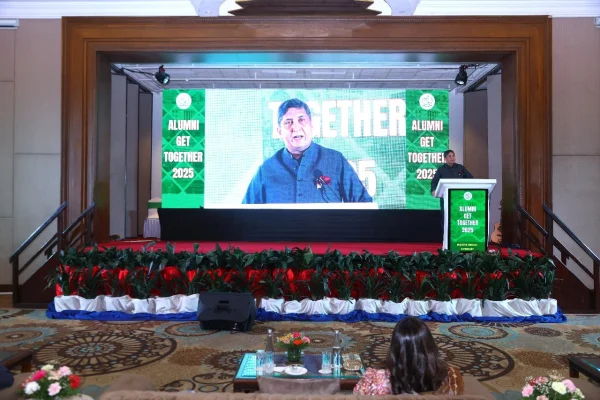
KATHMANDU, April 7: A two-day DAAD Alumni Symposium held recently discussed on the challenges of Nepal’s federal system and the growing need to engage Generation Z in governance and policymaking.
The symposium, titled “Federalization in Nepal in the Age of Gen Z: Challenges, Prospects, and Contributions from a Regional Planners’ Perspective,” underscored that Nepal is at a critical juncture where federalism must adapt to a digitally connected, politically aware generation demanding transparency, accountability, and effective service delivery.
Organised by DAAD alumnus Dr Chandra Bahadur Shrestha with support from the German Academic Exchange Service (DAAD) and the German Embassy in Kathmandu, the event brought together 44 participants, including representatives from the embassy, DAAD and SPRING alumni, former and incumbent Members of Parliament, government officials, academics, media professionals, and civil society actors.
US Embassy hosts Nepal-US Alumni Network Regional Connectivity...

Over the two days, participants held extensive discussions on the practical dimensions of federalism from a regional planning perspective. Keynote speakers included Prof Hans Detlef Kammeier, Professor Emeritus at the Asian Institute of Technology, Thailand; Dr Manfred Poppe, former professor at UNIDO; Dr Sangeeta Singh, professor at the Institute of Engineering and former member of the National Planning Commission; and policy planner Dr Ganga Dutta Nepal.
Participants noted that while Nepal’s adoption of federalism through the 2015 Constitution marked a significant step toward addressing centralisation, exclusion, and regional inequality, implementation challenges persist. These include unclear and overlapping responsibilities among different levels of government, limited technical and institutional capacity at provincial and local levels, and the continuation of centralised governance practices.
Such challenges, they said, have contributed to a widening trust deficit, particularly among young people.
Regional planners and development practitioners stressed the need for integrated and coordinated planning across all tiers of government, emphasising that federalism must function through cohesive systems rather than fragmented, project-based interventions.
They also highlighted the importance of clearly defining roles and responsibilities, strengthening institutional capacity, and improving intergovernmental coordination. Participants called for the meaningful engagement of youth in planning and decision-making processes to ensure sustainable development outcomes.
The symposium concluded that while Nepal’s federal system remains a work in progress, it holds strong potential to advance inclusive and sustainable development. However, its success will depend on improving service delivery, ensuring equitable resource distribution, strengthening institutional accountability, and integrating gender equality and social inclusion (GESI) principles.
Participants further emphasised the need to restore public trust, promote spatial planning at all levels of government, strengthen North–South academic collaboration, and align educational institutions with pressing societal challenges.
Aligning governance, planning, and academic systems with the expectations and aspirations of Generation Z was identified as critical to realising the full potential of federalism in Nepal.