

KATHMANDU, Jan 29: Nepali migrant workers—who keep the country’s economy afloat by enduring harsh conditions abroad—are once again bearing the brunt of systemic failure at home. Weak state mechanisms and diplomatic lapses have exposed them to severe financial exploitation in the name of foreign employment.
A new provision requiring additional authentication of Police Clearance Certificates (PCC) for Nepali workers heading to the United Arab Emirates (UAE) has added a financial burden running into billions of rupees. What was once a routine process has now turned into a costly hurdle for workers already struggling to make ends meet.
Under the new arrangement, even government documents already authenticated by Nepal’s Department of Consular Services under the Ministry of Foreign Affairs (MoFA) must now be re-authenticated through the UAE Embassy in Nepal and a private agency. This compulsory requirement has been enforced without any formal decision, Gazette notification, or public notice, raising serious concerns about transparency.
As a result of this undeclared “syndicate” operating through intermediaries, more than Rs 2.5 billion is estimated to flow out of the country every year—directly from the pockets of migrant workers.
Until recently, the character certificate issued free of cost by Nepal Police was considered valid for the UAE visa process after authentication by the Department of Consular Services for a fee of Rs 500. However, this long-standing practice was abruptly changed after December 4, without explanation.
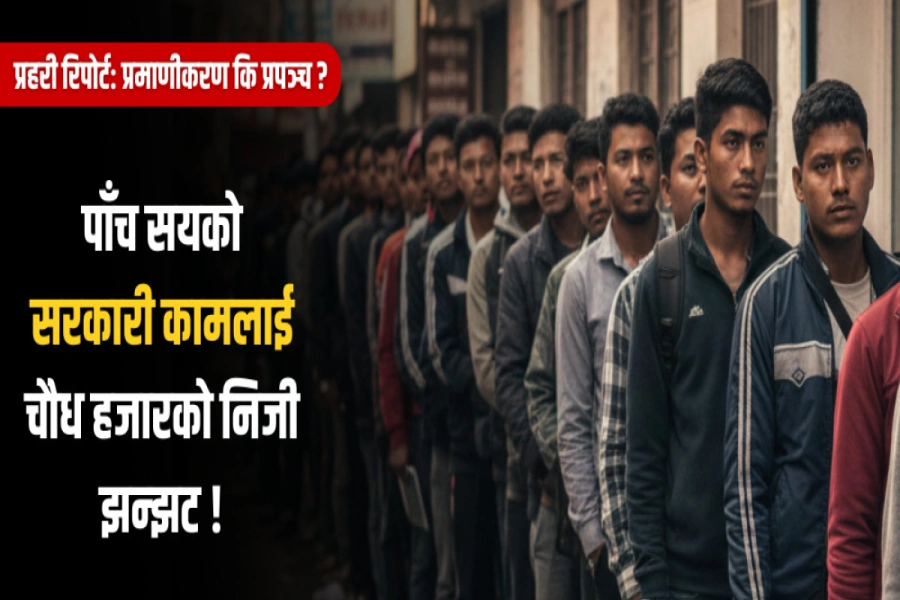
At present, to make the same PCC valid for the UAE visa process, workers are being forced to get it authenticated again by the UAE Embassy through a private agency named VFS. For this service, Rs 14,200 is being charged per person.
For economically vulnerable workers—many of whom take loans to finance their foreign employment—paying such a hefty amount without any assurance of visa approval has created a backbreaking situation. Failure to pay reportedly results in outright rejection of their visa applications.
New visa rules set to affect thousands of Nepali migrant worker...

According to statistics from the last fiscal year, the UAE remains one of the top destinations for Nepali migrant workers. Last year alone, 177,000 Nepalis traveled to the UAE for employment.
Based on this figure, an estimated Rs 2.51 billion is being extracted annually from workers solely in the name of PCC authentication.
Stakeholders warn that forcing re-authentication of documents already certified by Nepal’s official authorities—and allowing such a massive sum to flow abroad—is a serious blow to the national economy. Since the money goes directly to private companies and foreign diplomatic missions, Nepal earns no revenue from the process.
The UAE’s sudden tightening of requirements is believed to be linked to recent political developments and perceived security challenges in Nepal. Reports related to the so-called “Gen-Z movement” on September 8 and 9, along with information about prisoners escaping during unrest, reportedly triggered security concerns in the UAE.
Following the incidents, the UAE temporarily suspended visit and work visas for Nepali nationals, citing fears that individuals with criminal backgrounds could enter the country posing as workers.
Although visa processing later resumed, the UAE—citing security reasons—stopped relying solely on the seal of Nepal’s MoFA and made authentication by its own embassy mandatory.
However, business operators argue that introducing a private company into the process and directly imposing an additional financial burden on workers in the name of security screening is both suspicious and objectionable.
According to the Nepal Association of Foreign Employment Agencies (NAFEA), thousands of workers now risk being stranded due to this new and cumbersome requirement. A PCC is valid for only three months (90 days) from the date of issuance.
The NAFEA’s General Secretary, Mahesh Kumar Basnet, said delays in the new authentication process and visa issuance could cause PCCs of more than 10,000 workers to expire.
“About 15,000 workers travel to the UAE every month, but the current uncertainty risks bringing foreign employment to a standstill,” Basnet said. “Forcing workers to pay Rs 14,000 even before it is confirmed whether they will receive a visa has pushed them into severe hardship.”
Despite the gravity of the issue, the Nepal government and the MoFA appear helpless. A foreign embassy refusing to trust documents authenticated by MoFA—despite their official QR codes—raises serious diplomatic questions about Nepal’s sovereignty and the credibility of its state-issued documents.
The NAFEA had already drawn the attention of the MoFA minister to the issue on December 11. However, with the country currently preoccupied with elections and political leaders busy campaigning, the plight of migrant workers has been sidelined.
Basnet said, “The police report is an official document of the Government of Nepal, equipped with a QR code that can be verified online from anywhere in the world. Yet workers are being forced to travel from east to west to Kathmandu, stand in long queues at VFS, and pay Rs 14,000 just to get the same document re-authenticated by the UAE Embassy. The government gave assurances, but it has failed to resolve the issue through diplomatic channels.”
Organizations such as the International Labour Organization (ILO) and the International Organization for Migration (IOM)—which advocate zero recruitment costs and workers’ rights—have remained conspicuously silent. They have yet to speak out against the additional financial burden imposed on workers in the name of the visa process.
Manpower entrepreneurs have demanded the immediate scrapping of double authentication and the abnormal fees charged for the same document. They insist that no fees should be collected unless a visa is guaranteed and that high-level diplomatic initiatives are needed to ensure unconditional recognition of Nepal government documents.
The NAFEA has also objected to VFS allegedly beginning fee collection arbitrarily without any official written decision.
If the government fails to resolve the issue through timely diplomatic intervention, Basnet warned that the association may be forced to take the drastic step of halting UAE-bound employment altogether.
At present, workers from remote parts of the country are compelled to travel to Kathmandu, stay in hotels, queue for hours at VFS offices, borrow money to pay Rs 14,000, and wait indefinitely for visas—a grim irony for those seeking work to escape poverty.
The state’s inaction, even as its official documents are distrusted and workers are exploited by a private company, has raised serious questions about governance, accountability, and the protection of migrant workers’ rights.







-1200x560-1774606010.webp)


