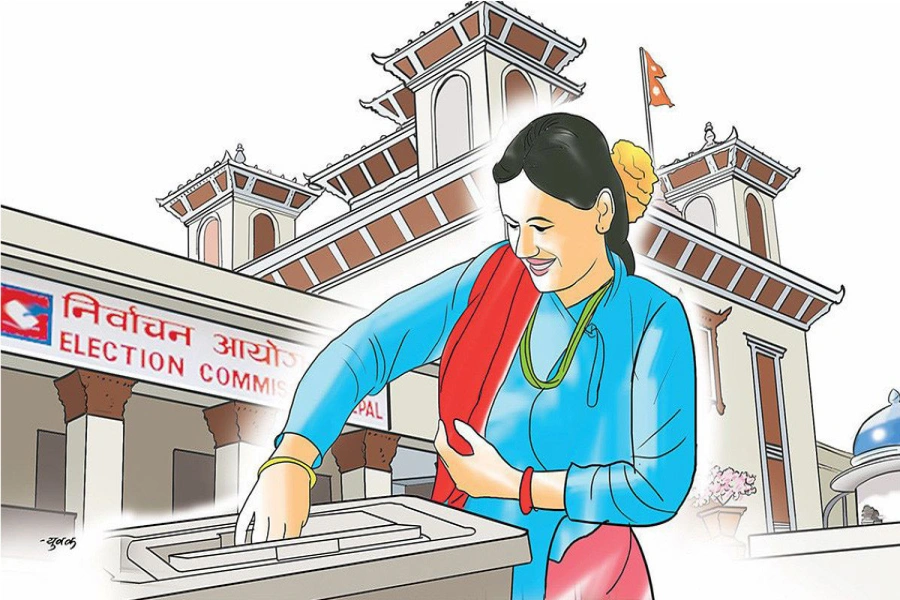
During his nine-hour stay in Kathmandu on July 9, India’s Minister for External Affairs Salman Khurshid emphasized that there is no alternative to holding fresh constituent assembly (CA) elections in Nepal. Although he urged the political leaders to bring the dissenting voices to negotiation, Khrushid said that the polls must be held. “There should be no ifs and buts,” he said. [break]
There is little doubt that India desires a free, fair and quick election in Nepal as the general understanding in New Delhi is that precious time has been lost since 2006 and Nepal is without a constitution even after six years of the peace process, a task which began in New Delhi with the famous 12-point agreement. Indian leaders have made it clear on many occasions that it is in India’s interest to see a peaceful and prosperous Nepal.
A statement issued by the Indian Ministry of External Affairs soon after Khurshid’s visit stated: “As a close friend, India remains strongly committed to the success of Nepal’s peace process and institutionalization of democracy in Nepal in a constitutional and multi-party framework.” Khurshid’s message that India is supportive of new election for the CA-cum-Parliament on November 19 reflected this larger opinion in Delhi.

Republica
As part of the election-related assistance to Nepal, India pledged to deliver by October this year 764 different types of vehicles costing approximately Rs 800 million and the two sides exchanged documents to this effect. Besides this, nothing significant came out of the visit. And however genuine the reasons for this trip were, the reality seemed that Khurshid’s trip came as a hurried response to China’s State Councilor Yang Jeichi’s visit to Nepal last month.
On June 25, Councilor Yang wrapped up his two-day official visit to Nepal, extending support worth RMB 10 million for the forthcoming election. While appreciating Nepal’s proactive measures to contain ‘anti-China’ activities and its firm commitment to One-China Policy, Yang expressed China’s commitment to work for future development of Nepal. Besides strengthening connectivity with Nepal, China is expected to pour huge FDI in tourism and hydropower sector in Nepal in the immediate future.
Not to forget, the Chinese are also deeply interested in strengthening the security agencies of Nepal. This will help China to receive the much-needed goodwill of the security agencies to curb the Free Tibet Movement in the most strategically located Himalayan country. In addition to many past agreements to help the security agencies, during Yang’s visit China vouched a grant of Rs 3.06 billion for the construction of a well-equipped Armed Police Force Training Academy at Matatirtha, Kathmandu.
The turning point that showed that China wanted a foothold in Nepal came with the signing of the West Seti project. China’s Three Gorges Corporation, a Chinese power developer, is currently involved in the development of the 750-megawatt West Seti hydropower project. The mere size and scale of this project with a huge potential impact on the economy of Nepal will make China a very important partner in Nepal’s development. Needless to say, the granting of West Seti project to China raised eyebrows in the inner circles of Delhi.
India’s long-held belief that Nepal is under its traditional sphere of influence is being increasingly questioned today as Nepal moves closer to China. It was the Baburam Bhattarai government, which India strongly backed, that signed the West Seti project with China. More importantly, it was during the then PM Madhav Kumar Nepal’s tenure that Nepal signed the comprehensive and cooperative partnership with China, which forms the basis of Nepal-China relation today. Again, India strongly supported Madhav Nepal’s government that time as Nepali Congress and CPN-UML were perceived by India to be leading the democratic block in the country. India’s Nepal policy took a big turn afterwards as it threw its weight behind the Maoist-Madhesi alliance to bring Bhattarai to power.
On the positive side, there is a realization of late in New Delhi that India can no longer deter the economic prosperity of Nepal in keeping with India’s traditional security concerns. As a senior strategic analyst in New Delhi told this scribe: “Security can no longer impede economic development. China coming to Nepal is inevitable.”
There are two clear but opposing views in India regarding its foreign policy in Nepal. One group backs the old hawkish approach, which considers keeping Nepal under the Indian hold as it sees this in its larger security interest. But the other group represents a more liberal outlook and is progressive in approach. This group urges for futuristic relationship—the one willing to look beyond 1950 Treaty and talk about 2020 cooperation model. My view is that more Indian politicians, bureaucrats and strategic thinkers are joining the latter group.
Nepal, on its part, unfortunately has not been able to address the security concerns of India. For instance, the extradition treaty, the flying of Air Marshal, curb on illegal counterfeit currency, signing of border strip map, among many other important issues have been left unresolved for just too long. Due to strong anti-India sentiment in Nepal the political leaders have not been able to deliver on many promises made to the Indian side. This has further strained bilateral relationship at a time India’s foreign policy, as put by another Indian analyst, in Nepal “is at a drift.”
But Nepal cannot ignore India as its leaders cozy up to China. India has thus far funneled in over IRs 3,600 crore in assistance to Nepal and is currently engaged in more than 370 developmental projects across Nepal with a total outlay of IRs 402 crore. India is Nepal’s largest trading partner. India accounts for nearly two-thirds of Nepal’s foreign trade, 70 percent of Nepal’s exports, and almost half its foreign direct investments. Around 40 percent of Nepal’s tourists are Indians and more than 5 million Nepalis find employment in India.
Nepal cannot afford to alienate India, but nor can it overlook China’s growing importance. The real challenge for Nepal is to bring the two giant neighbors together to help with its economic development.
The author is associate fellow at Observer Research Foundation, a Delhi-based think-tank, and a contributor to Republica
Related story
Historic leap in eye treatment: Lens sparing vitrectomy of 29 w...


-1200x560-1781083488.webp)