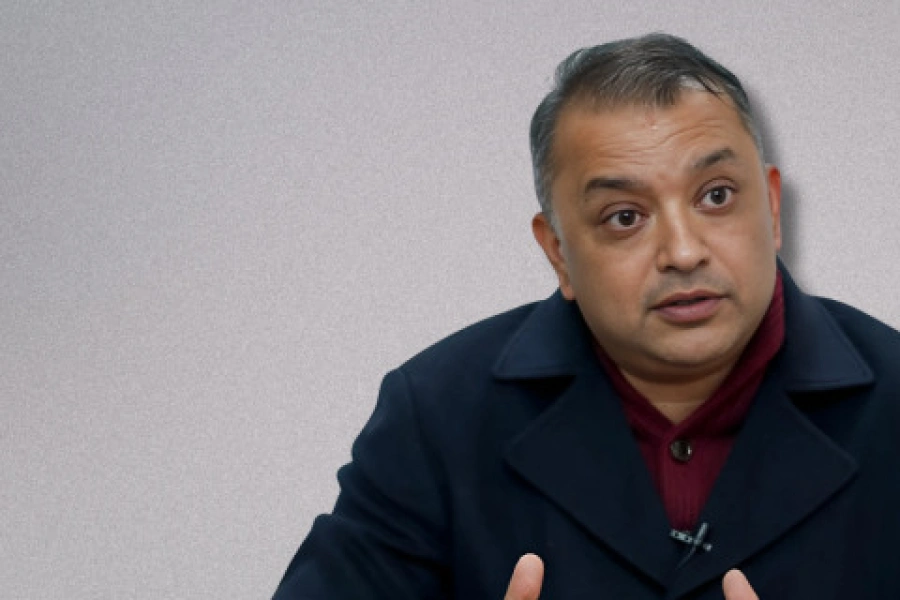
One of the most notable creative figures in Nepal, Shalabh’s participation in various fields such as media, entertainment and education is extraordinary. Currently working as the Executive Director of CG Entertainment and Law Associate at Tribhuvan University, Shalabh is also a film director, television producer and a literary enthusiast.
With his multi-talented personality, Shalabh has disproved the notion that multitasking does not often lead to success. The Week met with Shalabh to discuss how he managed to work successfully in so many fields, and his views on Nepali literature and cinema .[break]
How did you start writing?
I began writing quite early in life. Maybe one of the reasons for this is due my family influence. Our family owned a printing press. So the environment itself was such that it motivated me to write. Moreover, owning a printing press also meant that we were often acquainted with writers, which was also a crucial factor in my writing.
What’s the situation of Nepali literature?
The Nepali literature is divided into two major parts, Gadhya (prose or novels, stories) and Padhya (verses, poems). The Gadhya aspect of Nepal seems to be very strong. Besides, the market for Nepali books is rising everyday, especially among young people. However, the Padhya sector still has a long way to go. Besides, although most writers start their career by writing poems, they rarely gain commercial success in poetry.
So what can be done to improve the situation of poetry writing in Nepal?
I had made various audio visual poetry volumes where I invited some of the greatest Nepali poets, such as Madhav Prasad Ghimire, Durgalal Shrestha, Ishwor Ballav, to recite their poems. These events were organized primarily as a means of self-satisfaction rather than for commercial success. We must, however, be able to arouse public interest in poetry through various poetry recitation programs and similar events. An important drawback of Nepali poetry is that the translation is often difficult. Translation is the key factor in reaching out to larger audiences. However, the translation often changes the entire meaning of the poem, so the need for “trans-creation” arises. Hence, a proper understanding of both language and poems is necessary while translating them.
How did you join the media and entertainment business?
As a student, I was always interested in acting and I frequently participated in theatre plays. Once, I even won the Best Actor Award in the Academy Drama Festival. Then I started directing plays for the Godavari Alumni Association (GAA) one-act play competitions where we won the best-play awards for three consecutive years. Although I was a student of law, my interest always lay in this creative field. In the media sector, I started off by hosting and directing television and radio programs. While talking about films, I was offered to direct a movie by a businessman from Jhapa. He wanted to invest in films and wanted me to direct, so I tagged along.
Most importantly, I never planned beforehand as to what I wanted to do in life and took opportunities as they came.
As director/program producer, what changes and improvements have you seen in Nepali movies over the years?
I’ve directed four movies so far but there seems to be a huge change in the way movies are made now. Earlier, technology was very limited. For instance, when shooting for a movie, one had to depend hugely on the cameraperson, and as a director, one could only see the opening and closing shots. This made our work very difficult. However, today, with the help of video output, one can watch the entire shooting scenes as it happens and suggest amendments immediately. This advancement in technology hasn’t only helped reduce the overall filmmaking costs but has also made it easier. Moreover, most actors today come from theatre background and this has allowed for a very skillful and competent group of actors today.
What is the one thing that you miss about the old filmmaking style?
Previously, while making a movie, the entire crew worked together as one big family. We had a special sort of bonding that’s been replaced by professionalism today. However, this can also be a positive thing as it ensures increased efficiency since people are more concerned about their work.
What are the immediate requirements for Nepali films?
First of all, the market for Nepali films hasn’t grown over the years. Although the number of movies made each year has increased significantly, the number of people watching them has remained the same. One possible solution to this could be reaching out to more Nepali viewers by targeting our films to Nepalis living in foreign nations and also dubbing the movies in various languages. By also improving the marketing strategy, we could, in fact, gain commercial success.
In addition, Nepali movies face a huge competition from Indian and English movies, and this comes as a challenge. Since we’re competing with movies made with far advanced technology and huge budgets, we often lag behind. Therefore, we must be able to give the viewers something unique and different so that they will receive value for their money.
Nepali movies are often criticized for their lack of originality. What’s your say on this?
It’s true that Nepali films often lack originality. Although many new films have brought forward unique concepts, a lot of Nepali movies are still lagging behind. The main reason behind this is lack of good scriptwriters in Nepal. Due to this, Nepali movies lack proper storylines. Hence, I believe there’s a growing need of scriptwriters in Nepal. After all, Nepali viewers demand a story from a movie, and we haven’t been able to provide.
What should be done to promote theatre and similar creativity in Nepal?
In order to promote and develop these sectors, the governments should make sure that it rewards those institutions that are genuinely working for the improvement of the creative fields. Further, political interference and appointments in the filmmaking industry and other creative fields can be really unproductive and should be discouraged.
You seem to be involved in numerous fields, from being a law associate at TU to the executive director of CG Entertainment. How to you manage your time between these various works?
In my opinion, a person who is busy can always manage time. It’s those who have nothing to do who constantly complain about the lack of time. Speaking about myself , I feel there’s still so much to be done and the workload is never enough. Besides, if you really like what you do, and are interested in your work, it no longer feels like work. However, one should be able to allocate his time efficiently for various activities and thus manage time effectively.
Related story
Prime Life, Union Life and Gurans Life ink a merger agreement