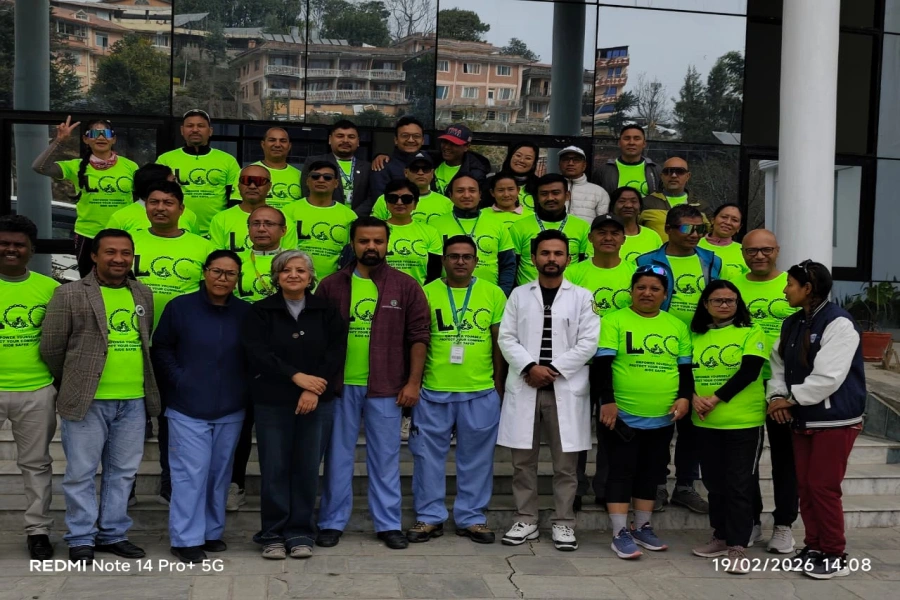
KATHMANDU, Feb 24: With cycling gaining popularity as a sustainable and healthy lifestyle choice, safety on the road remains a major concern. To address this, Nepal Cycle Society, in collaboration with Dhulikhel Hospital and with support from Laxmi Cycle Store, organized a one-day Basic Life Support (BLS) training program for cyclists.
The training was held on Thursday, February 19, at Dhulikhel Hospital, with participation from 35 cyclists. The program was coordinated and led by Nepal Cycle Society founder and former chairperson Ratna Ram Shrestha.
Since many roadways remain unsafe for cyclists, increasing the risk of accidents, organizers said such life-saving training programs are becoming increasingly important for riders navigating busy traffic conditions.
Celebrating 2nd World Cycle Day

Five professional medical trainers conducted the session. Emergency physician Dr Samjhana Basnet, orthopedic surgeon Dr Bikash Parajuli, and Dr Rajkumar provided hands-on practical training on emergency life-saving techniques.
Participants, most of whom rode their bicycles early in the morning, reached Dhulikhel Hospital by 9 AM. The training covered critical emergency responses including heart attack management, CPR for adults and children, choking management, spinal cord injury care, and immediate first aid for fractures and limb injuries.
Nearly half of the participants were female cyclists, highlighting growing women’s participation in cycling and safety awareness programs.
According to coordinator and cycling activist Ratna Ram Shrestha, there has been significant interest from other cyclists as well, prompting plans to conduct the training in three phases. The second phase is scheduled for the third week of March.
Participants Rakesh Shrestha and his wife Poonam Phaiju from Lalitpur shared that they initially joined expecting only basic accident-response training for cyclists. However, they later found the session to be a comprehensive life-saving skills program that could be useful beyond cycling emergencies.
They learned essential skills such as scene safety assessment, adult and child Basic Life Support (BLS), choking management, trauma care, and other emergency response techniques.
They described the training as valuable not only for cycling safety but also for general life preparedness, and suggested expanding such programs beyond Dhulikhel Hospital to community-level training initiatives for wider impact.

-1200x560-1774606010.webp)