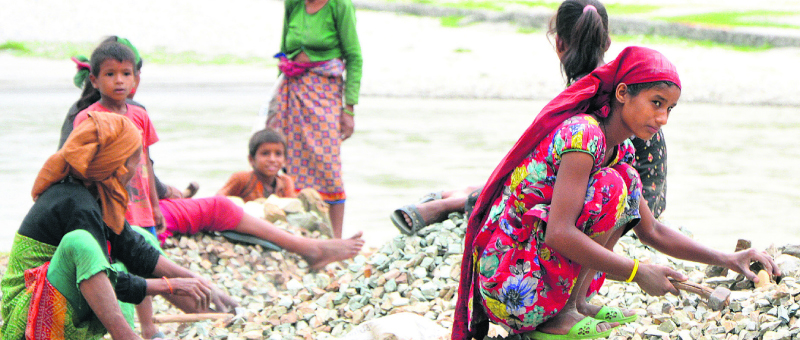
Despite human rights abuses, the decade long conflict in Nepal in several unintended ways introduced hitherto unknown aspects of empowerment to women and changed their role in the family and community, as women became active outside the home, challenged the security forces and began to assert their rights as citizens. Drawing on a research project on the participation of women in community development projects in three areas of Nepal, this article examines how far development agencies in the post-conflict period have succeeded in furthering women’s citizenship rights and participation as well as giving a voice to their concerns.
Development organizations and agencies have continued to largely operate without including women’s aspirations and women are disappointed by these non-participatory and top-down development models that are doing nothing to challenge their ‘second-class citizens’ status. Hence, women are now beginning to explore alternatives. The article uses examples from the field and interviews with marginalized women and NGO workers to suggest ways in which development agencies can work with participatory models to advance women’s citizenship rights. Given the diversity of social groups and gender relations in Nepal, women’s status has come to a point so far untouched.

TOWARDS EQUALITY
There has been growing awareness of and advocacy for women’s rights in both rural and urban Nepal recently, with the emergence of an active feminist movement that is in the process of legally and socially empowering women. Historically, the right to citizenship in Nepal has differed for women and men, who have had unequal access to citizenship and this has resulted in many basic human rights being denied to women.
The newly-elected Constitutional Assembly in Nepal is currently drafting a new constitution that will hopefully deliver a statute that, for the first time, will include full and equal citizenship rights for women. However, in addition to legal citizenship, women also need to be socially recognized as equal citizens at all levels, including the household and community. Only then can they participate uniformly in the economic, social and political life of the country, as well as the development process. Citizenship is more than a legal concept and goes beyond just claiming rights in institutions of the state. Because of the patriarchal nature of Nepali society that led to women’s unequal access to legal citizenship rights, this gender’s contribution to Nepali society has not been recognized so far. The status of women as ‘second class citizens’ has negatively affected their ability to participate in the development process.
However, now an increasing number of women are challenging their inferior status and asserting their rights, not only in government and leadership, but also at the grassroots level. Many such efforts to secure equal citizenship rights are being initiated in rural communities, through participation in women’s forums and NGOs.
The development of women’s capabilities was hindered by the conflict. The existing apathy towards women’s rights was amplified during the war, and subsequently, their different needs and experiences during the conflict and subsequent transition have been completely ignored in the peace process. In addition to being raped, sexually exploited, widowed and orphaned, women had to take on the burdens of earning a livelihood to support families or migrate and be compelled to do all kinds of work for survival.
However, one of the most striking aspects of the conflict in Nepal was the wide-scale participation of women and young girls in the Maoist movement. It is estimated that 39 percent of recruits were girls. This should not been seen as surprising, as the Maoists targeted their agenda of land reform and equal property rights to the marginalized ethnic groups, dalits (‘untouchables’) and women. Maoist-led campaigns focused on areas of concern to women such as domestic violence and male alcoholism and the Maoists established a parallel court system administering local justice.
The paradox of the conflict is that despite the fact that levels of violence and other human rights abuses increased during this period, with an obvious negative impact on women, it also unknowingly brought empowerment to women by altering their roles in the family and community with many of them stepping out of their thresholds, asserting themselves and daring to be independent.
Several high-profile female Maoist leaders emerged during the course of the conflict, and many women became politicized, particularly the Maoist female fighters. In 2006, the Comprehensive Peace Agreement between the new government and the Maoists brought an end to the conflict and established an interim government, which in 2007passed a law mandating 33 percent participation by women in every organ of the state and called for the repeal of discriminatory citizenship laws relating to women.
This has led to the newly formed Parliament having more than a 33 percent representation of women. As a result, there is suitable female representation in the Constitutional Assembly and is thus, more inclusive than ever before.
POST-CONFLICT PERIOD
Various male dominated interest groups, based on ethnicity, religion and caste issues, have so far oppressed women’s voices in Parliament. Other institutions and agencies of the state are yet to actively include women who make up only two percent of the judiciary, three percent of the army and seven percent of the police force. With the exception of the National Women’s Commission, not a single public or constitutional body is formally headed by a woman. Politicians do not adequately represent the interests of rural women and they are rarely able to implement female-friendly policies.
A local feminist and commentator says, "In practice, women MPs do not represent the grassroots female population. Most of them are wives, sisters or relatives of the male leaders of political parties.”
The right to citizenship in Nepal has differed for women and men, who have had unequal access and this has resulted in rights being denied to women.
Protests from the Women’s Caucus led to women’s participationon the drafting committee for the new Constitutionthatis expected to provide greater protection of rights for minorities, women and marginalized and vulnerable groups. For the first time in Nepal, there is a possibility that women’s fundamental human rights will be enshrined in law. However, given the patriarchal nature of Nepali society, there is also a possibility that even with the new constitution, gender inequality will remain rife.
For women’s citizenship rights to be realised across all levels of Nepali society, empowerment in their local community must be a priority for development agencies. Changes to the laws on citizenship will give women greater freedom and autonomy in decision making at the public, community, family and domestic levels, but legal changes at the national level alone will have little impact without a corresponding redefining of grassroots dynamics women and social restructuring of gender relations.
The author is a University of Liverpool-based researcher
bijanpant@gmail.com
Related story
#Sexploration Episode 3 Discussion on Gender Markers