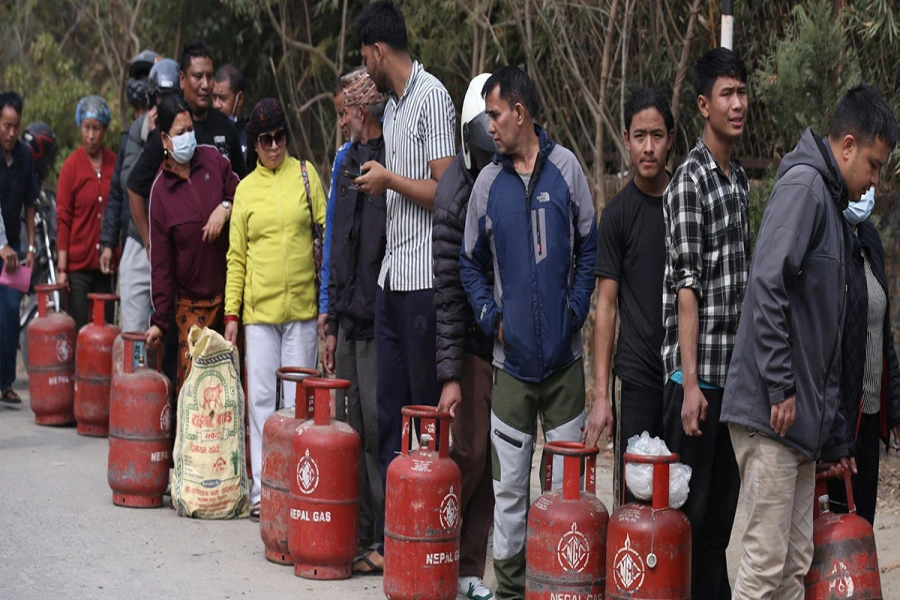
KATHMANDU, March 13: Long lines of frustrated consumers have become a daily sight at gas depots across Kathmandu Valley as a shortage of cooking gas grips the market. The scarcity comes amid over a week of ongoing tensions in the Middle East, forcing households to wait hours—and sometimes days—to get a cylinder.
The Nepal Oil Corporation (NOC) says the shortage is largely due to panic buying, with consumers stockpiling cylinders out of fear they will run out. “Imports from the Indian Oil Corporation (IOC) have continued regularly, but demand has surged sharply as people rush to secure gas,” said NOC Managing Director Dr Chandika Prasad Bhatta.
Pramod Rijal, waiting at a Banasthali gas depot, said he had to wait three to four days just to get a cylinder. “Even after reaching the depot, I had to stand in line for hours,” he said.
NOC to distribute half-filled cylinder gas

Consumer rights activists, however, blame NOC for mismanagement. Madhav Timilsina, chair of the Consumer Rights Investigation Forum, said the NOC failed to intervene and streamline distribution despite the looming crisis. He also warned that some gas companies are sending substandard cylinders to the market to take advantage of the shortage.
Under normal conditions, around 100 gas bullets are imported daily from IOC and refilled by domestic industries. Director at the Department of LPG and Aviation under NOC Chief Binit Mani Upadhyay said about 100,000 cylinders are distributed to the market each day. “Industries are supplying roughly the same number as usual, but the market shortage appears because people are stockpiling,” he explained.
To ease the situation, NOC’s board decided Thursday that only half-filled cylinders will be sold starting Friday. Currently, each cylinder contains 14.2 kilograms of gas and costs Rs 1,910. Under the new policy, cylinders will be filled with 7.1 kilograms and sold for Rs 955.
Dr. Bhatta emphasized that the decision is not due to a supply cut. “Gas imports have not dropped, but the Middle East crisis has created fear, prompting consumers to hoard cylinders,” he said. The half-cylinder distribution will remain until further notice.
Meanwhile, IOC has not formally informed Nepal of any reduction in supply. “Some days fewer bullets arrive, but the shortfall is compensated the next day,” Bhatta added.
Nepal requires about 95 gas bullets daily, while the market demand is roughly 110,000 cylinders. NOC previously adopted a similar half-cylinder system during the 2015 Indian blockade.
The shortage has even reached India’s universities, where notices have been issued reducing fried items in hostel kitchens due to limited fuel availability, though authorities assured that meal nutrition will not be compromised.