

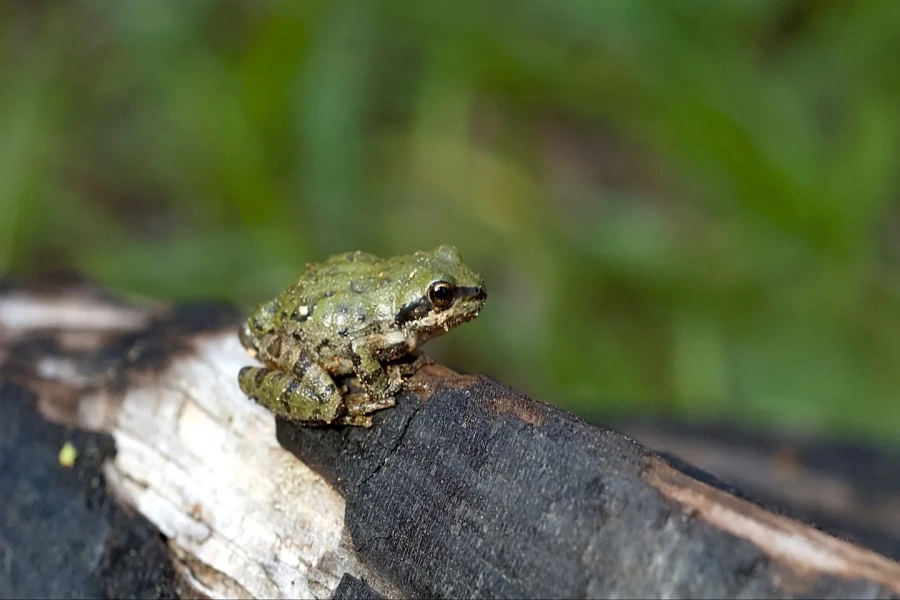
KATHMANDU, March 5: As the Earth’s temperature continues to rise, scientists are increasingly documenting subtle yet significant shifts in animal behavior. A recent study conducted in the United States has found that rising temperatures are directly altering the sound and quality of frogs’ mating calls—essentially reshaping their courtship songs.
The study, carried out by the University of California, Davis (UC Davis), shows that during the cold early days of spring, male frogs sing slow, sluggish, and less energetic songs. When temperatures are low, the rhythm of their calls is subdued. But as the environment warms, their songs grow faster, clearer, and more energetic. Female frogs can easily detect these differences and tend to pay closer attention to more active and vibrant calls.
In warmer conditions, when males produce more attractive mating calls, changes occur in the reproductive physiology of female frogs, triggering reproductive behavior. As a result, females may begin navigating toward breeding sites, and ovulation can begin. A strong courtship song does more than make a male sound appealing—it signals that environmental conditions are suitable for reproduction.
In the past, before climate change disrupted seasonal stability, warmer temperatures generally indicated the steady arrival of spring. The signal was reliable. Now, however, short warm spells can occur early in the season. Males may sound as though they are “ready,” prompting females to initiate reproduction. But if a sudden cold wave or other seasonal fluctuation follows, the eggs may be harmed. Scientists warn that this communication system evolved under stable seasonal patterns, and climate change is making those patterns increasingly unpredictable.
Julianne Penick, director of conservation science at the Amphibian and Reptile Conservation program at UC Davis and lead author of the study, said frogs’ songs are highly dependent on environmental temperature.
SHIFT for Our Planet: Youths urge authorities to make climate j...

“This process may help us understand how females track seasonal changes over time. As ponds warm, the calls of attractive males also begin earlier,” she said in a statement released by the university while presenting the findings.
“As ponds warm, the slow and sluggish calls of male frogs begin to sound faster and more urgent. I can hear the difference with my own ears, and female frogs are paying attention to it as well,” she added.
The research was conducted at the Quail Ridge Ecological Reserve in northern California and at the Lassen Field Station, also in northern California. Researchers recorded frogs’ courtship songs along pond edges in both warm and cold conditions and measured the relationship between water temperature and breeding calls.
As the breeding season approaches, male frogs gather in large numbers around ponds and other water bodies. They arrive earlier than females and effectively “warm up” their voices. But females do not respond to sound alone; timing must also ensure that eggs can survive. The study found that this environmental signal is embedded in the quality of the male’s song, which becomes more attractive as temperatures rise.
According to Brian Todd, a professor at UC Davis and co-author of the study specializing in reptiles and amphibians, “For males, it is advantageous to reach the pond as early as possible—earlier than other males. But for females, arriving at the right time to lay eggs is most beneficial.”
Timing is everything
Eric Post, a professor and senior author of the study who researches natural cycles such as flowering, insect emergence, and frog breeding, said the findings may reshape how scientists examine seasonal behavioral changes in animals and plants under climate change.
“Males may unknowingly provide subtle signals about how suitable the environment is for reproduction, and females may interpret those signals differently from what males intend, shaping their behavior accordingly,” he said.
According to Professor Post, the findings may also apply to other insects and species that rely on mating calls.
“The implications of this study are not only interesting but potentially far-reaching,” he added.
Climate change and conservation
In the context of accelerating climate change over recent decades, these findings carry important implications for wildlife conservation. Nearly 41 percent of amphibian species worldwide, including frogs, are at risk of extinction and are listed among the most threatened groups. Understanding when these species reproduce, how that timing shifts as the planet warms, and what factors influence those changes is critical for conservation efforts.


