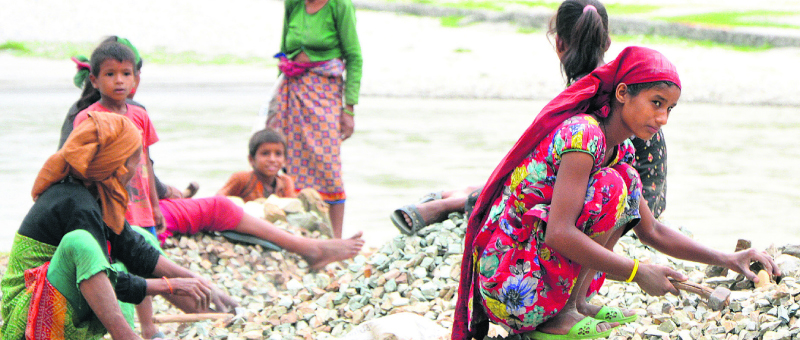
Several studies have pointed out that domestic violence is the most chronic and under reported crimes in the Nepali society. According to women’s rehabilitation center (WOREC - Nepal), an organization established in 1991 to curb violence against women and trafficking, 64 percent of Nepali women suffered from domestic violence in 2012. However, only 20 percent of them sought legal remedy. [break]
Quite a number of government and non-government bodies are said to have been working to improve women’s status. However, while success stories of women supported by them are few, crimes against women seem to have been growing alarmingly with those in the Tarai faring the worst.
Amid this situation, the focus of women activists currently is securing as many seats as possible in the Constituent Assembly (CA). Gaining political power and having a voice at the policy making level is extremely essential if women’s woes are to be addressed, the activists argue.

Interestingly, there is no difference between what women in the political sphere or ordinary ones feel about the patriarchal setup of the Nepali society. Male domination starts quite early with even the young male members trying to restrict the freedom of the female members.
“My son is barely nine years old. And he has already started demonstrating male chauvinism. He is inquisitive about where I go, what I do and so on. This really gets on my nerves,” said Neha Sharma, a media personality. “I wonder whether the boys develop this attitude naturally. Or may be that’s how he shows how responsible he is as his father lives abroad. Anyway, I am sure girl child would not behave the same way if I had one,” she added.
Another popular media personality Nirmala Sharma agrees that girl child is far more cooperative toward the mother as she respects women’s freedom and dignity which is hard to expect from a male child. “Girls are more sensitive and supportive toward parents. I do not think that boys can be equally comfortable as girls if their mothers want to break the stereotype, I believe that it’s an advantage for me that I do not have sons,” laughed Sharma, a mother of two daughters.
The children who have grown up believing that they are superior to women reflect the same attitude when they grow up, according to gender expert Gyanu Chhetri.
And dominating political figure coming from the same orthodox background is responsible for negligible number of women reaching to the top political level, notes Radha Gyanwali, former energy minister and Member of Parliament.
“Male psychology or patriarchal mindset is equally a matter of worry among women in politics. They fail to take a fair approach toward women. Or else, there is no dearth of capable women in politics but what is lacking is the eyes that notice such women,” said Gyanwali, who is also the central committee member of CPN-UML and member of inter party women alliance.
According to her, once again women are lobbying hard for their equal and meaningful participation in politics and state mechanisms. “Parties have never kept their promise regarding gender inclusiveness in politics and power. But we hope we can make a remarkable difference this time around.”
Gyanwali believes that only after women reach to the policy making level that all gender biased laws, which are largely responsible for the pathetic status of women, would be removed.
Former parliamentarian and human rights activist Sapana Malla Pradhan insists that state should accept individual existence of women, which means, they should be given equal property and citizenship rights. Secondly, domestic violence and other forms of violence against women should be labeled as serious crimes and dealt with accordingly. “There are number of discriminatory laws against women and when the state itself has treated women as secondary citizen, no wonder, they are bound to suffer. First the state should treat its citizens equally irrespective of their gender. And next, it should ensure that these laws and policies are implemented,” Pradhan notes.
As the country is gearing up for another CA election, all oppressed groups are in the race to secure their space in the mainstream politics, including women, who outnumber men in terms of population. From the first election in 2007 BS till date the country has witnessed a series of movements for democracy and equality and women have never hesitated to play their roles in hour of need. However, equality as a reality is still a dream for women.
“The country has gone a long way equality must prevail,” Nepali Congress President Sushil Koirala had announced amid a function organized by inter-party women alliance in the capital a few months ago. While such words sound pleasant to the ears, whether the new Constituent Assembly (CA) would strive to ensure equal status to women is yet to be seen.
Related story
Innovative take on gender equality


-1200x560-1781083488.webp)