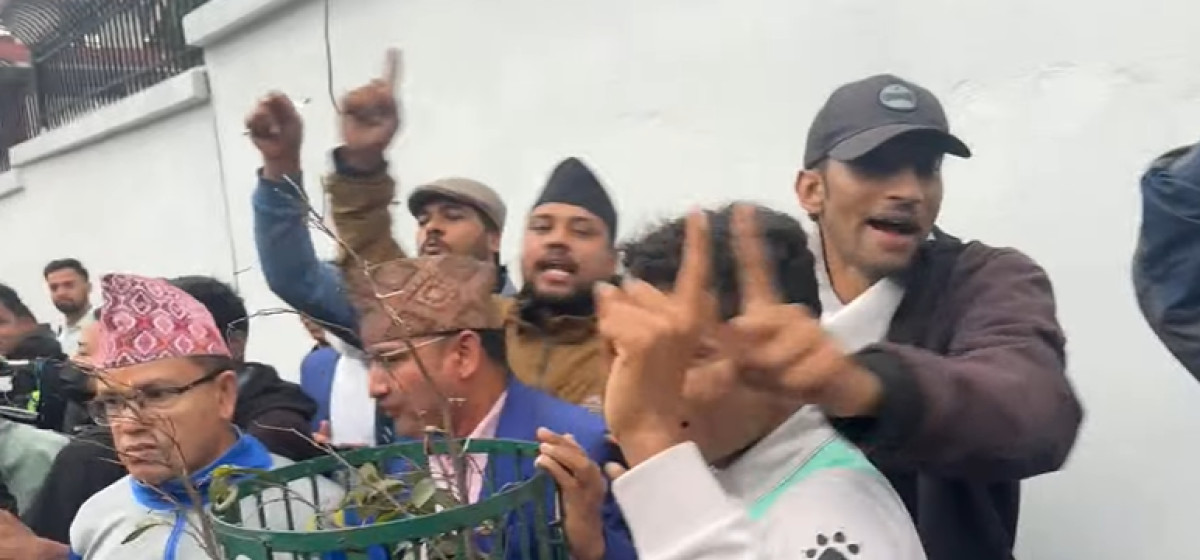
KATHMANDU, Oct 29: As tripartite talks between the government, political parties, and Gen-Z representatives got underway on Tuesday afternoon, a group of Gen-Z activists who were not invited to the discussions gathered outside the Prime Minister’s official residence in Baluwatar, staging a protest demanding that the deliberations be broadcast live for the public.
Convened by Prime Minister Sushila Karki at 4 PM, the talks aim to create an environment conducive to the upcoming House of Representatives elections scheduled for March 5, 2026. Sixteen representatives from major political parties and 14 delegates from various Gen-Z groups—including the Indigenous Gen-Z Collective, How to Nation Development, and Gen-Z Movement Alliance—participated in the dialogue. The government side included Prime Minister Karki, Home Minister Om Prakash Aryal, Minister for Communication and Information Technology Jagadish Kharel, and the Prime Minister’s Chief Advisor Ajaya Bhadra Khanal.
Has the govt placed suspended Chief Justice Rana under house ar...

The agenda focused on forging political consensus among parties and youth groups, discussing ways to ensure fair and inclusive elections, and building an overall atmosphere conducive to a credible 2026 vote.
Outside the gates of Baluwatar, however, uninvited youths made their voices heard, chanting slogans such as “No closed-door talks,” “We do not accept closed-door talks,” and “Let 30 million people see the talks live.” They warned that any agreements reached behind closed doors would be unacceptable to them.
“We do not accept closed-door talks,” said one protester. “Whether Gen-Z or anyone else is affected by these talks, the public should know everything.” The demonstrators insisted that every discussion be transparent and broadcast live on Nepal Television, asserting that citizens have the right to be informed about decisions shaping the country’s political future.
The meeting marks the first-ever tripartite dialogue involving the government, major political parties, and the Gen-Z movement—a platform the Prime Minister’s administration describes as crucial for fostering consensus and ensuring credible elections. Yet, the protests outside Baluwatar highlighted a growing public demand for transparency, underscoring skepticism over whether the process will fully reflect the voices of all citizens.



-1200x560-1774606010.webp)
-1200x560-1783685616.webp)