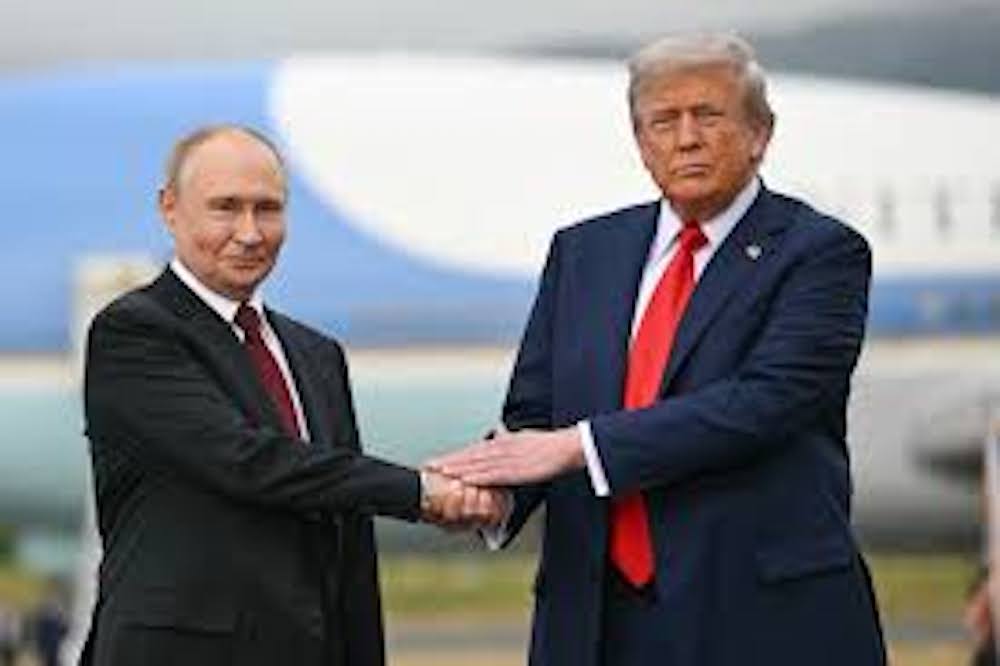
WASHINGTON, Oct 5: US President Donald Trump and Russian President Vladimir Putin have reignited an old propaganda term once used by Mao Zedong, trading accusations of who is the real “paper tiger” in today’s geopolitical landscape, AP reported.
Trump first used the phrase in a Sept. 23 Truth Social post mocking Russia’s military, calling the country “a paper tiger.” The Kremlin quickly pushed back. Trump softened his tone briefly but revived the jab days later while speaking to U.S. generals and admirals, criticizing Russia’s prolonged war in Ukraine: “You’re four years fighting a war that should have taken a week. Are you a paper tiger?”, AP stated.
Putin responded Thursday, arguing Russia was taking on NATO as a whole and still advancing. “We are fighting against the entire bloc of NATO, and we keep moving, keep advancing and feel confident, and we are a paper tiger; what NATO itself is? A paper tiger? Go and deal with this paper tiger then,” he said, according to AP.
Human-Tiger Coexistence Amidst Rising Tiger Population

Historians and scholars have noted the irony. Mao had first applied the “paper tiger” label to the United States in 1946, dismissing Washington’s nuclear power as intimidating but ultimately hollow. “As a Chinese historian I had to laugh at the irony when President Trump appropriated one of Chairman Mao’s favorite expressions,” John Delury of the Asia Society told AP.
Mao’s words had once rattled Moscow, which feared U.S. nuclear might more than Mao acknowledged. Now, decades later, the U.S. and Russia are using the same insult against each other, with Chinese leader Xi Jinping left to watch from the sidelines.
The phrase, “zhilaohu” in Mandarin, became entrenched in Communist Party discourse. Perry Link, an American scholar of Chinese culture, noted it was widely invoked during the Korean War, including by prominent writer Lao She.
Mao himself used it in interviews, calling America’s nuclear bomb a “paper tiger” meant only to frighten others. According to AP, Mao’s interpreter initially translated it as “scarecrow,” but an American doctor present suggested “paper tiger,” a translation Mao accepted. The phrase came to mean something appearing powerful but ultimately weak.
Rana Mitter, a historian of modern China, told AP the revival of the term by Trump and Putin carried “a Cold War echo.” Mao’s propaganda machine later elevated the slogan as one of his sharpest ideological tools, with the leader famously declaring, “All reactionaries are paper tigers.” The expression symbolized defiance against perceived imperialist powers, particularly the United States.
Though its usage faded as U.S.-China relations improved in the 1970s, Chinese officials have occasionally revived it. In April, amid escalating trade tensions, Beijing’s foreign ministry cited Mao’s 1964 remark that “America is just a paper tiger. Don’t believe its bluff.”
AP stated that even before Trump deployed the slogan against Russia, the phrase had already reappeared in U.S. discourse. Washington Post columnist Eugene Robinson described Trump’s foreign policy as that of a “paper tiger,” while Harvard professor Laurence Tribe used the term to reassure international students not to fear Trump’s policies.