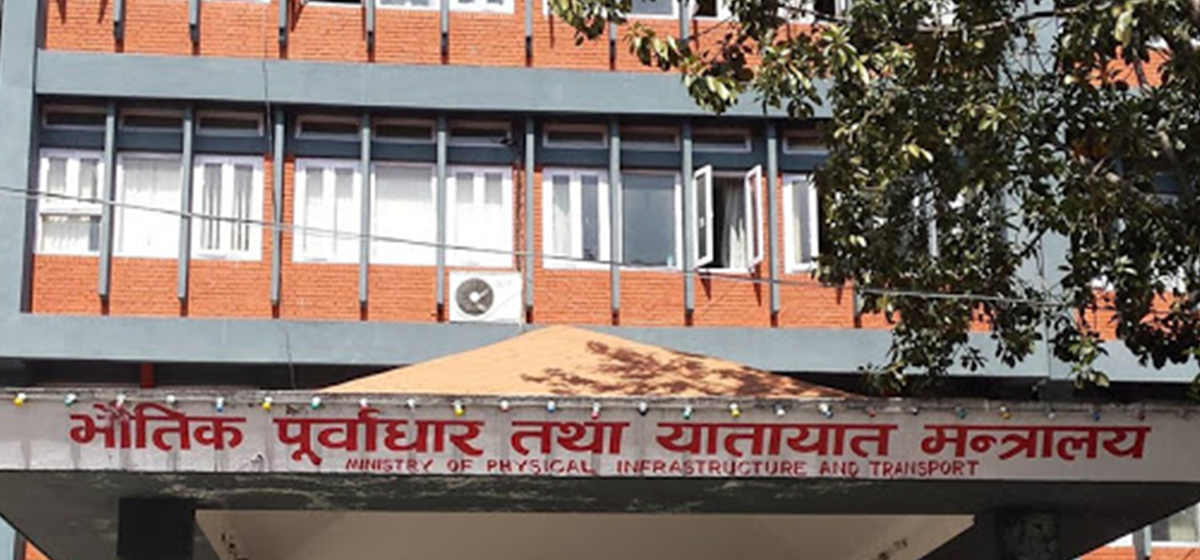
Perhaps it could do with a fresh coat of paint? The porch was once grand; it now appears gloomy.[break]
The driveway was awash with red flags.The unkempt front yard looked even untidier as cadres of trade unions affiliated to CPN (UML) began to gather for this year’s May Day rallies.
They could have easily chosen another venue and left the house of art and culture alone. But in the ideologies of uniformity, culture and politics are inseparably intertwined.
Tented galleries had taken up the backyard of the main structure. They housed the Indo-Nepal craft exhibition and sales.
Exhibitors had begun to set up stalls and dust their wares. It would be quite a while before the first visitors would arrive. Buyers of handicrafts often prefer languid afternoons to do their leisurely shopping.
After a spring storm the previous evening, the May Day morning was cool and sunny. Trees appeared greener. Flowers were in full bloom.
It was a public holiday; hence the traffic on Kathmandu streets had been unusually thin. It was too good a day to be going mourning. And then the reason behind needless wandering of the mind struck with the force of the head hitting a tree trunk during a careless walk in the wilderness.
Attention to atmosphere could have been the brain’s way of diverting the heart towards little pains, pleasures and concerns of everyday life.
People gathered at the small outdoor performance nook inside the normally feisty Academy grounds were having difficulty in accepting that they were there to pay tributes to the memories of a young theater personality.
The assembly was characteristically small. Life in metropolitan cities can be too complex to leave much time for events that don’t affect one directly.
In any case, actor Ranju Jha may have been a familiar name to theater lovers in Janakpur; here in the capital city, she was merely an exotic struggler from the margins who had taken up small roles in Nepali dramas.
However, a sense of loss in the intimate gathering was unmistakable. Writers, poets, photographers, filmmakers and artistes in general have a heightened sensitivity towards the ways of destiny.
Mourning for a young person induces mixed feelings. The sense of loss is of course paramount. But at the same time, there is a sneaking feeling in some corner of the heart that the one gone could easily have been anyone, including the mourner.
The relief induces a sense of guilt, which then expresses itself in public display of sorrow. The emotion becomes even more complicated as memories of the dead begin to pry open recesses of the mind where brief encounters had remained locked for years.

The veil of chatter
Even though better known as an academic, playwright, poet, and a cultural critic, Abhi Subedi remains a teacher at heart.
In his brief homage to the victims of the bomb attack in Janakpur, he tried to lessen the loneliness of the crowd with the observation that great changes in human history had been brought about by just a few thinking men and women charged with the energy of the cause they championed.
In that sense, no death in pursuance of a mission goes in vain. Like oil added occasionally to the lamp, death becomes the life of a burning flame.
After the customary moment of silence, there was little to do at the venue. Prattle is perhaps a diversionary device grownups use to hide their nervousness.
Mourners broke up in small groups. Some began discussing the schedules of the day with their colleagues. A few seemed worried about the implications of violence on body politic.
Discussions over the way the news of terrorism have been covered by Kathmandu newspapers dominated many conversations.
A reader was impressed by the headline in Nagarik daily of the morning, which was a play upon the title of a short film where Ranju had portrayed predicaments of the protagonist with rare sensitivity. She indeed crossed the doorframe, but her journey ended abruptly.
Media person Roopa Jha had not only known Ranju but also appreciated the travails of a professional young mother rearing her children almost on her own.
There is a Maithili song that wails about the fate of Janaki—a goddess-incarnate born to take up torments of humanity upon herself and liberate devotees from consequences of their sins.
Apparently, women continue to shoulder much of the burden of civilization upon their shoulders to this day, and a part of Goddess Janaki dies with the death of every suffering woman.
In a tragic coincidence, Ranju died on Janaki Navami—the day Goddess Sita was discovered inside a pot when Rajrishi Janak was plowing a field to rid his kingdom of a devastating famine.
Rupa narrated a conversation with someone in the family of the dead. Ranju was apparently excited about participating in the sit-in organized by the Maithili Natyakala Parishad for an autonomous Mithila state.
Life in small towns with their petty rivalries and little concerns could be dull, drab, routine, suffocating and exasperating.
In addition to the exhilaration of being an agent of history, the excitement of being in a political rally is akin to appearing on a grand stage with the whole world as audience of the performance.
Death on stage then becomes the ultimate act—the last but reality at its best.
Ranju will remain etched in the memories of her admirers as she appears in the poster of Chaukhat: A confident lady hiding her apprehensions behind an enigmatic expression that could have been repressed sorrow, suppressed smile or a combination of both emotions.
With the mixture of wisdom and courage that only women seem to be capable of marshaling at tragic moments, Rupa expressed her concerns for the future of the orphaned children. Ranju had achieved the highest honor possible for an actor: Death on stage.
Her circle of friends too will outgrow their grief after a while. The immediate family, however, would take a long time to cope with the consequences of the death of its sole breadwinner.
Dhirendra Premarshi, a well-known language rights activist and media personality, reminisced about his role in sparking recent protests over autonomous Mithila state. He had voiced the claims of the second largest linguistic community of the country in state restructuring debates.
There was no way he could have foreseen the terrorist attack on peaceful demonstrations for political rights of a cultural group, but all sensible people are accursed to live with the realization that everyone in society is at least partly responsible for eruptions of violence.
While Rupa was primarily concerned with human dimensions of the tragedy, Dhirendra was being personal and political at the same time. Together, they showed some of the ways human beings devise to cope with the stress of handling unsettling experiences.
The martyr mechanism
Stricken with the shrapnel of the blast that killed Ranju and three other Maithili activists, over a dozen injured victims were writhing in pain on beds of the Eye Ward of the Tribhuvan University Teaching Hospital.
Parmeshwar Kapadi, an academic and the coordinator of autonomous Mithila State Movement, lay on a crumpled bed. Along with sadness, there was a glint of determination in his eyes.
He wanted to emphasize that the victims of the bomb blast in Janakpur had become the very first ‘cultural martyrs’ of the country.
What would have Ranju thought had she heard the statement of the most energetic language activist of her hometown? Like conflicts over resources in economy, after a certain point, struggles for cultural rights acquire political overtones.
In its essence, violence too is an expression of outrage that it inevitably ignites in its wake. Over the ages, scholars have interpreted the use of destructive methods—duels, devious wars and devastating weapons—in many ways. In the Mahabharata, Lord Krishna justifies wars, even by deception if necessary, for the end of tyrannies and restoration of righteousness.
Violent behavior is said to be caused by a longing for emancipation, competition for resources, fear of the other, retaliation of humiliations suffered in the past, or to draw the attention of those one desires even at the cost of death.
According to the formulations of René Girard, violence results from learning to desire what others also do and are willing to fight to get it. He calls the urge “the mimetic rivalry.”
The logical conclusion of mimetic rivalry, however, would result in the decimation of humankind, as every act of aggression would go on inviting corresponding reprisals ad infinitum.
In Girard’s opinion, humanity has invented “scapegoat mechanism” in which surrogate victims absorb the repressed violence of the group.
While it may sound sacrilegious to call “martyrs” mere victims of violence—in popular imagination, they embrace death with courage and determination—perhaps it is possible to argue that struggling societies need a steady supply of “martyrs” to hide their inadequacies.
Ranju was a freedom fighter in the truest sense of the term, in a way that all of us want to be but few have the courage of conviction to take risks associated with the endeavor.
Call her a martyr, if you must, but she was one of this country’s brave mothers whom some of her sons killed on Janaki Navami.
Lal contributes to The Week with his biweekly column Reflections. He is one of the widely read political analysts in Nepal.
Related story
Kathmandu Road Division Office starts blacktopping road demolis...