Nepali Congress’s failings seem to be firmly established in both local and global media. At home, the grand old party is facing a legion of criticisms: It is bereft of a clear political road map to end the protracted impasse and its leaders are visibly divided into three camps under three individual leaders. Of the three, President Sushil Koirala lacks charisma and decision making skills; the perpetually power-hungry Sher Bahadur Deuba and Ram Chandra Poudel are bereft of any ideological moorings. The Maoist highhandedness in national politics is thus interpreted as a result of NC’s weak stand in national politics. And now, global media has started to sing the same tune: The Economist recently described NC as the “weak and fractious” opposition (November 17).
Indeed, the GOP is perhaps at its weakest point ever. It has been months since it declared a war against the ruling coalition in June. But it still cannot gather enough supporters to fill the open air theater at Tundikhel without UML’s support. Meanwhile, the ruling coalition has not budged an inch, despite NC’s repeated threats of a “storm of agitation.” Thanks to President’s Friday diktat, NC now can hold back its flagging protests. But given the constitutional complications inherent in the presidential call, the opposition parties do not have much to cheer about. If the opinions of constitution experts are any guide, the President’s move will most probably be a blessing in disguise for the incumbent PM, should the political parties fail to come up with consensus by November 29. As ruling Madhesi and Maoist parties are unlikely to approve a candidate favored by NC and UML, the stalemate is sure to be prolonged, giving PM Baburam Bhattarai an excuse to cling to power. In this scenario, NC will be the one to lose out.

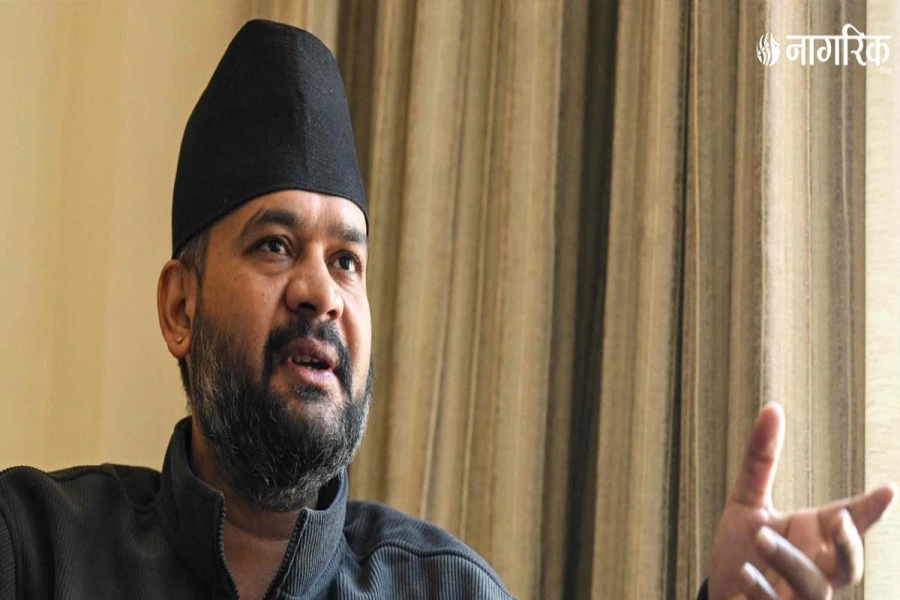
PHOTO: BIKASH KARKI/REPUBLICA
Is NC as “weak” as has it been portrayed? Not really. In fact, it is still strong in terms of wealth, intelligentsia and democratic legacy. It has a glorious history of uprooting Rana oligarchy in 1949 and leading the democratic movements of 1990 and 2006. It boasts of prominent thinkers—Dr Ram Sharan Mahat, Dr Minendra Rijal, Dr Naryan Khadka and Pradeep Giri, to name a few—who have good media access and who are capable of creating alternative political discourses to influence public mood. Its district chiefs can organize conclaves—the July Barhabise gathering a case in point—even without a concrete agenda spending millions for such programs. Most importantly, its cadres and supporters largely comprise of the comfortable classes of Nepali society: the educated middle class of Kathmandu and landlords from the hills and Tarai. A party with such a strong base should have been calling the shots in national politics. So what is amiss?
NC lacks a vital component that has the power to catapult it to power, a component that can boost the confidence of party leadership: the poor and the low income population group. Though this group can offer nothing save their votes, it has the potential to make or break a party. The reason for NC’s current downswing in national politics is its inability to take this group into confidence.
NC has been increasing its distance from this population cohort ever since it came to power in the early 1990s. During the 1990s, NC’s role was virtually confined to making and breaking coalitions, while the Maoists were pulling in low-income youths in droves. In Kathmandu, NC stood as a silent spectator, at times even a trusted accomplice, of corruption and misrule, instead of looking into the causes that gave the Maoist rebels an upper hand in rural hinterlands. Ever since, this vital group has felt alienated by NC.
This is the reason the GOP fails to inspire much hope in poor communities while its communist rivals, UCPN (Maoist) and CPN-UML, are masters at capitalizing on poverty issues. CPN-UML, which is no less elitist than NC in practice, still thrives thanks to its past pro-poor programs like its 1994 decision to introduce social security allowance. Old peasants and mourning widows thank UML each time they receive allowances. Perhaps this is the reason UML still retains a large number of working class voters. As for UCPN (Maoist), its leaders know how to appropriate the voices of the poor. Its vice chairperson camped at a poor Dalit’s hut in western Nepal earlier this month, a move which was derided as populist by the opposition parties but nonetheless contributed to enhancing his image as a friend of the poor and deprived.
What should NC do then? There is no dearth of prescriptions from opinion-makers in Kathmandu. While some want the party to take on the Maoists head on, others would like it to face the election without much ado about the government leadership. A prominent columnist, Bishnu Sapkota, has gone to the extent of saying that NC’s troika—Koirala, Deuba and Poudel— should take retirement from the leadership and hand the reins over to young leaders like Gagan Thapa (Kantipur, Nov 5). A section of intellectuals hold that NC’s success lies in embracing ethnic-identity based federal model. This writer believes that these recommendations will not lead NC very far in national polity.
NC will neither regain its lost clout nor succeed in the long run unless it reaches out to the poor and low income populace. Thus it has to make the shift from the perfumed class to the perspiring class. Unlike the comfortable class, this class does not demand much in return from politics and does not shift loyalty unless the trusted leadership fails to provide it with even basic amenities or completely betrays it.
Towards this end, NC needs to do a couple of things. It should rid itself of its self-inflicted paranoia of the Maoists. Truth is UCPN (Maoist) has become as weak as NC, or perhaps much weaker of late. And the longer it stays in power, the weaker it will be. Frustrations run deep among Maoist cadres and supporters. Those that previously revered its Chairman like a divine being have started to rebel, and the belief that the party can transform the country is fast eroding. But this is no time to revel in schadenfreude for NC. NC has to fill the vacuum created by Maoists’ and UML’s ascent towards what CK Lal calls ‘the status of lumpenbourgeoisie’, and Madhesis’ and Janajatis’ tilt toward ethnic politics.
A great majority of people are still undecided about a reliable political force they can support, thereby creating an opening for the GOP. Most of the people in this set are low-income families. The hard truth is that so long as a peasant in Jumla cannot identify NC as the party he can rely on, and so long as tempo drivers, street vendors and construction workers do not see their future in NC, the GOP can expect more heavy weather in the foreseeable future.
mbpoudyal@yahoo.com
Related story
Kathmandu Road Division Office starts blacktopping road demolis...