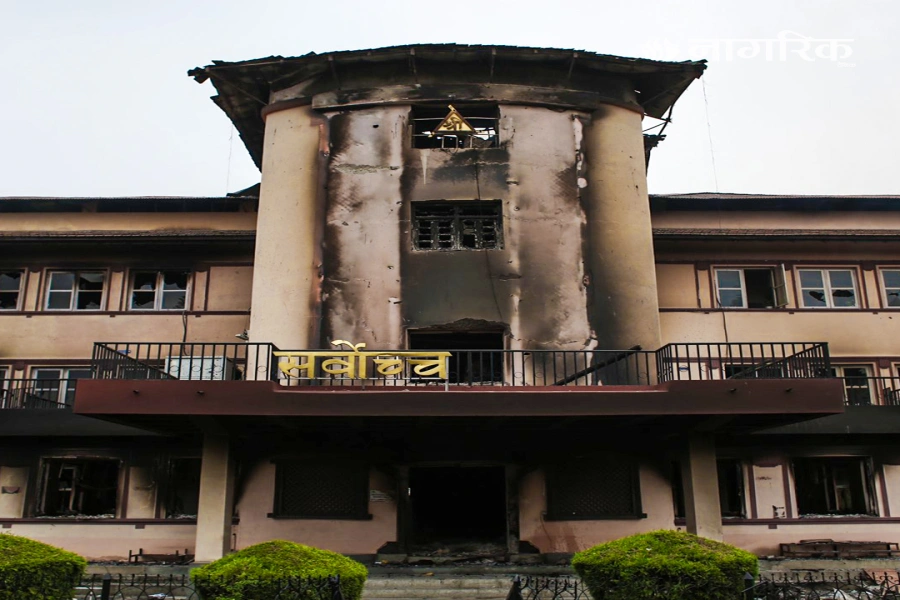
It is well known that the “People’s War,” in Nepal, initiated by Maoists, lasted for a decade between 1996 and 2006. During that period, more than 18,000 people were killed. Rampant atrocities, including but not limited to unlawful killings, disappearances and abductions, were committed by the warring factions against civilian population. Also, beatings, threats, humiliations, forced unethical acts, rapes and cases of sexual harassment were quite common. It is estimated that 150,000 to 400,000 people were displaced due to the conflict. Besides, government buildings, health posts, drinking water systems, police posts, airports, schools, roads and telecommunication systems were destroyed or damaged in different parts of the country. The economic cost of the conflict is estimated at 8 to 10 percent of the GDP, and it is supposed to have taken the country back by at least three decades.
The Maoists signed a Comprehensive Peace Agreement with the government of Nepal in 2006 to end the decade-long People’s War. That agreement was reached after the Maoists failed to completely capture any district of Nepal, though they were influential in many parts of the country. The government too had had enough of fruitless military actions against the Maoists. So by that time, an agreement had become inevitable for both the warring factions.

PHOTO: SOUTHASIAREV.WORDPRESS.COM
Soon after the historic agreement was reached between the rebel forces and government, the election of 601-member Constituent Assembly (CA) was conducted in 2008. As per the Interim Constitution of Nepal, the CA was expected to draft and endorse a new constitution within two years. As part of sweeping changes ushered in by the newly elected parliament, the 239-year old institution of monarchy was abolished. The country was declared a federal democratic republic, though a federal structure was yet to materialize. Overnight, the country became secular! The leaders issued a clarion call for a NEW NEPAL. It was expected that the new government headed by Maoists would bring about significant transformations in the socio-economic and political set up of the country.
But soon people’s faith in the new political leadership crumbled. The leaders became more interested in power games than in the welfare of the people. The position of prime minister resembled a game of musical chairs. On average, one prime minister has lasted hardly more than a year in office in Nepal. In the five years since 2008, Nepal has gone through five prime ministers!
After 2008, the only major breakthrough was the resettlement of 19,500 Maoist fighters living in different cantonments and satellite camps. To entice them to leave the camps, the fighters were offered hefty settlement amounts from the state treasury under a voluntary retirement scheme. But then, the gains made from the demobilization of Maoist fighters are likely to be hijacked in the future. An effort is being made by certain quarters to re-mobilize the fighters, along with other politically indoctrinated cadets. The property confiscated from individuals during the conflict is yet to be returned. Let alone a truth and reconciliation committee, even a committee on disappeared people is yet to be formed. As a result, those who committed crimes during the period of the conflict are still walking free.
Over and above these inadequacies, foreign investment projects including hydropower projects have been attacked. Vehicles with foreign number plates have been vandalized. Periodic attempts have been made to ban foreign movies and music. Even certain crucial treaties, agreements and arrangements are being challenged against the will of the people.
Alarmingly, unemployment rate has reached 42 percent, and more than 1,500 youths are leaving the country each day in search of jobs in overseas countries including Malaysia, Qatar and Saudi Arabia. It is estimated that currently, more than 3 million of the 30 million Nepalis are working, legally and illegally, in foreign countries other than India.
Because the people are so neglected by the government, the per capita income of Nepalis is still as low as US $ 650. Nepal’s rate of economic growth is 3.8 percent, while in comparison, India and China have growth rates of 7 and 8 percent respectively, even during the recession!
Most industries in Nepal are closed due to inadequate and erratic supply of electricity, scarcity of raw materials, labor militancy, forced donations and frequent closure (banda) of one district or another. The lack of investment and shortage of labor has hit agriculture sector the hardest, as most of the working age population has left the country for foreign employment.
A MoU has recently been signed by certain quarters—amidst mounting controversies—to facilitate investment of up to US $3 billion for the development of infrastructural facilities at Lumbini, the birthplace of Lord Buddha. Many people feel that the project has some hidden motive. Since the location of Lumbini is at a stone’s throw from Nepal’s border with India, the project could have major strategic implications. This project is likely to trigger further rivalry between our two close neighbors, China and India, on Nepali land.
The government is simply a mute spectator doing very little to diffuse this mounting crisis. The country faces an aggravating predicament, and not least because the CA failed to draft the constitution even after a second extension on its term. The current government has lost the people’s mandate to rule, and as a result, all Nepal has now is a care-taker government which cannot take any crucial decisions except those related to day-to-day work. Additionally, the prime minister’s commitment to conduct a fresh election on November 22 also failed to materialize.
Though late in the day, President Ram Baran Yadav took recourse to Article 38 (1) of the Interim Constitution in his to bid diffuse the crisis, and recently asked the political parties to come out with a consensus candidate for prime minister within a week. But even after the expiry of the deadline, the four major political parties—UCPN (Maoist), Nepali Congress, CPN-UML and the United Democratic Madhesi Front—failed to come up with a consensus candidate. Though the deadline has been extended for another week, the consensus is likely to remain elusive even then.
In the existing situation, the role of the President has become all the more important. It would be best if the President were to ensure that a new government is formed under a competent retired judge of the Supreme Court, and that the election for a new parliament is conducted along with elections for local bodies like Village Development Committees, Municipalities and District Development Committees, so that power is genuinely transferred to representatives of the people. Revival of the CA is not the solution to the problems facing the country, and likewise, conduction of elections by the party currently in government is not going to bring tangible peace or stability to the country. The sooner fresh elections are conducted at central and local levels in free and fair manner, the better the chance of averting the crises that loom large.
The author is Executive Director of Center for Economic and Technical Studies in Nepal
dr.hbjha@gmail.com
Related story
Cabinet determines perks for former presidents, vice presidents...