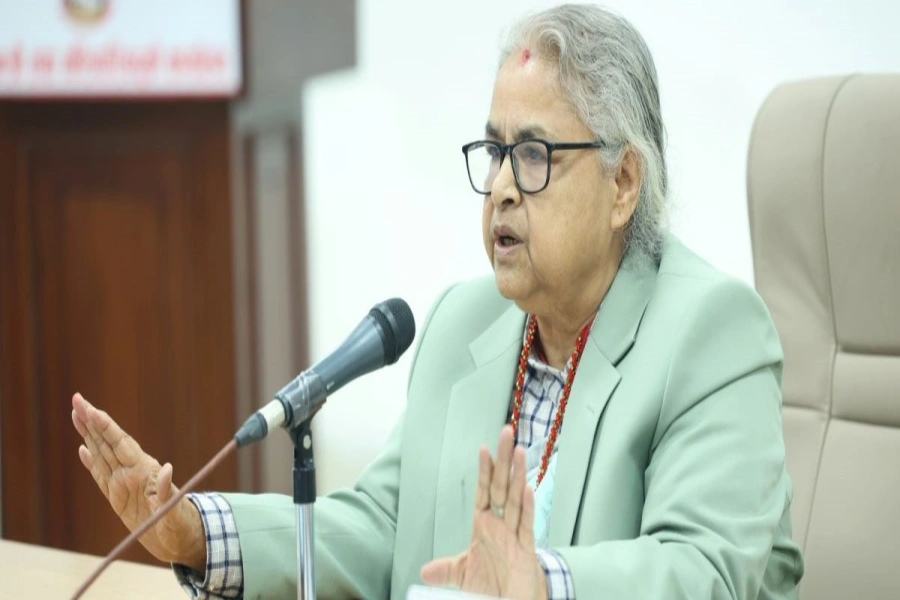
Prime Minister Sushila Karki assumed office at a time when the country was gripped by deep political uncertainty. Then prime minister KP Sharma Oli was forced to step down and parliament was dissolved in the aftermath of protests led by Gen Z youths. The killing of at least 19 youths on the first day of the protest on September 8 triggered widespread demonstrations in the following days, leading to vandalism, arson and looting in several places. The lawlessness that followed the uprising pushed the country into a serious political crisis. Against this backdrop, former Chief Justice Sushila Karki was appointed interim prime minister with the primary task of holding parliamentary elections within the stipulated timeframe and returning the country to the constitutional path. In this interview taken after her government successfully conducted the House of Representatives election on Thursday, Prime Minister Karki reflects on the challenges her government faced in organising the polls, the importance of ensuring a peaceful and disciplined electoral process, and her expectations from the incoming government to address the demands raised by the Gen Z movement and ensure good governance.
Excerpts:
You assumed the responsibility of Prime Minister under very difficult circumstances. Today you have successfully conducted the election. How do you feel about it?
Naturally, I feel happy that we were able to fulfil the responsibility entrusted to us. That was the mandate given to our government. However, this achievement is not mine alone. The entire Council of Ministers worked tirelessly. The Election Commission, security agencies, civil servants, political parties and candidates all played important roles. Most importantly, the Nepali people who responded to our call and participated in the election made it a success.
What kinds of challenges did you mainly face before completing the election?
There were many challenges and obstacles, the foremost being security. We introduced an integrated election security plan, which proved effective in maintaining peace. There was strong coordination among the Nepal Army, Nepal Police, Armed Police Force, National Investigation Department and the Home Administration. Everyone worked with a shared sense of national responsibility, and they all deserve appreciation.
Minister Khatiwada calls for collective effort for promoting wo...

At the same time, the patience and understanding shown by the families of martyrs and injured fighters should not be forgotten. They deserve our deepest respect.
There were doubts about the election from the very beginning. Some even said the election would not take place and that this government would not be able to conduct it. How did you make it possible?
You are aware of the difficult and uncertain situation in which we assumed office. Despite that, we had confidence that we could deliver. With dedication and perseverance, even difficult tasks become possible.
There were various forms of criticism and obstacles along the way, but we were not distracted. We believed that sincere and selfless work would ultimately lead to success. No matter how many challenges arose, we remained committed to our responsibility.
We faced many criticisms. Some political parties questioned our capability, and some individuals associated with the Gen Z movement also raised doubts. Nevertheless, we remained focused on our primary goal—maintaining peace and stability in the country.
From the very beginning, our priority was to ensure that there would be no bloodshed or untoward incidents and that the election would take place in a peaceful and disciplined manner. Elections must be civilised and free from violence. Our efforts were directed entirely toward that goal. We did not dwell on criticism; we focused on the work at hand. What we did was not for ourselves but for the country and its people. We also received support from across the nation.
Do you feel there was anything that could have been done better while conducting the election?
It would have been better if Nepalis living abroad and those residing outside their home districts had been able to vote. We also adopted austerity measures to reduce costs, although perhaps expenses could have been lowered further.
However, due to the incidents of September 8 and 9, we had to procure a number of new resources and equipment. Even so, the election was conducted in a highly disciplined and civilised manner.
What message would you like to give to the incoming representatives and the new government?
Everyone is aware of the country’s problems. Many have identified them, but sincere efforts are needed to resolve them. The Gen Z movement has raised several demands that must be addressed.
These include ensuring good governance and creating opportunities for people to live and work in Nepal. Corruption, discrimination and favouritism must end. The tragic reality of young people returning home as dead bodies from foreign lands must be brought to an end.
Young people should be able to access quality education within the country. The fundamental rights guaranteed by the constitution must be implemented in letter and spirit.
Before leaving office, we will present a white paper outlining what we attempted to achieve, what was accomplished, what remains unfinished and why certain tasks could not be completed. This will help guide the incoming government.
What will happen to the report of the probe commission led by Gauri Bahadur Karki?
Once the commission submits its report, the process of implementation will begin. As I have repeatedly stated, there must be no room for impunity in the country.
Therefore, not only this commission’s report but also any other such reports will be reviewed and made public so that the people are informed.