

Just four months after completion, there were at least six potholes and numerous cracks that were obvious even to the most casual observer. As for the reasons of this deplorable situation, the authorities had no satisfactory explanation except to mumble that the contractor will have to undertake the repair job since he has guaranteed hassle free performance for at least a year.
The TIA case in mismanagement and the improper spending of state funds is only a tip of the iceberg of a culture of corruption that seems to be engulfing the nation. In fact, corruption, which in World Bank definition is private gain at public cost, is almost becoming an accepted norm even though politicians do not miss an opportunity to decry it in speeches.
TYPES OF BANDITRY
While writing on corruption Prof Mancur Olson (economics) outlined two different models. The first was labeled as stationary banditry. In a situation of stationary banditry, the ruling class has an interest in maintaining a minimum level of services so as to make sure that the people do not rebel and continue production that is necessary to extract surplus for the state. In our own country, the Rana rule was an example of stationary banditry type corruption. The state provided basic law and order services and used its powers to extract maximum surplus from the farmers given the level of technology and the feudal institutional set up.
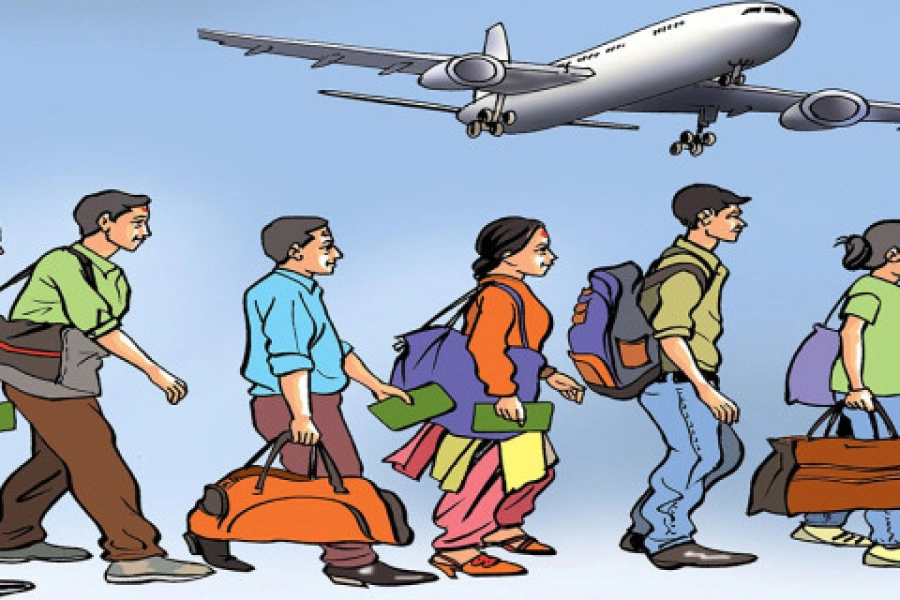
Whatever was left after paying for maintaining a minimum level of governmental services became the property of the ruling class. In this process, when the exploitation of the state made it difficult for the people to survive, they just left farming and migrated to different parts in India mainly the present north eastern states. The rulers, on the other hand, eased taxes and showed some leniency when families started to leave the country for the simple reason that depopulation meant less production and a smaller base for extracting surplus. In Olson´s thinking, exploitation and corruption of this nature would fall under stationary banditry. Old feudal societies like Nepal followed this model.
The second type of corruption is roving banditry. As the name indicates, roving banditry defines a situation where the nature of corruption takes place within a short time span and the bandits leave the scene, most probably to be replaced by another similar set. In ancient times, roving bandits were probably a common phenomena whenever there was a weak state to counter this trend. Roving bandits were relatively more destructive and difficult for the people because they did not have the responsibility of providing minimum services as in the case of stationary banditry. People therefore preferred stationary bandits as opposed to roving bandits.
In modern democracy, political parties have the mandate to rule the country for a given number of years within a constitutional structure that tries to make sure that private gain is not allowed at public cost.
In a developing country, where constitutional checks and balances are weak, there remains the serious possibility that corruption in the form of modern party-based roving banditry becomes a real problem. In Nepal, this is not just a possibility but a near reality.
Thus we have different checks and balances to minimize chances of corruption. The essential point however is that even in a democracy with constitutional checks and balances, hold on power is only for a fixed time period. There is always the possibility that the party might not get a second chance. Even in established democratic polity there is a certain "roving banditry" element in this struggle for power. In a developing country, where constitutional checks and balances are weak, there remains the serious possibility that corruption in the form of modern party-based roving banditry becomes a real problem. In Nepal, this is not just a possibility but a near reality.
ROVING BANDITRY IN NEPAL
Corruption of the roving banditry type becomes a serious concern in countries that are in the process of political transition. Even in relatively established political systems, stationery banditry symptoms can emerge but the institutional checks and balances within the system can keep it within acceptable boundary lines without seriously affecting the growth trajectory. India and China would be examples of this reality. Major corruption scandals have plagued both countries but institutional response has been rather different because the political systems in both countries are different. In India, there can emerge someone like Anna Hazare challenging the symptoms of stationary banditry; in China, this is not possible but the response can be quick and harsh.
Countries that are in transition face a difficult situation. Constitutional norms and values are still being defined and new institutions are in the formative stage. The whole system has yet to find its moorings in the new politics. Power relations are fluid and governmental stability is lacking. In such a setting, the political elites develop a tendency of roving banditry. Whichever party or leader is in power knows that its hold on power is uncertain and capacity to deliver services to the people is strictly limited both because of political uncertainty and the lack of accepted norms of political action. Therefore the old saying "make hay while the sun shines" becomes the "rational" course of action leading to a sense of immorality and cynicism that reinforces the rot within creating in the process the base of social instability and even violence.
Symptoms of roving banditry and its increasing acceptance as a norm that has to be endured as a part of "new politics" and "new Nepal" is a dangerous phenomena that is threatening the political transition of the nation. Outright loot by the high and the mighty in political parties like the Darfur scandal or the outrageous plunder in helipad construction represent only the tip of the iceberg. Protecting mafia style political behavior, (if it can be called political) promoting politicians who have been convicted of murder or similar criminal activities are other symptoms of roving banditry that seems to be gaining momentum in the nation. Unless we become serious on this issue and take corrective actions that people can see and feel, we may be headed for instability that we have not visualized at the present.
The writer is the co-chairman of the Rastriya Janasakti Party
prakash_dr@hotmail.com
Related story
UNCDF, Tootle to pilot roving agents in Nepal


















-1200x560-1779450784.webp)

