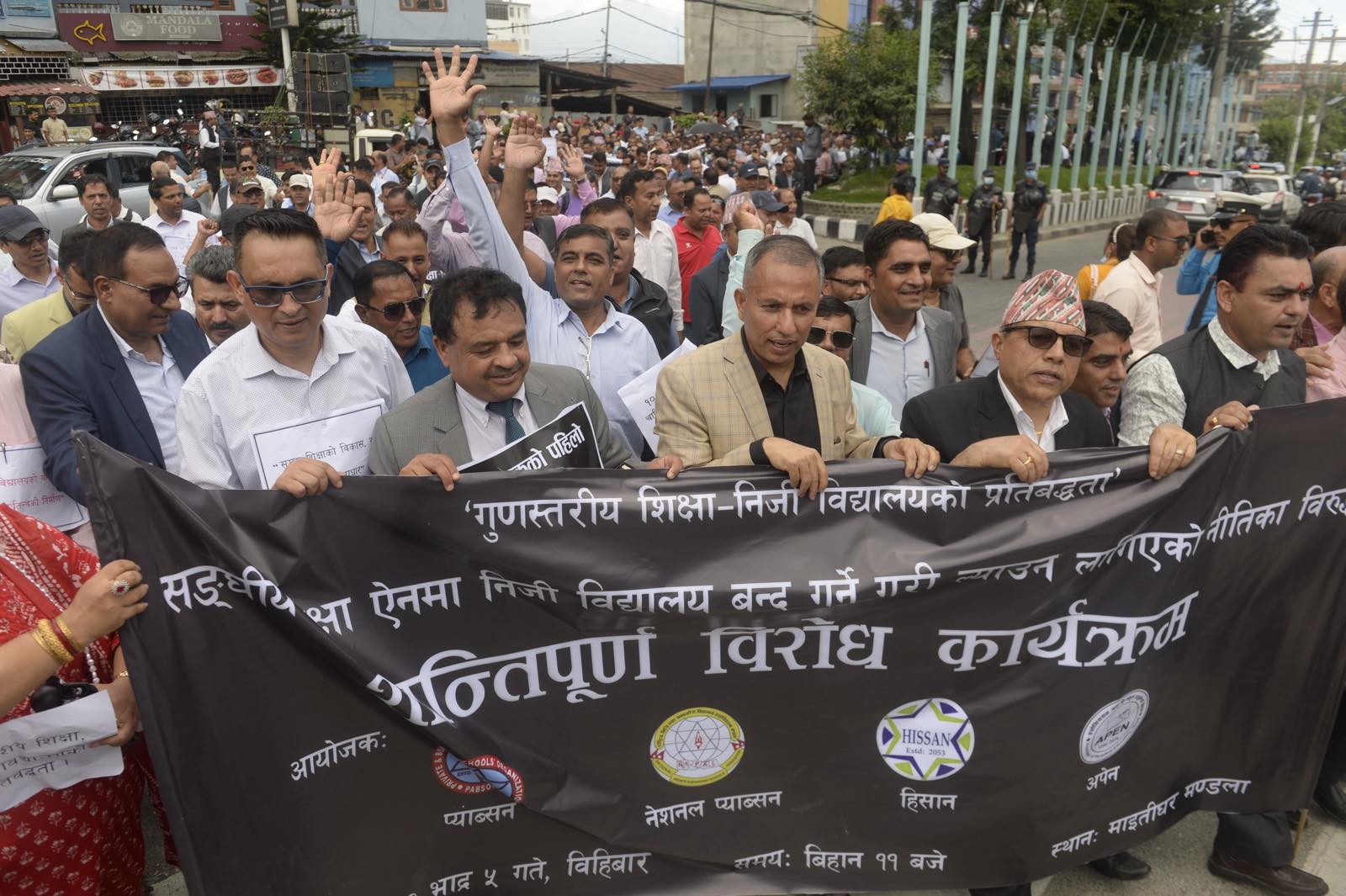
The organization has also threatened to form a struggle committee to launch protests from mid-July to pressure the government to revise some provisions in the directive. Issuing a declaration on the last day of its general assembly on Monday, the organization has put forward a demand to abolish the provision of guaranteeing 45 percent scholarships to the students from marginalized section of the society. [break]
“The students do not feel equal when some are paying the fees and others are not,” claimed DK Dhungana, general secretary of the PABSON.
Putting forward the 12 points demand to the government, the private school´s association has also demanded the cancellation of 1 percent tax to be paid by the schools.
In March, the PABSON core committee members had said that the private schools would not follow the guidelines that they say are against their business. PABSON General Secretary Dhungana has openly voiced his opposition to the limit on how much schools and colleges can spend on advertisements arguing that any organization registered with the Office of the Company Registrar can´t be restricted on ads.
“The government´s guideline does not prioritize quality education and is also harsh towards the child´s rights to education,” he claimed. “The private sector needs at least five years to create the infrastructure as described by the directive.” There are around 10,000 private schools in the country.
The directive calls for setting up of monitoring teams in each district to inspect the implementation of the guideline.
However, none of the district education offices have monitored the status of implementation.
Meanwhile, the government officials have said that the directive would not be amended for now. Director at the Department of Education (DoE) mentioned that the directive has addressed the problems of private schools. He added that the guideline would be amended giving more priority to guardians and students, if necessary.
Despite tall claims of the government, the authorities have failed so far to regulate the valley-based private schools. Though the District Education Office, Kathmandu had found six schools violating the provision related to admissions in the new session, no action has been taken against them. The office had directed schools to produce a written clarification for defying the guideline in April. But the office never followed it up with the schools again.
The PABSON, whose members were involved in drafting the guidelines, had participated in every discussion sessions organized by the MoE until the preparation of the final directive. The nine member committee that drafted the law included the director of the Department of Education, representatives of the Guardian Association of Nepal, student leaders, journalists, PABSON and N-PABSON. The directive came into effect on February 19 following the Supreme Court verdict to regulate the private institutions.
Related story
PABSON emphasizes keeping private schools within companies