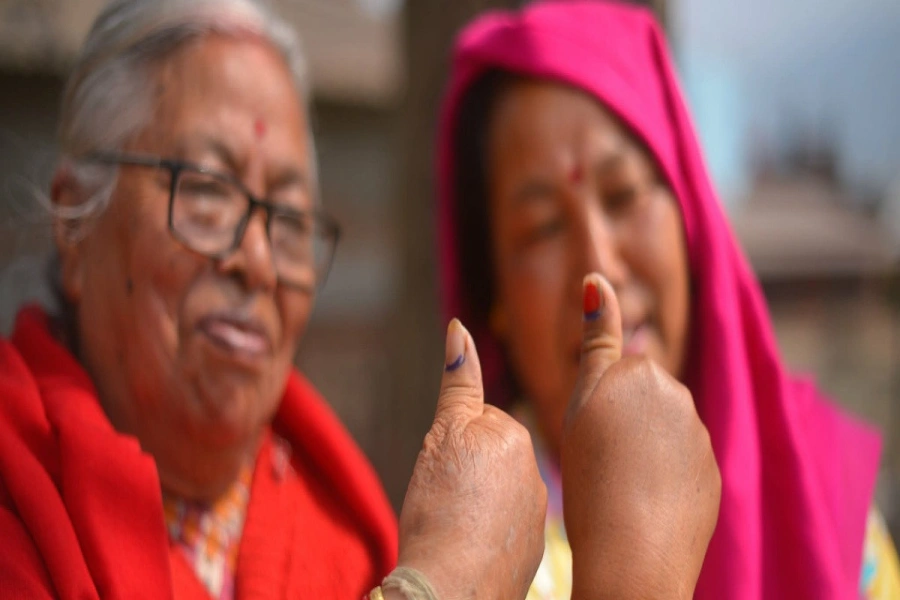
KATHMANDU, March 10: Nepalese politics has long been defined by division—sometimes along caste, sometimes region, and at other times religion. For decades, politics repeatedly fragmented society. But this election appears to have written a new, hopeful story—one of unity. Along with votes, the ballot box sent a clear message of national cohesion.
This election signaled a fresh way of connecting the country, linking the Himalayas, the hills, and the Terai into a single thread of unity. From the day of voting to the announcement of results, voters across Nepal sent a powerful message: decisions rising above identity-based politics are possible.
Take Tikapur in Kailali, for instance, a settlement dominated by the Chaudhary community. In previous elections, voting largely followed a predictable pattern—supporting candidates from their own community. This time, the pattern broke.
“We didn’t think we had to vote only for a Chaudhary this time,” said Pramila Chaudhary of Shaktinagar, Tikapur. “We voted for the candidate we thought was better, regardless of community.”
In Pramila’s place, Komal Gyawali of the Rastriya Swatantra Party (RSP) emerged victorious, defeating Janakaraj Chaudhary of the Nepali Congress (NC) and Ramlala Dangaura Tharu of the Nepali Communist Party (NCP). This result went beyond a single constituency—it was a social signal. Politics, long dictated by ethnic equations, seemed to be shifting. Tikapur, part of Kailali-1, has historically been a laboratory of identity politics.
Ballot boxes set on fire in Bajura

Factors such as the Tharu movement, political changes following the Tikapur incident, and the rise of Resham Chaudhary had made identity politics particularly influential here. This time, areas under Resham Chaudhary’s influence saw his allied parties fall to third and fourth places.
“The victory of a candidate from a hill community in this area is more than an electoral result; it signals a shift in social mentality,” said sociologist Bidur Lamichhane. “The country is moving beyond ethnic divisions. This election showed that the old mindset of ‘divide and rule’ must give way to uniting the nation.”
Pramila agreed. “In the past, we prioritized our own caste,” she said. “But this time, we changed our thinking.”
This trend was not limited to Kailali. In Bardiya, strong support from hill communities helped Thakur Singh Tharu lose, further signaling that voters are no longer deciding solely on ethnic identity.
Previously, ethnic representation was key. Today, voters are also valuing development, leadership, and alternative politics. “This election made us feel that all of Nepal won,” said Prakash Bist of Kageshwari Manohara-6. “In that sense, the country as a whole triumphed, more than any single party.”
A similar message came from Jitpur-Simara in Madhesh Province. “There were candidates from our community too,” said Naveen Adhikari. “But we voted rising above caste and religion.” From Bara-4, Rahabar Ansari won.
Madhesh politics, too, felt a shake-up. Regional parties, long rooted in the Madhesh movement, faced a major setback. Even in areas considered strongholds of Upendra Yadav, key figure of the movement, Madhesi parties appeared weak. In some places, analysts observed their influence wiped out collectively. From Birgunj, long seen as the heart of the Madhesh movement, Pradeep Yadav lost while Hari Pant of RSP won—a result that was not just a political defeat but a new message from Madhesi voters. Previously, Madheshi leaders had consistently won here.
Some argued that Balendra Shah won because he is the son of a Madhesi, but the public is not ready to accept that. Balendra himself clarified in a Janakpur speech: “Vote for a good person, not because he is Madheshi.”
“He won not because he is Madhesi; we wanted change,” said Rewant Chaudhary of Bakuliya, Bara. “That’s why we voted for a party different from the old ones.”
Similar trends were seen in rural Parsa, where caste-based voting had been the norm. In Tharu settlements, Chaudhary candidates lost, while candidates from the Shakya caste won. The results made the shift clear: voters are moving beyond narrow identity politics.
This change also appeared in Kathmandu Valley. In Patan, Lalitpur, home to a large Maharjan community, voters had traditionally supported candidates from their own community. This time, things changed. “Two candidates from our Maharjan community ran—one from UML and one from NC,” said Prabhat Byanjankar, met in an inner alley of Patan. “But we voted for Jagdish Kharel of RSP,” signaling his victory.
His statement highlights an important fact: even with candidates from their own community, voters chose someone else. This election signals a new political culture in Nepal. Voters are thinking beyond identity—but this shift did not happen overnight. Expanded education, social media influence, increasing youth participation, disappointment with traditional parties, and the rise of alternatives all contributed, according to sociologists.
Sociologist Pushkar Phuyal said this change is a significant signal. “For the first time, I have seen politics unite so much of society,” he said. “It is a positive message.” He added that as democracy matures, voter thinking evolves. “Previously, representative politics was necessary, but now voters value performance and ideas. This is a positive message for a civilized society.”
Looking at the results, one thing is clear: politics should no longer be a tool of division but a means of unity. Voters are showing change not only in slogans but in action. “This election has pushed Nepalese politics in a new direction,” said Prakash Bist. “If this trend continues, Nepal’s politics could become more inclusive and mature, and a political culture that unites the Himalayas, hills, and Terai could take root.”







-1784277548.webp)