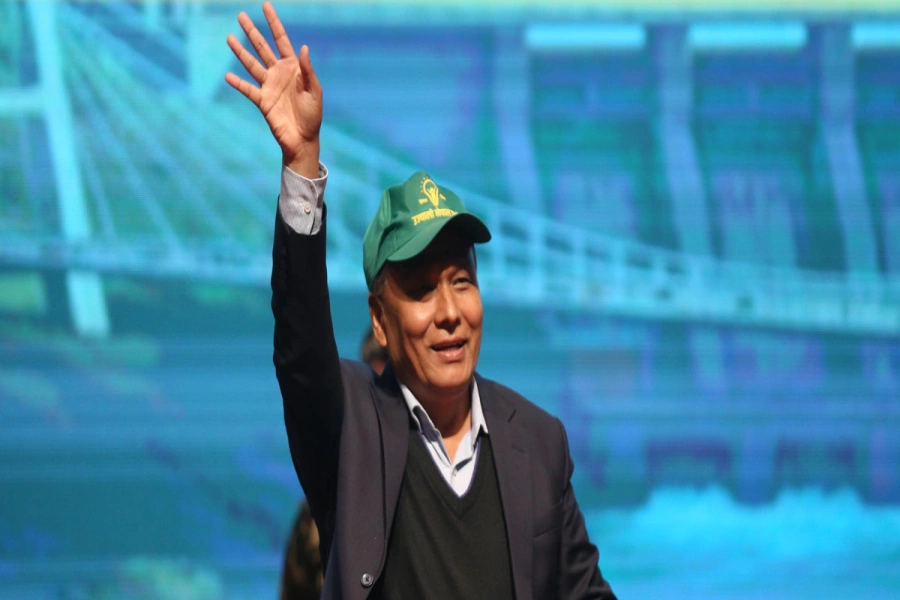
The parliament meeting on June 3, 2011 formed the special committee headed by Speaker Subas Nembang. [break]
The stricture for developing the birthplace of Gautam Buddha as an International Peace City by accomplishing the development plans envisioned in the Master Plan for Lumbini Development within a period of three years was endorsed by the House meeting on April 2, 2010.
However, not a single meeting of the committee has been convened since August 16, 2011. Prior to that, the committee had held three meetings.
Some of the members of the committee confide that the committee became ineffective mainly after the present government last year formed a parallel body on Lumbini headed by UCPN (Maoist) Chairman Pushpa Kamal Dahal.
Lawmaker Prakash Chandra Lohani of Rastriya Janashakti Party said the committee has become inactive for months. He said the previous governments did not allocate enough money in the annual budget.
“Moreover, the present government deliberately made the parliament-formed monitoring committee dysfunctional by forming a parallel body on Lumbini headed by the ruling party´s chairman,” Lohani told Republica. He said the Dahal-led committee has eclipsed parliament´s committee.
It is estimated that at least Rs 6 billion is required to accomplish the development activities as per the Master Plan, which was crafted by a famous Japanese architect Kenzo Tange. The speaker-headed committee last year pressed the government to allocate at least Rs 2 billion a year in the annual budget but the government earmarked only around Rs 110 million for the purpose.
Admitting that the committee has remained idle for months, Speaker Nembang said he is planning to activate the body to press the government to allocate adequate money in the annual budget. He claimed that it was the monitoring committee that compelled the previous government to incorporate the project in its policy and programs.
“But, later the government didn´t allocate enough money despite continuous pressure,” said Nembang. Nembang, however, didn´t buy the argument that it was due to the government´s move to form the Dahal-headed steering committee that rendered the parliament-formed special committee dysfunctional.
“We can, instead, summon ministers and government officials as well as the Dahal-headed committee and seek details of the activities undertaken and the progress it has made so far,” he said.
Officials at the parliament secretariat admit that the parliament-formed committee couldn´t work as per the gravity of the issue. “Parliament endorses strictures only on special cases and it should be dealt with accordingly. The concerned ministry should submit a periodic report on the matter to parliament,” said an official at the secretariat. “Unfortunately, the committee, which was formed to press the government, has itself been acting like a government.”
The special monitoring committee was formed after the government didn´t submit any report to parliament for around a year after the stricture was endorsed. “Now, who will monitor the monitoring committee?” said the official.
Last year, when a deal reportedly reached between the United Nation´s Industrial Development Organization (UNIDO) and the Asia Pacific Exchange and Cooperation Foundation (APECF) with regard to developing Lumbini as a religious and tourist center was dragged into controversy, the committee in its fourth and last meeting on August 16, 2011 sought details from then government. Then, the foreign ministry clarified to the committee that the government was completely unaware of any deal as such.
The committee headed by former Prime Minister Dahal, however, has stepped up its activities in the recent days. UN Secretary-General Ban Ki-moon is visiting Nepal at the invitation of Dahal, chairman of the government-formed High Level Steering Committee for the Development of Greater Lumbini.
Related story
Save Lumbini Struggle Committee calls for mobilizing income gen...