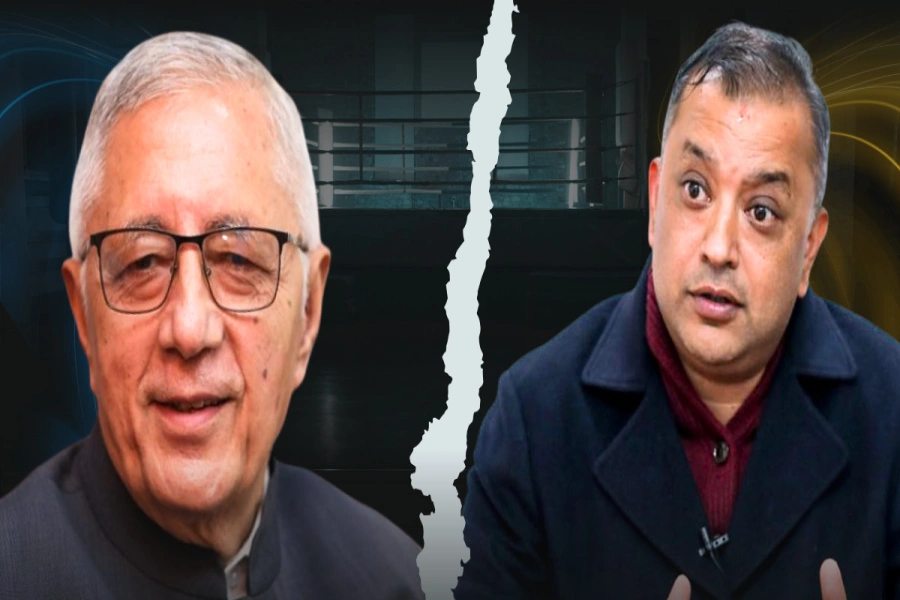
KATHMANDU, Jan 9: The Nepali Congress (NC) is heading into one of its most consequential internal showdowns in decades as rival factions lock horns over a proposed Special General Convention scheduled for January 11–12.
Tensions escalated on Wednesday after the Central Work Performance Committee (CWPC), dominated by the party’s establishment faction, formally urged members who had demanded the convention to withdraw their signatures.
On October 15 last year, 2,488 general convention representatives—around 54 percent of the total—submitted a petition to Acting NC President Purna Bahadur Khadka calling for a Special General Convention. The signature campaign gained momentum in the aftermath of the September 8–9 Gen Z-led protests that brought down the Oli government backed by the NC.
According to Article 17(2) of the party statute, a Special General Convention must be convened within three months if at least 40 percent of general convention delegates demand it. The statute also stipulates that 25 percent of delegates are required to file an impeachment motion against the party president.
Special general convention of the party will be held after elec...

The CWPC’s position was immediately challenged by General Secretary Gagan Thapa, who has emerged as the most prominent supporter of the convention. Speaking after the CWPC meeting, Thapa rejected claims that holding the convention would divide the party.
“What’s wrong with following the party statute?” Thapa asked. “Why would abiding by legal provisions split the party, and why are such rumors being deliberately spread?”
Thapa accused the establishment faction of opposing the convention for political, not legal, reasons. “They are trying to subdue us because our names have come forward in support of the Special General Convention,” he said, adding that the statute leaves no room for deferring or bypassing the convention once the legal threshold is met.
The pro-convention faction argues that the requirements of Article 17(2) have already been fulfilled, leaving the party leadership with no option but to proceed. “There is no turning back,” Thapa said, accusing the establishment of searching unsuccessfully for legal loopholes to avoid the convention.
The establishment camp, largely made up of senior leaders with long-standing influence, is accused by rivals of attempting to intimidate younger and second-tier leaders pushing for reform. The opposing camp is driven mainly by second-rung leaders and activists who argue the party needs urgent course correction, particularly in the wake of the Gen Z movement.
The internal rift has also spilled onto social media, with both factions circulating videos and statements. Seven provincial presidents—many aligned with the establishment—have publicly urged party cadres not to participate in the Special General Convention.
Senior leader Dr Shekhar Koirala, long regarded as a key swing figure within the party, has recently signalled his alignment with the establishment’s position.
Despite these calls for restraint, preparations for the convention are moving ahead. Buses bearing banners in support of the Special General Convention have begun departing from districts across the country, while Kathmandu’s Bhrikuti Mandap has already been booked as the venue. Organisers claim more than 1,500 hotel rooms have been reserved for delegates, arguing that the scale of logistical preparations makes cancellation impossible.
“There is no going back,” leaders of the signature campaign have repeatedly said, describing the convention as both a legal obligation and a political inevitability.
However, differences are also emerging within the pro-convention camp over the convention’s objectives. While one group favors a policy-focused gathering aimed at ideological clarity and organizational reform, another insists it should be a full-fledged convention centered on leadership change.
Guru Raj Ghimire, one of the initiators of the signature campaign, has been explicit. “The main purpose of the Special General Convention is to change the leadership,” he said, arguing that the party must respect the will of its voters and cadres.





-1200x560-1774606010.webp)
-1200x560-1783685616.webp)