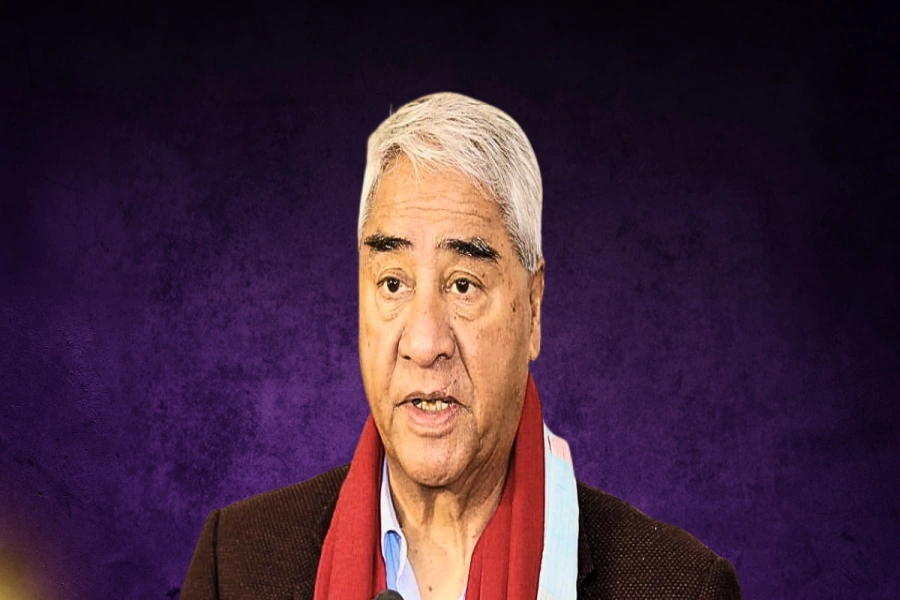
Prime Minister, you had argued last year that forming a consensus government had become essential to save the country from plunging into a deep political crisis, but you have failed to even give full shape to your two-party coalition government even three months after you were elected to the post of prime minister, let alone forge such a consensus. How do you explain this?
The need of national consensus is the objective reality of the country. We can’t forge consensus on each and every issue. We need to reach consensus at least on the major and basic points of the national agenda. At present, we need consensus primarily on concluding the tasks of constitution writing and the peace process. Delivering peace and constitution is not possible without consensus among the parties. I have been concentrating all my efforts to forge consensus ever since I was elected prime minister, and I will work continuously for that.
But people have already started to term this government a failure as it has not been given full shape even after three months. What do you say?
We can’t imagine this government failing. The two-party [Maoist-UML] agreement itself is enough for the government. But we want to broaden it. We are working actively for that. We are committed on forging consensus even if it takes months more.
But the two-party agreement itself has been controversial and even the Maoists have shown their dissatisfaction, saying that the agreement has not been implemented sincerely. What do you say?
The seven-point agreement is a milestone. We have to clarify the main spirit of the deal. The main thrust of the agreement was to take the peace process to a logical conclusion. We have to be committed to that. Secondly, the agreement accepts that the country will be pushed to a serious crisis if we can’t promulgate a new constitution. Therefore, we have to frame a new constitution as soon as possible. Thirdly, we have to make the people feel real change as per their aspirations. Similarly, the agreement is committed to strengthening national independence, sovereignty and integrity. There is no dispute between the two parties over implementing these four points.

Though you hail it as a milestone, the agreement process was not transparent and it was kept secret afterward. Both you and the Maoist chairman didn’t inform even parliament about this agreement. It is argued that the problem started with the 7-point agreement.
At some special junctures in history, leaders have to take some bold and risky decisions. They shouldn’t shy away from taking new initiatives. It was not an agreement signed clandestinely, to be shelved in a box indefinitely. It was signed with a plan to implement it in broad daylight. There were some natural ways to bring it out. But there was lack of time to hold enough discussions and reach consensus over such issues. We seldom reach such decisions. We have to be ready to face some disputes after making such moves. Some questions were raised about the deal. And later, we clarified them through a joint statement. We also held discussions at our [UML] central committee meetings. The party has already endorsed it. Therefore, disputes over the deal are already a closed chapter. Now, we have to be forward looking. We are moving ahead as per that same agreement. The deal has not barred any other political party from working together with us. There is no relevance to allegations that the deal only paved the way for left polarization.
What is the main reason behind delay in appointing a home minister despite the fact that the country is facing a serious law and order situation?
At present, the issue of concluding the peace process and constitution writing is more important than the law and order issue. Though we can’t understate the importance of maintaining law and order, we have to concentrate our efforts on delivering peace and constitution.
If law and order is not your priority but peace and constitution is, what progress have you made so far in the peace process and constitution writing?
We can make progress in delivering peace and the constitution in consensus. The special committee is actively working in connection with advancing the peace process.
But even the special committee is not meeting regularly?
No it is working. We have taken decisions in connection with looking after the Maoist combatants after the exit of UNMIN. We have mobilized necessary human resources in the cantonments.
They have already started work at the sites. We have also formed a taskforce to address various issues including setting the integration modality, norms and standards, fixing the number of former combatants to be integrated into the security agencies, preparing a rehabilitation package and coming up with a calendar of events to accomplish the remaining tasks. The taskforce is at work. It is true that the work is slow but it is the responsibility of the political parties to support the taskforce.
Immediately after you became prime minister you and Dahal had announced you would come up with a 50-day plan of action on PLA integration and rehabilitation. You have so far not been able to bring out the action plan even though the CA term is expiring in a month. Don’t you think the government has wasted much time?
At present, all major as well as smaller political parties in Nepal are seriously undermined by deep intra-party feuds. We can see various reasons behind that. We are seeing the transitional stage being reflected in the major political parties as well. They are having serious problems. It is also one of the major reasons why we are failing to achieve satisfactory progress in the peace process. But lately we have seen some indications of movement toward resolving these problems. We are in a situation of overcoming the difficulties and moving ahead in a new manner. I am hopeful that we will soon be able to find common ground for fixing the modality and standards for integration. Once we settle these issues, the peace process will take on momentum.
What major achievements do you think there will be in connection with concluding the peace process and constitution writing before the CA term expires on May 28.
I am optimistic that the peace process will see important achievements. On the constitution writing front, three issues are crucial. With intensive talks underway, I am hopeful of finding a solution to the form of governance and the political parties are very near to consensus in determining the electoral model as well. The third and most sensitive issue is state restructuring. It will take more time. By May 28, we have to determine the form of governance and electoral model and we have to at least come up with a concrete vision for settling the state restructuring issue. Once we do these three things, we can come up with the first integrated draft of the new constitution by May 28.
Do you agree that your government will lose its legitimacy if it fails to make significant progress on peace process and constitution writing by May 28?
The legitimacy of the government is based on how we formed the government. Ours is an unwavering commitment to the objectives and the spirit that we had during the time of government formation. Whether there is significant progress before May 28 or failure in this regard will definitely make a difference to the government. I believe that we will make some progress by then. Let’s believe in the brighter side.
Don’t you think the government will become irrelevant if it fails to make significant progress by May 28?
I won’t say so at present. The issue depends on the agreement among the political parties. Many things depend on such agreements. Government formation can be possible even through a simple majority in parliament. And it can be done by forging a broader national consensus as well. Therefore, no constitutional question can be raised against the government. It might be necessity to think about it at a political level.
Maoist Chairman Dahal at his party’s central committee meeting has reportedly come up with a view against giving continuity to the current coalition. What is you opinion?
–– I don’t have such information. The information I have is, they are for further broadening the two-party coalition. I am optimistic that the conclusion the Maoist meet will draw will further strengthen the government.
What would be the new political course if the Maoist meeting comes up with a conclusion that there is a need for national consensus government and decides to hold dialogues with other parties including the main opposition NC?
–– There is no need to draw a new conclusion for that, because the seven-point agreement and the joint statement [issued later by the prime minister and Dahal] have clearly pointed out the need for cooperation among the democratic and republican forces. We are not for polarization but for accommodating more political parties. Therefore, we are open toward incorporating the Nepali Congress and other parties in our coalition.
But the NC has clearly said that there will be no talks without first scrapping the seven-point deal.
–– I have many a time clarified them about the seven-point deal and urged them to leave it and move ahead forging a new agreement. There is no need to take the seven-point deal as an obstruction. It is not against any political party.
The gist of Dahal’s political paper has emphasized on the need for cooperation between the Maoists and the NC to resolve the current political crisis? What do you think?
It is very essential to hold dialogues between the Maoists and NC. They have to hold discussions and come up with some concrete ideas on some major issues. But, all the problems in this country are not going to be solved through cooperation between the Maoist and NC. They have to understand it. The need of the hour is cooperation among the major parties for peace and constitution. It is certain that the country can get a new constitution once the major parties work together.
But with the May 28 deadline approaching you have time constraints as well.
May 28 deadline is definitely a challenge before us. We have to resolve the problem through consensus.
What do you expect from the Maoist CC meeting in terms of peace and constitution?
Maoists will come up with a new agreement with regard to taking the peace process to a logical conclusion. They may develop a new concept to this effect and that will eventually create an environment conducive for forging a national consensus. The more flexible they are, the easier would be the task of forging consensus.
Lately, your government is reportedly not receiving wholehearted support from Dahal. For instance, he has not nominated new Maoist leaders to be inducted in your cabinet. Do you agree?
I don’t think so. They also have internal problems in the party. They are busy settling the intra-party row. I wish them the best to be able to settle their internal problems at the earliest.
How do you describe the challenges and opportunities facing your government in comparison to that of your predecessor Madhav Nepal-government?
We have a host of challenges and immense opportunities as well. If I fail to solve the problems, the new government will face bigger challenges. Therefore, this will be the last government to accomplish the tasks of concluding the peace process and writing the new constitution. We have to focus on delivering peace and constitution. Otherwise, the country will encounter a new crisis.
Do you mean the next government will oversee the election?
Once we deliver peace and constitution, the country will definitely enter a new stage. In such a changed context, the political parties can move ahead in a new way.
Tomorrow [Sunday] is Democracy Day. Do you have any message for the nation?
I call upon all the political parties to stand united to ensure success of peace and constitution making process and to institutionalize the achievements of the people’s movement.
Related story
Govt forms committee to solve payment problem of sugarcane farm...