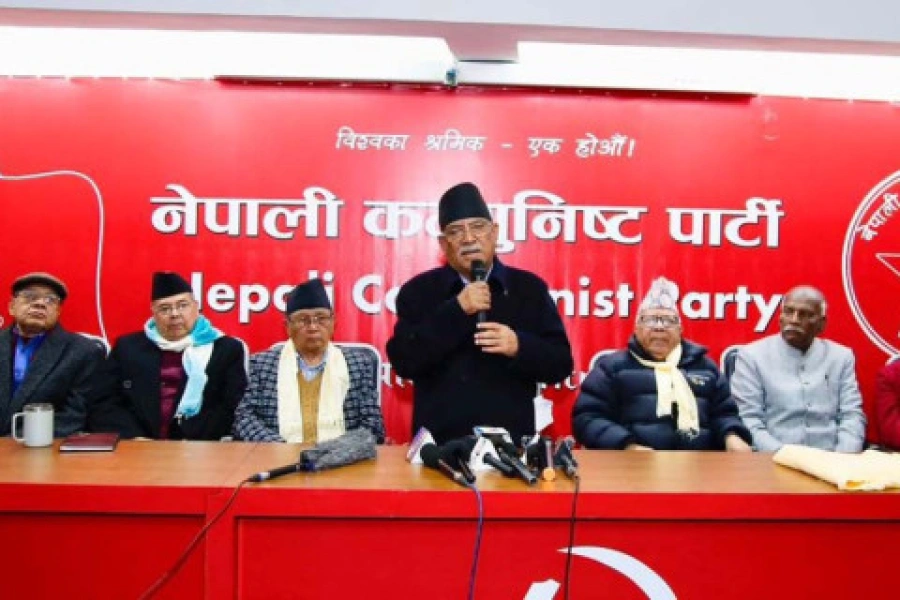
It is widely believed that the diplomatic community in Nepal played a crucial role in formation of the CJ-led government, even though the modality of such a government was initially proposed by Maoist supremo Prachanda during the last Maoist General Convention. The diplomatic community seemed to be testing an abstract philosophy with the formation of such an unlikely government in a young democracy in prolonged political transition. [break]
Why did the international community encourage four major political forces to form a government combining the CJ and former bureaucrats instead of political personalities? What were their underlying assumptions? And if the international community in Nepal was instrumental in formation of the CJ-led election government, doesn’t it also have the responsibility to ensure that new CA election is held on the stipulated date with the participation of all political parties?

Voter turnout will eventually show how enthusiastic people are about the second CA election. Many factors such as emergence of new parties, pre-election campaigns launched by major political parties including the royalists, expression of support by the international community for the electoral process, and enthusiasm about election among urban population suggest a vast majority are in favor of election. Contentious issues like PR threshold, delimitation of constituency, and electoral law are near resolution. The only obstruction seems to be the anti-election campaign launched by CPN-Maoist which has vowed to actively disrupt polls.
Who could convince CPN-Maoist to join the electoral process? Multiple rounds of fruitless negotiations hint that none of the domestic forces has the capacity to convince the radical Maoist party. CPN-Maoist does not trust any of the mainstream political parties: their political contradictions with UCPN (Maoist) remain unresolved and they simply don’t trust Nepali Congress, CPN-UML and Madheshi Morcha.
The current government cannot convince CPN-Maoist because the dash-Maoists, from the very beginning, have been against the CJ-led government, which they believe is unconstitutional and has been formed under the grand design of foreign forces. Civil society organizations also do not have the requisite persuasive capabilities because there is no strong, trustworthy relationship between the mainstream civil society and CPN-Maoist leaders. The dash-Maoists also don’t have the trust of civil society organizations. An independent pro-election people’s advocacy group could force CPN-Maoist to take part in upcoming election; unfortunately no such group exists in Nepal.
That leaves us with only two options to sell upcoming election to CPN-Maoist. First option would be fulfillment of most CPN-Maoist demands, expect the dissolution of current government. This seems unlikely. In that case, there is still one last hope to bring CPN-Maoist into the electoral process: proactive international intervention. Formal and informal third-party interventions in armed conflicts and political crisis are common around the world.
Nepal cannot be an exception at a time it has been suffering from a deep political crisis. In this regard, international community can act as an informal third-party mediator to break the current political stalemate. International actors, particularly China, have the capacity to persuade CPN-Maoist to get involved in electoral process. Notably, China is the only external actor which enjoys good relationship with CPN-Maoist.
There were recent reports that Congress Chairman Sushil Koirala had requested the Chinese Ambassador to Nepal to convince CPN-Maoist to come into election fold. Some analysts believe his request is against national sovereignty. But there is nothing wrong in seeking foreign support if key domestic political actors are incapable of breaking the political deadlock.
Nepali political leaders had asked and got support from India and other international actors during the signing of the 12-point agreement, and the following People’s Movement in 2006. Why not ask for issue specific support from international actors one more time in order to hold CA election on schedule? Nepal has asked for logistics and moral support from the international community to hold CA election. Why can’t international community’s support be sought to include CPN-Maoist in the proposed election, the only way out of the current political deadlock? More than that, if high-profile leaders can visit India to seek its advice on the future of Nepali politics, what is the harm in asking for specific help to actually solve something more tangible?
Nepal, as a conflict-prone country, cannot afford to remain in status quo for long. A positive intervention of international community is an utmost need when domestic actors are repeatedly failing to find creative and timely solution to the current political conflict. In this context, the role of China seems relevant in order to get CPN-Maoist ready for proposed CA election. Likewise, other international community members can also play third-party roles to make sure there is no space for CPN-Maoist to boycott election. International community should also be involved in election observation to make it free, fair and fear-less. Since CPN-Maoist has often expressed its concern about the fairness of election, such a collective assurance from the international community could convince them to participate.
The international community is the guarantor of electoral processes during political transition. Since Nepal is also in transition, and second round of CA election has been proposed to end the same, the international community can help make the process fair and participatory. CPN-Maoist has been claiming that this government was formed as per the grand design of foreign forces. In this context, dialogue is essential between the diplomatic community and CPN-Maoist. It will help both parties understand the context of formation of this government and resolve other contentious issues regarding active foreign intervention. If international community can engage in dialogue with other domestic political forces, why not do the same with CPN-Maoist?
If the present government has indeed been a creative idea of domestic forces, the international community should issue a white paper that they had no role in it. Such an action will delegitimize the popular claim made by CPN-Maoist that this government is formed under the grand design of foreign forces. It will put moral pressure on CPN-Maoist to stop making excuses not to participate in CA election. Another popular claim of CPN-Maoist relates to national ownership of government.
International actors that were active during the time of CJ led government formation process should take initiative for dialogue and convince CPN-Maoist that the government is under national ownership. If international community cannot play a constructive role at this critical juncture, they will be considered a failure, just like the domestic political forces.
The author is a PhD
candidate in Peace and Conflict Studies at
University of Otago,
Dunedin, New Zealand
prakash.bhattarai@gmail.com
Related story
Labour ministry to launch ‘Help to Help 10 Cell’