“It’s a misconception of many people that only those who have studied about environment and work in this field have the responsibility of conserving it,” says Barsha Parajuli, Vice President of Safe Environment Nepal – Youth for Conservation (SEN-Y4C). A non-profit organization led by women, SEN-Y4C has been dedicated to working for the conservation of environment and different environmental issues since 2008. As Barsha says, each person has responsibility towards the environment.
On December 6, SEN-Y4C held its National Youth Forum on Green Solutions, a conference that lasted for three days. Supported by International Center for Integrated Mountain Development (ICIMOD) under its Youth for Sustainable Mountain Development (Y4SMD) initiative and Eco-Friends Nepal, its main objectives were to create national-level awareness amongst the youth on green economy, establish a youth network, and motivate young people to contribute to green economy. Around 40 young people from diverse backgrounds participated in the event.
Green economy in Nepal is very slowly on the rise. Not through any major work being done, but through the increasing level of awareness and involvement of the youth.
Ujjwal Tiwari, 24, is currently pursuing his Master’s in Environmental Science from the College of Applied Sciences. Working as a program co-coordinator for Eco-Friends Nepal, Ujjwal is also a board member of Bagdole Youth Club where he heads its environment department.
“Before the conference, I had mostly theoretical knowledge about green economy. I didn’t know exactly what kind of practices had been conducted in Nepal, apart from community biogas plants around the Valley,” he says.
The conference was a good learning platform for him. He cites that learning about the various kinds of green economy activities conducted all over Nepal was very interesting. “I came to know about different agricultural practices without using any kind of chemical fertilizers. I learnt so much more about vermicomposting,” he shares.
Similarly, Diwas Panta says that he emerged from the conference with new ideas and much more information. At 27, Diwas has a Master’s degree in Environmental Science.
“One of the interesting new things I learnt was that to sustain green economy, technological advancement and nomadic concepts should be merged,” he points out. Solar, hydro and wind power can be used to greater success and effectiveness.
He is currently involved in finding out eco-friendly adaptation measures and he says that most importantly, changes have to start from the household level. He shares, “Mitigation from household level is needed, with small simple steps like oxidation pond. Why don’t we collect household waste and create a pond with free air flow where we can dump them? Water scarcity can be dealt with the help of plastic pond. Dig a pond, and to stop the infiltration of water, spread a sheet of plastic over it and collect rainwater there.”
Districts like Kavre, Ramechhap, Nuwakot and Rasuwa, where water scarcity hits hard, have the optimum use of plastic pond.
According to Ujjwal, who visited Bhakundebesi in Kavre district last year, the residents married off frogs with the belief that it would rain. Of course that didn’t work, so they’ve started using plastic ponds where they collect rainwater during monsoons and use it during the dry season for irrigation.
Like the golden words of Kathmandu Municipality’s solid waste management scheme, ‘Fohor bata mohor banau,’ (Rubbish into Rupees) using your household’s waste to generate income is a great idea. Diwas cites an example where a lady managed to invest in a pair of gold earrings with the money. Namrata Khanal, 23, is also a firm believer in the virtues of solid waste management. “The fact that earthworms are so fruitful was new to me,” she says of the concept of vermicompost.
For Kanchan Upadhyay, rainwater harvesting and solid waste management were some of the things that struck her. The 20-year-old is a student of Bachelor’s of Science in Botany at Tri-Chandra College. “Now I’ve told everyone at home about solid waste management and we’ve started practicing it. I’ve also talked to them about rainwater harvesting and maybe we could also work on it.”
The Bagdole Youth Club members are already managing the solid waste of their community. “We’re telling people to manage organic waste at home while giving away plastic wastage,” says Ujjwal. The club will soon be installing around 12 community dustbins to control dirt on their streets.
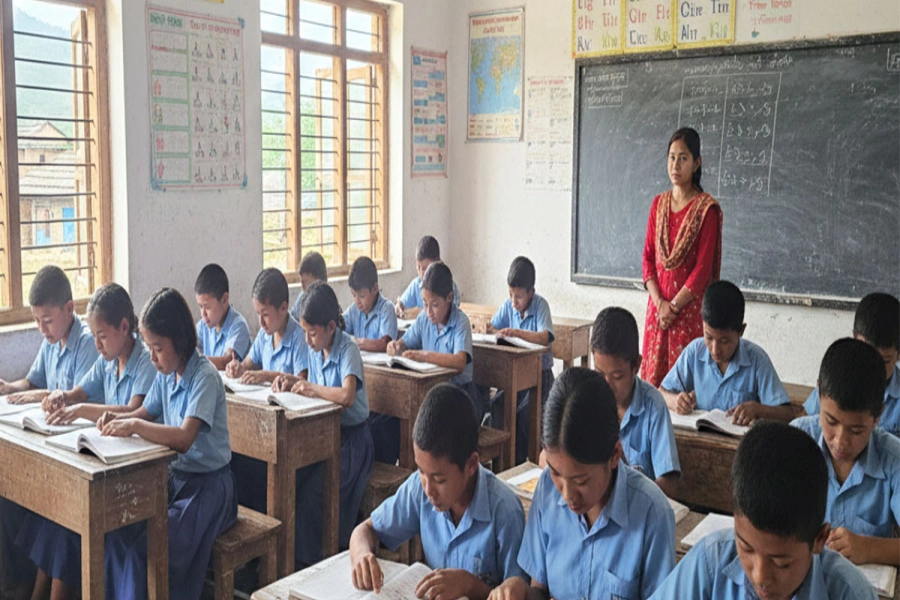
To raise awareness, most schools have Eco Clubs. However, there is no active participation or any activity being done in many such clubs. ICIMOD and Environmental Camps for Conservation Awareness (ECCA) have started the concept of Eco schools. In an Eco school, the entire student body is involved in environment conservation. They are taught and are involved in organic compost creation and also maintain school gardens with that compost. Vegetables are grown in the gardens.
Yogendra Chitrakar, Director of ECCA, informed, “We have 12 Eco Schools in Lalitpur, among which are Yashodhara Bauddha Higher Secondary School, Lalit Kalyan Kendra Lower Secondary School, and Prabhat Higher Secondary School. We have five indicators through which we monitor Eco Schools: water, toilet, nature club, school-parent relationship, and greenery.”
Schoolchildren have the potential to be the best ambassadors of green economy. Teaching them about the significance of green economy can be truly helpful for everyone in the long run. A school student is more likely to share new information with parents and other family members; hence, disseminating knowledge in their own way better than a college student. Diwas agrees with this, claiming that an adult is more often only sharing ideas and information with peers than with family members.
Ujjwal opines, “We are totally dependent on fossil-based economy at present, and it’s not possible to switch from it to green economy quickly. But we could just begin by taking small steps.”
Talking about the changes in the last couple of years, Barsha also sounds positive: “Awareness is definitely on the rise. We know now that even small steps are effective. But while implementation has a lot to be desired, it’s still going in a progressive direction.”
Related story
Growing a Green Economy