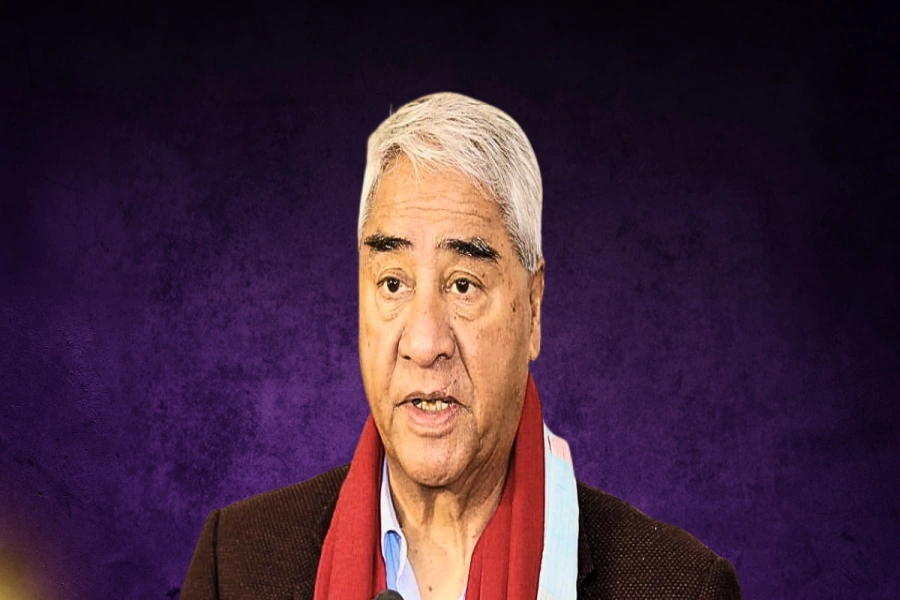
Born in Dhankuta in 1936, he first came to Kathmandu in 1961. [break]
He went to Banaras and Allahabad after completing his high school and then came to Kathmandu where he completed his Bachelor’s degree in Law and MA in English literature from Tribhuwan University (TU).
He started his career as a journalist in1962 as an editor-cum-reporter for Rastriya Samachar Samiti (RSS). He, later, worked there as an acting general manager for two-and-a-half years.
After receiving his first fellowship from UNESCO, he went to Cardiff, Britain, to do his five-month-long diploma in journalism at Thompson Foundation. His career moved on an upward trajectory when he got the opportunity to work as an intern at the editorial department of Agence France Presse (AFP) based in Paris.
He also completed a course on editorial from Tokyo and a course in development communications from Hawaii. His wide exposure abroad has helped him hone journalism skills.

“When I was shifted from RSS to The Rising Nepal, I was put to test; I was asked by the Ministry to prepare a feature article which got approved and then I was selected as the chief editor. I was constantly put into rigorous test every time,” he recalls.
Explaining why he has respect for this field, he explains, “Journalists are put to test at all times. Moreover, at that time, no favoritism was shown so we needed no sources, no push and pull strategy, which is why I have high regards for this field.”
He worked for The Rising Nepal for six years, until 1973, and then got appointed as associate editor and also the chief editor of Gorkhapatra. Pokhrel’s fluency and command in both English and Nepali made him a versatilie journalist. “I got exposure in various fields that enhanced my professional capabilities,” he says. In 1991, he voluntarily retired but still continues to contribute to the field.
Things, however, were different when he was a journalist back then. Working as a journalist during the Panchayat era was not an easy task due to the curtailment of freedom of expression.
“We were the only official print media but were not allowed to write anything against the state and the government. We were put to rigorous discipline,” he says.
He recalls one incident from 2039 BS when he was working as the editor of Gorkhapatra. “We knew BP Koirala was about to die, so one month before that we had to draw up a scenario and make a draft news story of what would happen.
That story was sent to the Royal Palace where they wanted us to put in a reference to an incident which was not favorable to Koirala’s image,” he explains.
He further adds, “We were asked to mention the agreement made by BP Koirala for the Gandak project with India. The Palace wanted us to publish that because it was opposed by Nepali people at that time.”
“But we refused to put that reference in our text. We opposed and we ultimately prevailed. The Palace asked us to do so three times but we denied. The reference would not have suited the context,” explains Pokhrel.
“We had the audacity to oppose the palace because professional integrity mattered to us,” he adds.
“But Journalists today are free from fears and have democracy,” he says. He, however, laments the lack of professionalism in the field of journalism and says there are more ‘namesake’ journalists nowadays.
“These days, everyone wants to have their job title as journalists, both as an image and social status, but simply getting a title isn’t enough to earn that image.
One should have the required skills for the job. Journalists should have other qualities too, such as politeness, dignity, good behavior in the society and that they need to exhibit exemplary character,” he explains.
Taking about the entertainment aspects of those days, he recalls, “We belonged to the lower middle class and juggling between job and study was difficult. We also didn’t have time for other hobbies. We were subjected to all sorts of rules.”
He then adds, “Since I lived in Dhankuta village we had to do different chores like tending cows, cooking meals and running various errands. Compared to our times, there are many schools now.”
“Since I studied a diverse range of subjects, it gave me the stamp on my career building. The interdisciplinary field of studies helped me a lot in my journalism career,” he says.
He further says that youth now have many opportunities but they don’t read much. The ‘elemental’ thing that makes them, which is an important part, is still missing, he says. We also see hypocrisy and flaws in their characters as well and they don’t show their actual self.
He founded the Nepal Press Institute (NPI), a private training institute that provides one year diploma course in Journalism, in 1984.
He explains how in his time he was fortunate enough to get exposure abroad but not everyone has this opportunity. “I founded this institute to enable young Nepali aspirants to get training in journalism. I was in this field for so long so I founded this institute as a gift,” he says. He retired from NPI in 2009.
Pokhrel further stresses that to be a professional journalist, he or she should be a model of decency, cultivate good manners and have high integrity in society. Apart from these qualities, they should have writing skills and should not brag about their profession.
“A professional journalist should also stray himself/herself away from partisan influences so that he/she can detect the flaws and defects,” he adds.
In Nepal, we still need to provide trainings, right kind of academic environment and increase the quality of contents and standard of what is being taught to journalists. “What we need for young journalists today is integrity to the profession and specialization,” he adds.
Related story
Veteran journalist Gokul Pokharel no more