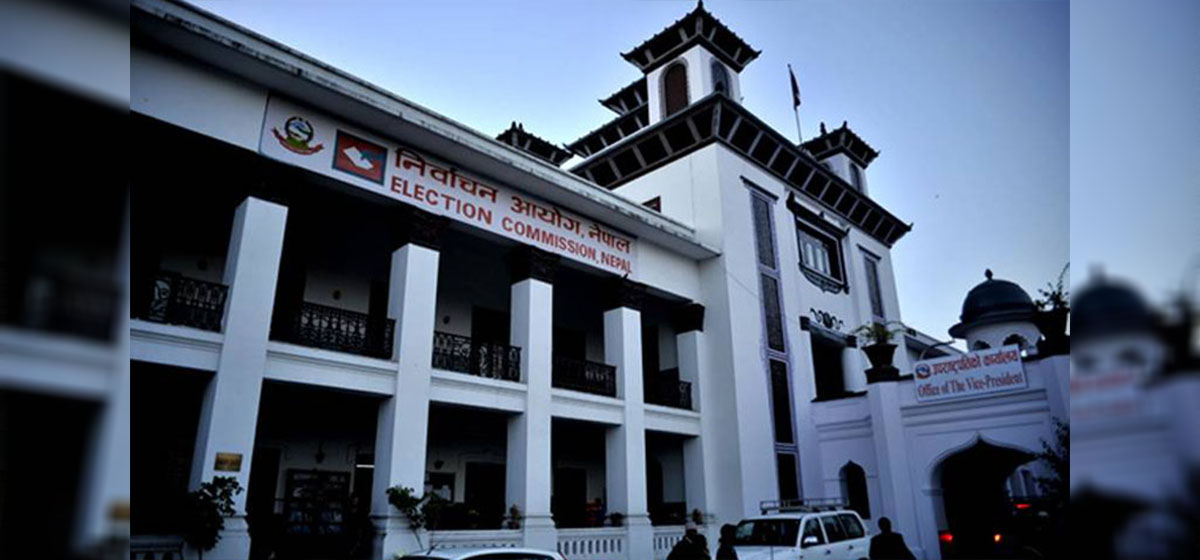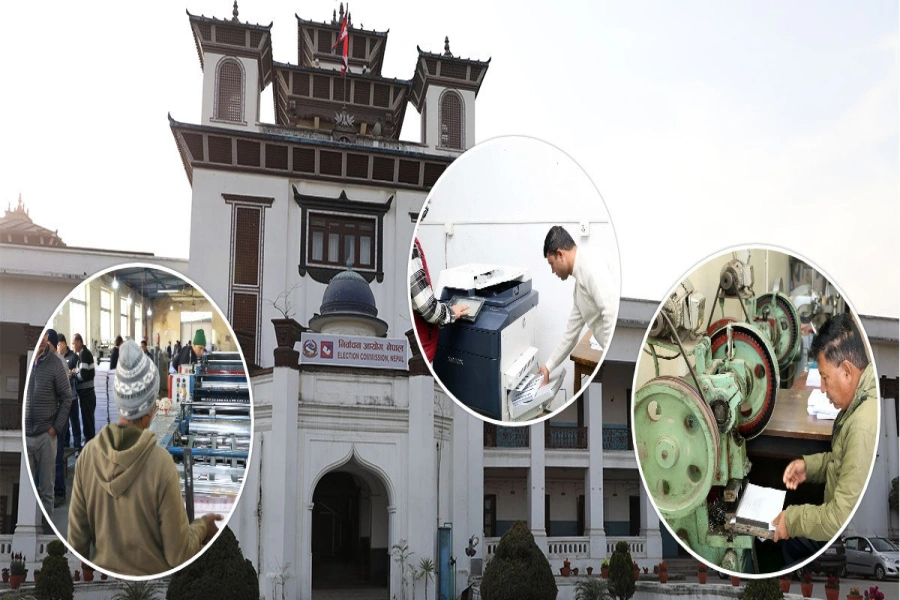
KATHMANDU, Jan 11: The Election Commission (EC) has claimed to have completed preparations for the upcoming House of Representatives election, scheduled for March 5, including the appointment of chief and district election officers, printing of sample ballots, and coordination with social media platforms.
Speaking to the media, EC spokesperson Narayan Bhattarai said the commission had finalized all essential pre-election arrangements. “Sample ballots and voter lists have been printed, chief and district election officers have been appointed, and orientation programmes for election officials have been completed,” he said. He added that the EC has verified the closed lists of candidates submitted under the proportional representation system and communicated its findings to the political parties concerned.
Bhattarai also said the commission has held meetings of the Election Code of Conduct Monitoring Committee, ensured coordination with provincial and local governments, and engaged social media platforms for election-related information dissemination and oversight.
Appointment of election officers
In line with Article 8 of the House of Representatives Election Act, 2074 BS, and on the recommendation of the Judicial Council, the EC has appointed 77 district judges as chief election officers. Similarly, 88 second-class officers of the Nepal Judicial Service, recommended by the Judicial Service Commission, have been appointed as district election officers. The appointments took effect on January 9.
EC completes preparations for upper house election

Assistant spokesperson Kul Bahadur GC said the appointed officials will undergo orientation training on January 12 and 13 before assuming their duties at their respective election offices from January 15. “The orientation programmes will be held in Kathmandu, Chitwan, Biratnagar and Nepalgunj. Master trainers were prepared on January 6 and 7,” he said.
The training covers constitutional and legal provisions, election programme management, information and technology systems, voter education, monitoring of the election code of conduct, election observation, voting, vote counting and reporting procedures.
Sample ballots and voter lists
For voter education and preparation, the EC has printed 10 million sample ballots for both direct and proportional representation elections. Sample ballots for the proportional representation system are printed in black ink on white paper, while ballots for the direct election use red ink.
The commission has printed voter lists for 26 districts, while printing of proportional representation ballots began on Sunday. These ballots carry 58 election symbols representing 64 political parties. Based on the number of voters, the EC plans to print around 20 million proportional representation ballots.
Verification of candidate lists
The EC has reviewed the closed lists submitted by political parties for the proportional representation system and found several discrepancies, including duplicate names, ineligible candidates, mismatched personal details, missing citizenship certificates, absence of voter list references and inconsistencies in the inclusion of marginalised groups. The commission has given political parties seven days to correct and resubmit the documents.
Code of conduct monitoring and coordination
The Central Code of Conduct Monitoring Committee met on January 5, 2026, to discuss effective implementation of the election code. The meeting identified potential challenges and proposed solutions, stressing the need for awareness campaigns, punitive measures and coordination with social media platforms to curb misinformation and misuse of technology.
On the same day, the EC also held a meeting with chief secretaries and internal affairs secretaries from all seven provinces. Discussions focused on code of conduct enforcement, voter education, election security, human resource management and intergovernmental coordination. Provincial representatives assured the commission of full cooperation to ensure a smooth election process.
Engagement with social media platforms
To prevent the spread of misinformation, disinformation, defamatory content and other illegal activities during the election period, the EC has engaged with social media platforms including Meta, TikTok and X. The commission has deployed social media monitoring software and assigned a dedicated unit to disseminate verified information and coordinate responses to unlawful online content.