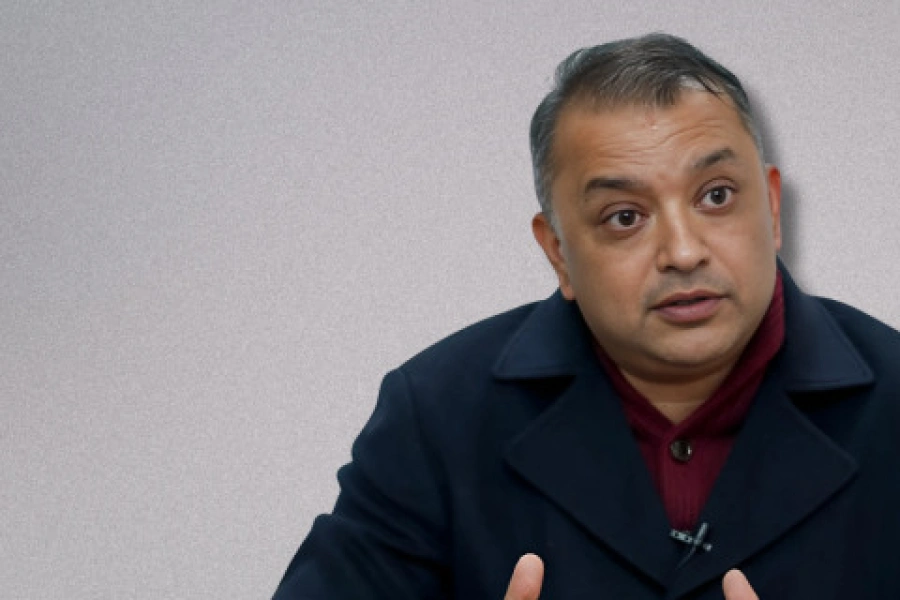
His solo works, Rato Mato, a folk-fusion album and Adhunique, an EP, explore Nepali folk compositions. His covers of timeless Nepali folk songs in Rato Mato were highly appreciated by the audiences in Nepal and the United States alike.[break]
The Week’s Asmita Manandhar met Gurung, currently based in Ithaca, New York, over Skype to know more about his present ventures.
What are you involved in these days?
It’s been 8-9 months since Ayurveda broke up. Now I’m in a band called Photoreal. The band has three of Ayurveda’s members – Dan Halperin, Mike Parker, and me.
How was your experience of forming Ayurveda and making music influenced by Nepali folksongs?
It was a rock metal band when we started. Eventually, we made music that sounded more like progressive rock and it was after I recorded Rato Mato, Ayurveda too became heavily influenced by Nepali folk music.
When we did live music for the Nepali Folk Night, a biweekly show at a local club, the band members weren’t tied to any limitations. Even when we were playing Nepali music, we used to play music which suited our individual interpretations and that also brought lot of new taste to the music.
In later days, Ayurveda had gained a dual identity. People who had followed Ayurveda in its initial days took it as a metal band. And later, Nepali folk influenced music gathered a different kind of crowd. The band itself was very confused and we were in dilemmas, mainly while touring. Some would expect us to play pure metal; some would anticipate fusion and traditional Nepali music.
Now that we’ve formed a new band, I’ll be doing my Nepali compositions side by side. I have no intention to mix it with Photoreal’s style of music.

How is Photoreal different from Ayurveda?
With Photoreal, we’re trying to make music that naturally comes to us. The music is going to be western, more of electronic. Though the band constitutes members from Ayurveda, the music won’t be influenced by Nepali compositions. For now, I want to venture into Nepali music separately.
You started off with metal, then progressive rock, and later were influenced by Nepali folk music. How did these changes happen?
Metal is certainly very restricted, and it’s more appealing to a certain age group. We were purely a metal band and performed hundred of shows. But it became too confining for us.Music yields more meaning when we’re able to add something to what there already is. But with metal, we couldn’t do that. There was nothing for us that weren’t already done.
Also, our tastes got refined and broadened. There should be something surprising in music for a musician to move on. Then we experimented with different music styles along with Nepali folk songs. Now, dark electronic music is exciting me and that’s what’s influencing Photoreal’s music.
How was your experience of playing music influenced by Nepali folk songs in a foreign land?
Nepalis in United States have a great appetite for Nepali folksongs. So when we were playing for the Nepali crowds, it was always great. For non-Nepalis, they wouldn’t understand anything. But despite that, some had really liked the melodies.
Nepali music had different impacts on different people and it also depended on the contexts. Our live shows have been pretty powerful and I’ve seen non-Nepalis equally enjoying our shows. I also have had experiences of people researching Nepal after they heard our music, which was great.
How do you see Nepali music progressing in Nepal?
It’s been a while that I’ve been to Nepal. So I have yet to perceive the music scene there. I haven’t yet fully realized how Rato Mato or Adhunique have been taken by people out there. But with the help of social networking sites and Youtube, I’ve been able to follow Nepali bands and I think they are bringing out some good music. I liked Night band’s song and there is Jindabaad.
I mostly follow ktmROCKS and the underground music scene. I can see there’s been a lot of progress. Music videos have also become very polished. We had to struggle a lot before when we made music and it’s good to see good music coming from the youth.
Also, the way bands are incorporating Nepali flavors to the western music is appreciable. I feel that the fusion actually creates more amazing music. And to have realized it is a mature choice. I guess it took me way longer than them to have realized that.
How important are native compositions for any musician?
The beauty of Nepali folksongs is that nobody knows who wrote them. They have been mostly handed down from generation to generation, which allows its flexibility to change according to every generation. We have a chance to experiment those songs with western instruments. Every attempt at a new adaptation is an effort to preserve native compositions. However, the efforts have to be genuine. There should be a realization and love for that kind of music.
What would you like to say to aspiring musicians?
Hard work is definitely there. But besides that, you also have to enjoy the process. Also, finding the right people to work with is most important.
Moreover, music as a career is not yet convincing. You have to make up your mind because it’s definitely not a financially stable career and you have to be okay with it. Also, you’ll have to persuade your parents with what you want to pursue.
What are your future projects?
We’ll be releasing two songs of Photoreal from a German record company next month. We will also be focusing on our live shows, enhancing it with synchronized light and sound effects. Most of my attention in the near future will be for Photoreal.
And I’ll be working on my Nepali album, too. It’ll be a mixture of some original compositions, covers and some of my father’s (OB Soaltee) songs. For this album, I’m also planning to include more Nepali music and incorporate Nepali percussions. I hope to visit Nepal in the winter and I look forward to build a skeleton of the album while there.
Related story
Madhesh province government to celebrate Swabhiman Diwas on Jan...