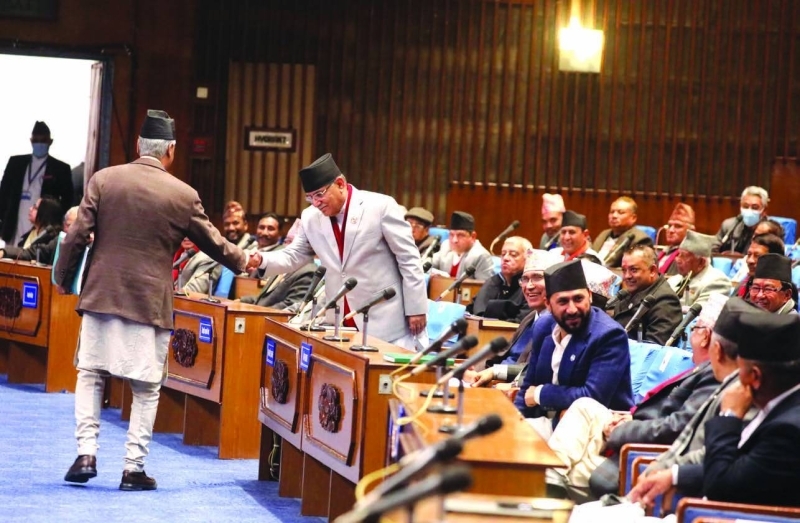
The latest party to show internal rifts is the Unified Communist Party of Nepal (Maoist), with Maoist Chairman Pushpa Kamal Dahal sabotaging Dr Baburam Bhattarai´s political career, but the other parties have suffered internal bleedings for long. [break]
The NC is in transition-related pain as its overbearing president, Girija Prasad Koirala, is at the fag-end of his political career and perhaps in the last few years of his life.
UML Chairman Jhala Nath Khanal is fighting an uphill task to maintain his grip on the party as UML strongman Khadga Prasad Oli mounts a sustained challenge.
The ever-quarreling Madhes-based parties are in permanent trouble. Madhesi People´s Rights Forum (MPRF) has already split in two and hardly any Madhesi leader feels assured about his party or his own leadership.
“This is an ominous sign for the country,” says Prof Dr Lok Raj Baral.
The internal wranglings in the parties have distracted and weakened the leadership, disappointed the masses, disillusioned the cadres and raised doubt that the parties will be able to deliver as the country stands at this critical juncture.
So, what is wrong with our parties?
Prof Krishna Khanal speaks of lack of party mechanisms to address differences, if not outright grievances. “The main reason behind intra-party conflicts is the desire [ego] of individual leaders to assume the top party posts as the structure of all the parties is hierarchical in nature,” he says.
Khanal argues that things get worse when other leaders get no say in the party.
UML leader Pradip Gyawali also attributes the malaise to lack of democratic practices in the parties. “Intra-party rifts are often the results of party leaders´ tendency to take decisions on major issues single-handedly."
Gyawali, however, argued that dissenting voices in parties also reflect growing pressure within the parties for democratization. "Cadres have begun to question the leaders and their competence."
Political analysts say the intra-party rifts will further frustrate people and weaken the leaders´ ability to draft a new constitution and conclude the ongoing peace process.
“Things get difficult when the top leader of a party cannot take any decision,” argues Dr Baral. “Even if a leader takes a decision he is found unable to implement it.”
Gyawali argues that it will have an adverse effect on the long-term progress and democratic stability of the country.
The effect of intra-party divisions has also been seen in the responses of various leaders to the recently constituted High Level Political Mechanism (HLPM).
“This not only reflects lack of adequate homework on the part of leaders before taking any decision, but also shows the dysfunctional anarchy prevailing within the parties,” adds Dr Baral.
Baral fears that intra-party differences could further fuel political instability in the country.
koshraj@myrepublica.com
Related story
General strike in Israel over hostages leads to uneven closures...