

About eleven kilometers South of Janakpur is Debadiha, a small village bordering India. The story of the tiny village goes back to the early 1800s when King Girwan Yuddha Bikram Shah awarded two hundred and two bighas of land to Haradutt Jha who was a priest for the royals. Of the two hundred and two bighas, half lay in the Debadiha region, where his eldest son settled. The villagers are mainly his descendents. I know this history because this is also my village.
Not everyone in Debadiha has Nepali citizenship. This is because Indian nationals who settled there after marrying the daughters of the village were prevented from being Nepali citizens by Nepal’s law. The son side descendants of Hardutt Jha have also had occasional problems with the Chief District Officer in Janakpur, but the copper plate engraving proving the “Birta”(award) to Hardutta Jha has erased any doubts on land ownership. [break]

Once a vibrant village, Debadiha is now a place for the weak, the sick and the unemployed. The decay lies not in its people, but in the economy around it that has collapsed. Until the 1980s virtually everyone who lived there farmed. But tilling one’s land is not enough for survival anymore. These farmers face tough competition from farmers who have adopted new technologies and improved productivity.
The last half century has been one of technological innovation in the agricultural industry, but the farmers in Debadhiha cannot make use of it. They hold small pieces of land that make it impossible to apply new technologies to cut cost. As a result they cannot compete with farmers abroad where farming is done on a large scale, lowering the cost of the products.
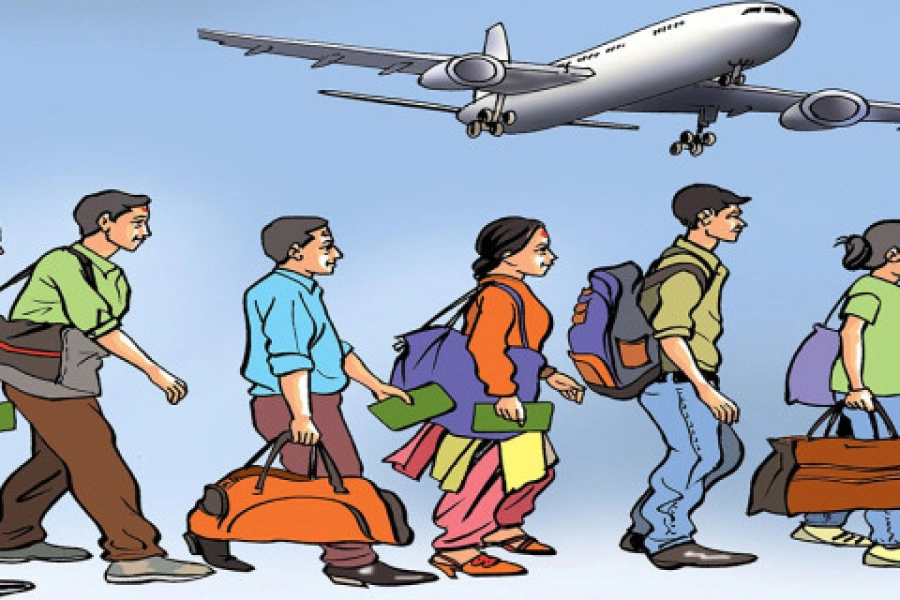
With farming out of question, the younger generation has looked for employment in the manufacturing and service sector. Unfortunately, there is none available nearby. This has led to mass migration to places like Delhi, Kathmandu, Birgunj and Biratnagar. What has happened to Debadiha is not unique.
This is the story of thousands of villages in Nepal, where the economy has collapsed forcing the young and able to migrate—sometimes leaving their wives, children and parents in the village.
Such large-scale migration not only creates problems for these tiny villages, but also the cities that the migrants move to—putting pressure on cities’ infrastructure. But it doesn’t have to be that way. Policies in Kathmandu can alter this mass migration. True, technological innovation and the pressures of globalization are not in the control of policymakers, but here are a few things they could do.
One, they can encourage new industries in areas that tend to have poor economies. The medical and engineering colleges and hospitals that open in these regions can be given more concessions. A similar idea can be applied to other industries. This method is better than taking money from this business, and then pouring it back into the economy. The disadvantage of collecting and then pouring back is that it makes the money susceptible to corruption as it moves through the system. The best strategy then is not to collect money in the first place.
Second, we need to devise a way to improve the productivity of the land. Many people are still tied to agriculture, but most are involved halfheartedly and on a part-time, temporary basis. Unless we make it possible for a group of people, or an individual to hold a large piece of land in one place, productivity will not improve. Perhaps, allow for holding 20 bighas of land, provided they own it in one place, and use it for agriculture. As ironic as it might sound, the land reform we need is not for people to hold less land, but rather that we allow people to hold more land.
Third, allow the local governments to raise their own money. For example, Janakpur could issue its own public bonds which anyone could buy, and the money obtained from the bonds could be used to finance part of some new infrastructure. This is again better than Kathmandu collecting money and pouring it back into Janakpur depending on the political conditions. In the first case, the citizens and financial institutions around Janakpur are likely to buy these bonds, and as investors there are likely to hold the city accountable. In the hills, where small scale hydro-plants could light up towns, money raised from these could be used to produce electricity, and possibly sell to the cities than don’t have power.
Fourth, it is mistake to view people who live in bordering towns and do not have citizenship as a liability. We need to view them as an asset and make it possible for them to participate in the economy. This does not mean giving Nepali citizenship to Indians, but making sure that Indians who migrated long ago and are settled in these villages for generations get citizenship. This way they can participate in the economy to the best of their ability.
One advantage of federalism is that, by design, it develops multiple cities in the country. If we have fourteen states, we will have at least fourteen power centers. As Kathmandu is important because it is the capital of the country, so will the fourteen state capitals of the new states. This should, to some extent, curb the migration to Kathmandu, and the other major cities. This will also improve the economy and therefore society in villages like Debadiha.
680anand@gmail.com
Related story
Tales of Tilaurakot

















-1200x560-1779450784.webp)

