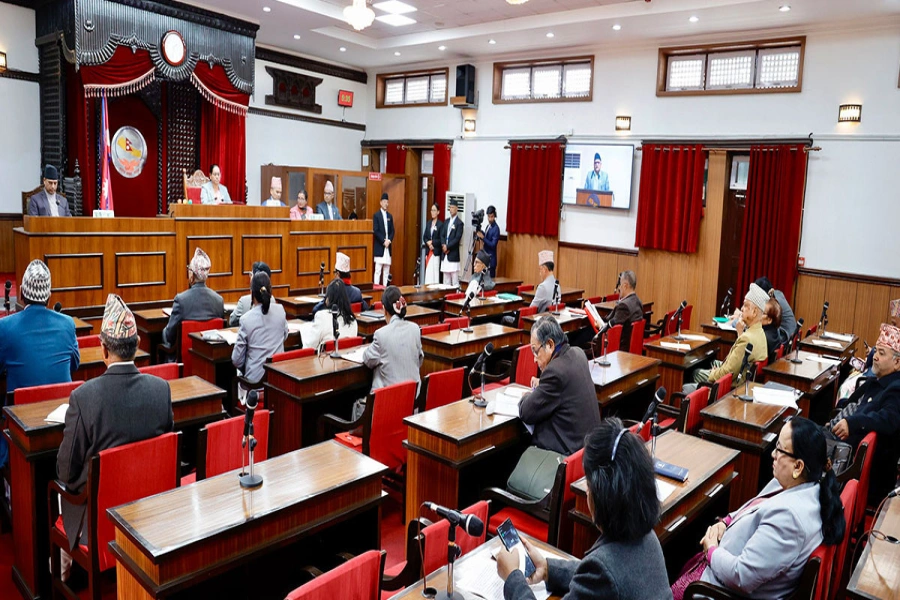
Much to the dismay, as straightforward as that sounds, we very well know that it's not all that's to be said in the 'constitution complicacy.' Many things happened in the past eight years and its final product has its own intricate provisions, controversies and criticisms. Keeping that in mind, we attempted to answer some of the probing questions youth might have with the pursuit to explain constitution and some of its major components in simpler terms.
MAJOR HIGHLIGHTS
The Constitution of Nepal 2015 is the first constitution made by the people for the people. No other constitutions have gone through a process as democratic and inclusive as this one. The constitution of 1990, for example, was made by a commission appointed by the then government. However, this constitution was made by the representatives elected by the people including significant representation from marginalized groups. The following timeline highlights major events.
November 21, 2006: Comprehensive peace accord signed between the Unified Communist Party of Nepal (Maoist) and the erstwhile government led by Nepali Congress marking the end of a decade long civil war. The accord proclaimed that the king shall be stripped of political rights; Truth and Reconciliation Commission will be established to monitor war related injustice; and UNMIN will be invited to supervise military activities, among others.
January, 2007: Interim Constitution was written stating that Nepal would become a Federal Democratic Republic.
April 10, 2008: First Constituent Assembly election was held.
May 28, 2008: Monarchy was officially abolished.
May 27, 2012: Dissolution of Constituent Assembly I. However, the first constitution assembly set a fertile foundation for the second constitution assembly for it solved some major contentions.
November 19, 2013: Second Constituent Assembly election held.
April 25, 2015: National disaster probed the leaders to establish a constitution as quickly as it can be.
September 13-16, 2015: Voting on the Constitution Bill by lawmakers.
September 20, 2015: The new constitution unveiled by President Ram Baran Yadav.
Police seize 101 kg of marijuana in Dharan

Some major highlights in the new Constitution of Nepal 2015:
• Democratic Republican state, which means Nepal shall remain a democratic nation without the reign of a monarch.
• Federal model with seven provinces
• Secularism
• Three-tier government: federal, provincial and local
• Full press freedom
• Citizenship by descent to a child of a Nepali father or mother
• In order to amend a feature in the constitution, a two-third majority vote in the parliament shall suffice
• Free education till class 10
• Proportional representation for women, dalits and various ethnic and marginalized groups.
WHAT'S GOING ON IN MADHES?
The Madhesi groups aren't happy with the provincial demarcation. Especially the Tharus, who have been marginalized for long, aren't happy that the proposed provincial model divides their community into two. They aren't also ready to share a province with the hilly districts, fearing the "highlanders" will continue to "oppress" them. Madhesis further feel that they will be politically marginalized with the new constitution.
Over 40 people have died so far in Madhes, in the ongoing protest against the new constitution.
DEBATE ON FEDERALISM
The need for federalism has been expressed mostly by the Madhes-based political parties and the Maoist party. Nepal being a multi-lingual and multi-ethnic nation, it's said that the federalism would safeguard their sanctity, and preserve traditions that are on the verge of disappearing. They argue that Nepal has been largely centralized and a federal system would amend the damages of the past.
HOW MUCH MONEY WAS SPENT IN THE PROCESS?
A total of about Rs 117.74 billion was spent in the process, as per the data released by the Election Commission, the Office of the Auditor General, the Ministry of Peace and Reconstruction, and the Peace Fund.
Why are women's rights activists not happy with the citizenship provision?
The main article states that citizenship by descent will be given to a child of a Nepali father or mother, so what's the problem? Well, because the clauses that follow state various conditions for acquiring citizenship by descent through the name of Nepali mother.
The clauses specifically state that the child of a Nepali father and a Nepali mother will get a citizenship by descent.
In case of a child born to a Nepali mother with "unidentified husband", if s/he is born in Nepal and is permanently residing in the country, s/he will get a citizenship by descent. But, if later the father is identified to be a foreign citizen, the child's citizenship will be converted to naturalized. No clause says so in case of children of Nepali fathers with "unidentified wife."
Child born to a Nepali mother and a foreign father, if s/he is born in Nepal, is a permanent resident of Nepal, and hasn't taken citizenship of any other country, will get a naturalized citizenship. The following clause does state that citizenship by descent will be given to that child if by his/her legal age, both the parents are the citizens of Nepal. The problem is, there's no provision for a foreign man married to a Nepali woman to get a Nepali citizenship. However, a foreign woman married to a Nepali man can obtain a naturalized citizenship if she so wishes to. This means, there's no way the child of a Nepali mother and a foreign father can get a citizenship by descent.
Why is this a problem?
Women's rights activists have pointed out cases of children of trafficked women, and migrant women workers. What if they become mothers in a foreign land, and upon their return to Nepal, are unable to provide details regarding the whereabouts of the father? Will the children then be denied the citizenship of Nepal altogether? Or will they simply be handed out a naturalized citizenship because they don't have a Nepali father?
GOOD TO KNOW
Citizenship by descent: If a person possesses a citizenship by descent, s/he can enjoy all the rights ensured to a Nepali citizen in the constitution.
Naturalized citizenship: If a person possesses a naturalized citizenship, s/he may not enjoy all the rights fellow Nepalis enjoy. For example, s/he won't be able to run for the Presidential or Prime Ministerial elections.



-1200x560-1779450784.webp)