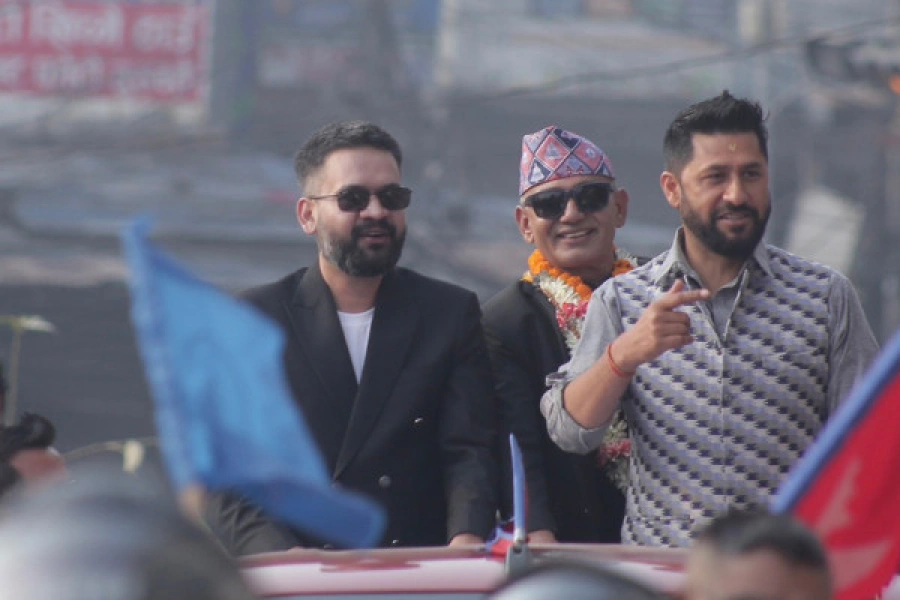
After two weeks of uncertainty as to what course the country´s politics would take, the three major parties--UCPN (Maoist), NC and CPN-UML-- have resumed dialogue with the seriousness it deserves. [break]
On Friday they had a meeting that holds significance not only because it dispelled concern in various quarters that the country was headed towards a fresh round of confrontation but also because it decided to take up all the major issues.
For the first time since the Maoists left the government some eight months ago, the big three parties have agreed to discuss and sort out two key issues in the current stalemate: power sharing and PLA management.
For the Maoists power sharing is the key issue. The Maoists as the largest party in the Constituent Assembly claim that they need to be in power.
And for NC and the UML, it is management of the Maoist combatants currently living in UN-monitored cantonments that matters the most. The two parties have publicly said that promulgation of a new constitution is possible only after management of the cantoned Maoist combatants.
They have a fear that the Maoists can and will be inclined to pursue the politics of violence as long as the issue of PLA management is not addressed.
Besides these two outstanding issues, the three parties also set out four other agenda items for dialogue ---resolving contentious issues that surfaced during the constitution drafting process, reviewing the status of implementation of all past agreements including the Comprehensive Peace Accord, taking confidence-building measures among the major political parties to bridge the trust gap, and the issue of civilian supremacy vis-à-vis the president´s move to reinstate then the army chief.
The seriousness was visible at Friday´s meeting. Representatives of the three parties had first shared their concern over possible delay in constitution drafting and the impact that widening mistrust among the major parties--especially after Maoist Chairman Pushpa Kamal Dahal publicly termed the NC and UML ´puppets´ operated by ´remote control´ from New Delhi--would have on the ongoing peace process.
There was a serious deficit of trust among the major parties as Dahal vowed to talk directly to New Delhi to resolve the political deadlock, during the party´s rally held some two weeks ago at New Baneshwar.
The three parties had floated their respective issues before setting the agenda for future negotiations. The meeting then decided to put less controversial issues first while leaving the most contentious one -the president´s move to reinstate the army chief- for the last.
Leaders seem optimistic that negotiations on the six-point agenda would eventually help resolve the deadlock. "Setting out of all pertinent issues for discussion on priority basis is itself an achievement as negotiations so far centered only on the president´s move," argued NC General Secretary Bimalendra Nidhi.
Nidhi said talks on the set agenda would yield positive results if they move ahead in the same way they began Friday. "We have for the first time been able to identify the agenda for negotiations," he said.
What makes the NC and UML hopeful is that the Maoists have agreed to set the agenda of PLA management on priority basis.
UML leader Keshav Badal, who has been engaged in negotiations with the Maoists for the past few months, said the negotiation on the set agenda would pave way not only to settle the issue of PLA management but also to accomplish the task of constitution drafting within the stipulated date.
Though they agreed to set the agenda priorities, the Maoists still seem less confident that the negotiations would resolve the political deadlock.
Maoist Vice Chair Narayankaji Shrestha said the talks would help to end the protracted deadlock only if the NC and UML first address their demand concerning “civilian supremacy”. The Maoists have demanded that a resolution motion over the president´s move to reinstate the army chief dismissed by the elected government should be allowed for debate in parliament for ensuring ´civilian supremacy´.
Should the Maoists continue sticking to the demand it is less likely that talks will make headway any time soon, given the stiff opposition the NC, if not the UML, has maintained so far.
koshraj@myrepublica.com
Related story
No dream is too big or too small