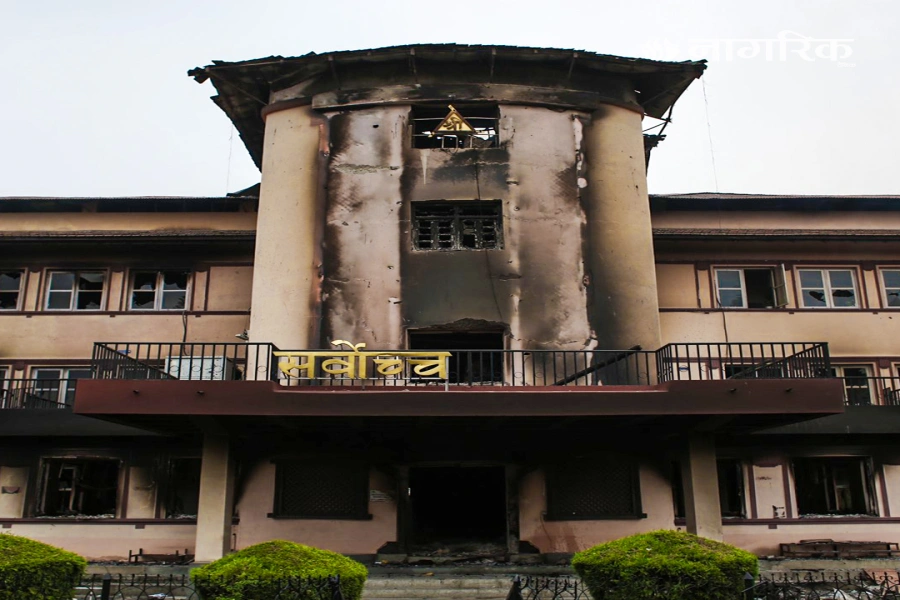
A divided bench of Justices Ram Kumar Prasad Shah and Girish Chandra Lal issued an order to forward the case to a full bench of the court for the final verdict. However, it does not seem possible as at least, three judges are required for a full bench. [break]
Shah and Lal can not be a part of such bench as they passed the verdict while the chief justice and senior justice Damodar Prasad Sharma are made defendants in the writ. Justice Prakash Wasti, who is a temporary justices, can not be a part of a full bench as the issue concerns him too.
Similarly, temporary Justices Baidhyanath Upadhyay and Gyanendra Bahadur Karki will return to the appellate court as they came from the post of principle judge.
Following the Sunday´s verdict, the apex court is likely to remain with only six permanent justices including the chief justice. Out of seven temporary justices, tenure of five will end on Wednesday while the tenure of Justice Prakash Wasti will end on January 21, 2013. Justice Bharat Raj Uprety resigned from the post on Thursday.
Arguing that the parliamentary hearing is mandatory for the appointments of judges, Justice Shah stated that the tenure of the temporary judges cannot not be extended or they cannot not be appointed permanent justice without conducting mandatory parliamentary hearings.
"It should be taken into consideration that there are no legal and constitutional grounds to such a demand," read the order issued by Justice Shah. He stated that there is no constitutional provision regarding appoint of temporary judges to the post of permanent one or extending their tenure as they are appointed for a particular time period.
"Parliamentary hearing is the last and mandatory process before appointing judges," states the verdict adding, "There is also involvement of the legislature beside the judiciary in the process. So, appointment process of judges does not seem to be complete and legitimate without involvement of legislature or parliament in the process."
Justice Shah has stated that it would be misinterpretation of the constitution that conducting parliamentary hearing for appointments of judges is not necessary in the present context as there is no parliament.
Justice Shah has also stated that a verdict could not be issued against the apex court´s order which was issued two years ago accepting the same provision.
However, Justice Lal argued that the present context should be taken into consideration regarding the issue as parliament does not exist.
Justice Lal said that there was no possibility of conducting parliamentary hearings for the appointment of judges stating that it is not even sure that there will be election of a parliament in future.
Meanwhile, the Judicial Council has called a meeting for Monday to discuss about the issue. "A meeting has been called to hold discussion on temporary judges and appointments of judges," said Secretary of the Council Jiwan Hari Adhikari.
Related story
‘Justice is dying in Nepal. Let’s save it!’