

"Months have elapsed since the quake and Nepal is now moving ahead with rebuilding and reconstruction. But they have forgotten the socioeconomic impact of the jolt. The country will rise only if the quake victims get the opportunity to rebuild their lives for a sustainable development," said Dr Golam Rasul, an expert on livelihoods.Rasul, along with six other experts, has prepared a framework on Strategic Framework for Resilent Livelihood in Earthquake-Affected Area of Nepal.
"The framework is a guideline on how to build a sustainable livelihood for the quake victims so that both the country and its people benefit in the long run," said Rasul.
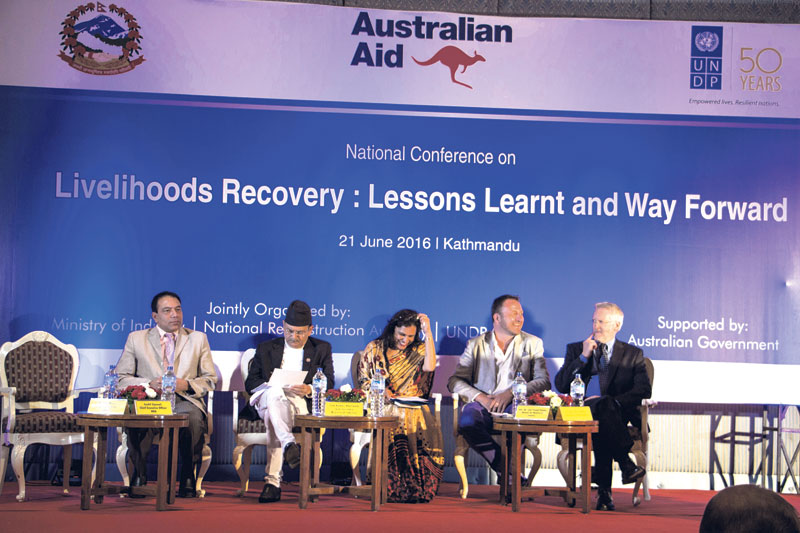
Launching the Framework in Kathmandu, Prof Govinda Raj Pokharel, vice chair of the National Planning Commission, said a livelihood recovery strategy must not only focus on repairing damage, but also help build resilient communities for future."
"The Framework will be beneficial to the Government of Nepal, private sector and other development agencies in streamlining developmental efforts in the process of rebuilding the nation," said Pokharel.
As per the government's Post Disaster Need Assessment (PDNA) report, the total loss caused by the quake is estimated at USD 7 billion, which is equivalent to about a third of Nepal's Gross Domestic Product.
The total loss to the agriculture sector, the main source of livelihood in most earthquake-affected areas, is estimated at around Rs 28.4 billion.
The official death toll from the quake and aftershocks now stands at around 9,000. While 23,000 were injured, more than 785,000 homes were damaged or destroyed, and about 2.8 million people displaced.
Related story
Sana Kisan offers first livelihood restoration credit









-1200x560-1774606010.webp)


