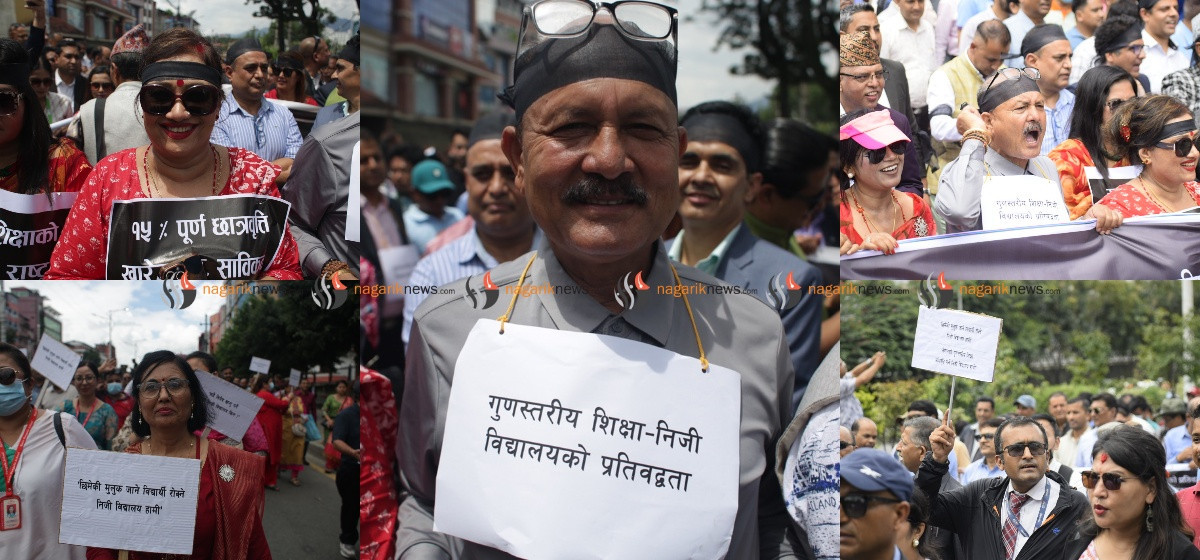
But who is responsible for providing them with skills, knowledge and employment? Educational institutions run by the government, or privately managed ones? Who will bear their costs of education? The government or individuals? These and many other issues remain unaddressed in our education policies. On the other hand, there are unanimous agendas in the manifestos of all the political parties, the civil society, teachers and students’ unions for “free and quality education for all.” If education policies are made whimsically for the promulgation of meeting political gains only, the future of thousands of graduates will remain dismal. Consequently, this huge chunk of a potentially productive populace will remain a liability to the nation at large!
Although Nepal’s private sector has played a key role in nation building, particularly through resource and employment generation, the government has failed to identify this mammoth contribution. On the contrary, it has viewed this sector as an antagonist to the existence of government-run institutions.
Last year, major issues of taxation in education imposed by the erstwhile government paralyzed private schools and colleges across the country. Repeated dialogues on the relevance of the “education tax” went astray. The Association of Private Educational Institutions, Nepal (APEIN), the representative association of all private educational institutions, apparently agreed to the cause to support the government-run schools in remote districts.
Another issue of concern is that the government, as custodian of the life and development of the people and institutions under it, fails to realize the adverse impacts of the policies it formulates. For example, in the last fiscal year budget, considerable increment in remuneration, perks and benefits was declared for the teachers of government schools. This indeed was a welcome step. However, the government failed to address the consequences of such an unplanned policy, and consequently, private schools and colleges had to bear huge financial burdens.
It is time the Nepal Government rather started contributing to the holistic development of even the private sector in terms of infrastructure, subsidizing duties on equipment and vehicles, enhancing skills and qualifications of teachers, providing support and scholarships to the needy children, among other initiatives. It is also time that the government realized that the ultimate aim of the private sector is to contribute to nation building!

So what next? With the accession of World Trade Organization (WTO) in education services from 2010, dozens of foreign universities and education boards have already been established, and many are in the pipeline. As a result, our institutions are bound to face more competition in the days to come. At the same time, it will also experience opportunities to attract thousands of foreign students and retain Nepali students from going abroad for higher education.
We need world-class educational institutions within a decade, based on equity, quality and practical requirement. It is time the government started immediate steps to separating the Education Board for private educational institutions to accredit, control and supervise them.
Under the University Umbrella Act, there should be a provision for private universities as well as autonomous colleges at the central and state levels, keeping in mind their federal setup. A new paradigm on private sector in education should be initiated through a nationwide dialogue before it is too late.
Yubaraj Sharma is the General Secretary of Higher Secondary School Association of Nepal (HISSAN ) & CEO of White House Education Network.
Related story
Regulation of private education essential: Minister Poudel