Any agreement on the contentious issues appears unlikely as the rival sides have refused to budge from their respective stances during recent negotiations. This, subsequently, has also delayed announcement of the poll date.[break]
While leaders from the UCPN (Maoist), Madhes-based parties and some other fringe parties have been arguing that the provisions proposed by the Election Commission (EC) are unacceptable as “ they are against the spirit of inclusion and would deprive marginalized communities of representation in the statute drafting process”, Nepali Congress (NC) and CPN-UML have maintained that the provisions are necessary to do away with anomalies witnessed during the four-year term of the dissolved legislature.
Chairman of Federal Sadbhawana Party Anil Jha described the new provisions as a conspiracy hatched by leaders of the big parties to deprive small political parties and marginalized communities of representation in CA.
Jha also held leaders of the big parties responsible for the failure of CA. “The big parties are conspiring to negate small parties. So it is simply unacceptable,” Jha told Republica.
Nepal Federation of Indigenous Nationalities (NEFIN), among some other groups, is also against the proposed provisions.
NEFIN Chairman Nagendra Kumal argued that they are against the proposed provisions as they are against their demand for “representation of at least one member from each ethnic group, mainly the marginalized communities, in the constitution drafting process.”
“Once the CA is downsized and the proposed ratio of seats under the first-past-the-post electoral system and the proportional quota is introduced, it is certain that the marginalized communities will be deprived of representation in the CA,” Jha told Republica.
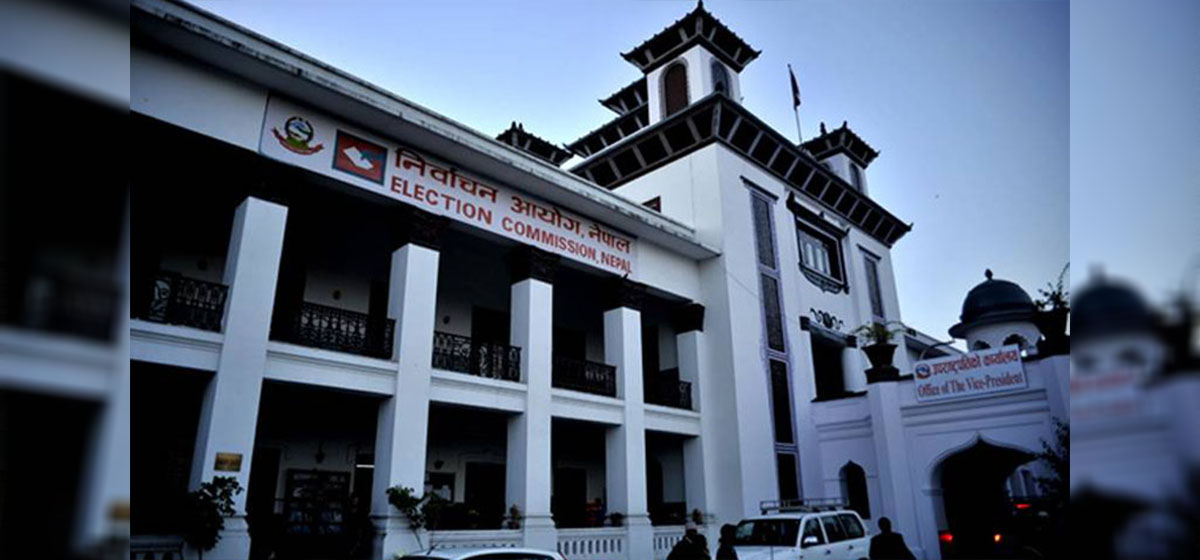
EC has proposed to introduce threshold that would make it mandatory for a political party to secure at least one percent of the total valid votes cast in the election to be eligible for seats under the proportional quota in CA.
EC has also proposed to downsize the 601-member CA to 491 members. As per the new proposal, of the total 491 members, 240 will be elected directly from the electoral constituencies and other 240 will be nominated under the proportional representation quota. Other 11 members will be appointed by the government.
In the previous CA, 240 members were elected directly, 26 members were nominated by the government while rest of the members were nominated under the proportional quota.
“We protested against the new proposal because it has drastically reduced the seats to be allocated under the proportional quota,” said Kumal.
However, CPN-UML leader Agni Kharel, who is involved in inter-party negotiations, claimed that the proposed provisions aren"t against the spirit of the principle of inclusion.
He argued that the threshold provision would inspire fringe parties to merge with other groups sharing similar ideologies while lack of such provision would encourage leaders to split the parties.
“If a single member is elected from a party, either chairman or the general secretary of the organization will represent the party in the CA irrespective of the community s/he represents,” Kharel explained. “But, if such parties unify and send more members in the CA, they will naturally have greater representation.” He also argued that the proposed provisions would also ensure political stability in the country.
“UCPN (Maoist) is lobbying against the threshold and other provisions because the former rebel party is still against stability and the rule of law in the country,” said Kharel. “Maoist leaders want anarchy in the society.”
NC and UML leaders also claimed that the issue of inclusion can be addressed even if some fringe parties fail to secure seats in CA as representatives various ethnic and indigenous communities, including the marginalized ones, will be elected or nominated from the major political parties because every political organization must prepare their list of candidates based on the principle of inclusion.
Related story
Delay in candidate selection hits parties' poll campaigns