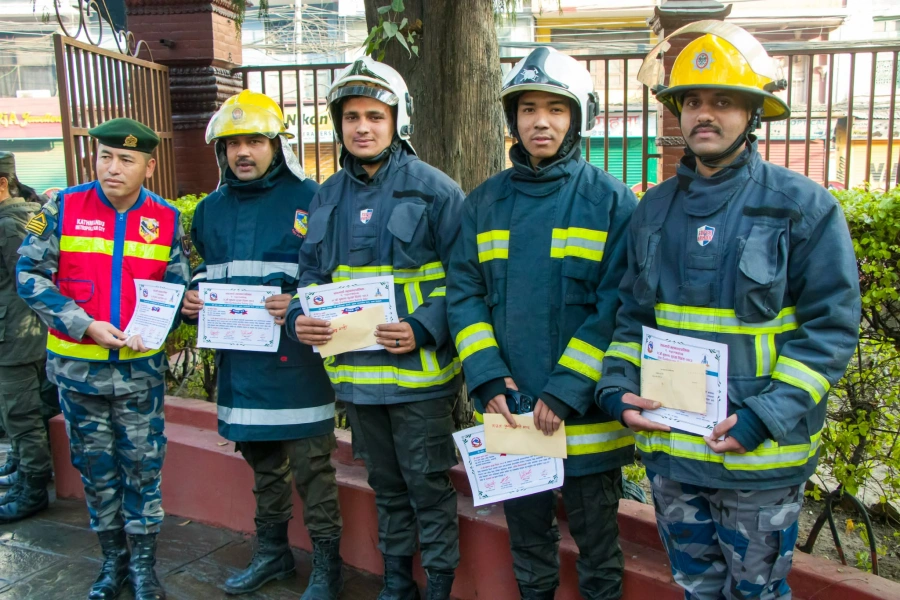
The great earthquake of 1934 – which registered 8.4 on the Richter Scale – that hit Nepal on Jan 16, 1934, killed 16,775 people and damaged 318,000 houses, rendering thousands homeless. A recent report by Japan International Cooperation Agency (JICA) estimates that if an earthquake of the same intensity were to hit the Kathmandu Valley, 50 percent of the buildings would be damaged while 12 percent of the population would die. Another recent study on the movement of tectonic plates and analysis of the history of Himalayan earthquakes has predicted that the next great earthquake will hit the ‘central gap’ of the Himalayas of Nepal. The earthquake can strike anytime. All these facts clearly demonstrate the alarming situation that Nepal is in. Against this context, celebration of Earthquake Safety Day on Jan 16, which also marks the 76th anniversary of the great 1934 earthquake, is not only meaningful but should be of concern to all Nepalis.
Nepal has acknowledged the need for earthquake safety measure especially after the International Decade for Natural Disaster Reduction (1990-2000) and has already initiated different strategies at the national level. Implementation of building code and mandatory requirement of submitting structural calculation in building permit system are some of the specific measures that have been taken up. Other activities include retrofitting of schools, preparation of emergency hospital plans and conducting training and drillings in different parts of the country. These fragmented efforts need appreciation; however, they are not sufficient to deal with the complex nature of an earthquake.
In the case of Nepal, socioeconomic disparity and uneven development within the larger economic political system is more responsible for increasing vulnerability to earthquakes rather than the natural hazard itself.
We need to understand that the disaster created by an earthquake is the result of seismic hazard (physical event) in a vulnerable city (social aspect). The seismic hazard of the Kathmandu Valley (in fact, the whole of Nepal) is due to four geological processes: (1) location between the two young and active Tibetan and Indian Plates, (2) many fault lines crisscrossing the Valley, (3) soft floor of pre-historic lake, and (4) occurrence of many earthquakes in the past. As these natural processes cannot be changed, the only practical solution is to build human settlements as per seismic hazard and to prepare for an emergency situation. In fact, in the case of Nepal, socioeconomic disparity and uneven development within the larger economic political system is more responsible for increasing vulnerability rather than the natural hazard itself.
Numerous activities associated with the present trend of rapid urbanization (6 percent in the Kathmandu Valley) and haphazard urban (re)development in the historic core area as well as in the peripheral agricultural lands of Kathmandu (and other urban centers) are responsible for increasing vulnerability to an earthquake, exposing a higher percentage of population to seismic hazard, and decreasing the capacity of urban and emergency services to cope with disaster in many ways.
Even the so-called planned development of private apartments and land pooled neighborhoods, including individual construction of buildings, are not designed from a seismic perspective. Many private schools, colleges, other educational institutions and private nursing homes, which should act as ‘evacuation shelters’ and ‘treatment centers’ in the event of an earthquake striking the Valley, are running their activities in ordinary residential buildings. Replacing old three- to four-storied residential houses with eight- to ten-storied commercial office complexes in the urban centers has converted the narrow pedestrian lanes, street squares and courtyards into parking lots, garbage dumping sites, and ‘death traps.’ The riverfronts, prone to liquefaction in case of an earthquake, are filled up by either slums or squatter settlements.
New emerging architectural trend of decorating building façade with numerous ‘false’ elements by putting decorative elements such as double columns, bay windows, sloped roof, etc also makes buildings vulnerable to earthquakes due to the lack of structural connection with the main system. Due to differences in building (and floor) height, materials and construction technology in new constructions, there will be ‘pounding effect’ vis-à-vis adjacent houses in case of an earthquake. The existing legislation is simply inadequate and ineffective to curb these practices.
The Department of Disaster Management (earlier Special Disaster Unit) within the Home Ministry is the only government agency entrusted with issues related to natural disasters. Sadly, it also only deals with relief and rescue part during the emergency period under the Natural Relief Act 1982. Other public agencies have neither the managerial capability to analyze earthquake vulnerability in the context of the whole city within comprehensive framework nor have a disaster management unit within their organizations. Hence, no fund is allocated for mitigation and preparedness works.
The 1995 Kobe, Japan, earthquake has clearly demonstrated that preparedness of emergency plans in the hospitals alone does not make any sense, unless there is means of keeping all the apparatus and equipments and staffs including electricity in tact during emergency, which is not possible in the case of urban areas of Nepal. Similarly, lack of quality control on construction work and building materials, wrong detailing of bars in slabs and columns and absence of supervision on the site, have reduced the effectiveness of checking structural drawings at municipalities.
Moreover, the built form of urban centers of Nepal, including the capital cities of Kathmandu Valley, does not allow rescue and relief operation on the site and transporting the victims to the hospital. On top of that, the ambulance facility, fire fighting capacity and scarcity of water have all rendered these emergency facilities ineffective even in a normal situation, forget during an earthquake.
Celebration of Earthquake Safety Day will only be meaningful if the above mentioned issues are addressed. It makes sense only if the losses of lives and property and disruption in socioeconomic activities can be reduced if and when an earthquake strikes the Valley. Many people have not only adopted wrong practices of building construction but they have also taken earthquake awareness programs as an ‘event’ like ‘Dashain’ or ‘Deepawali’ to be celebrated once in a year. This is unfortunate and needs to be corrected.
On the development front, what is required is an integration of disaster mitigation components and techniques into urban (re)development process. They need to be applied through flexible means of incentives, consensus and awareness programs rather than by rigid bylaws. On the legal and institutional front, a separate disaster management institution at the central level backed by new legislation to formulate earthquake mitigation techniques, emergency response plan, and post-reconstruction programs by coordinating various concerned agencies is essential. The community’s preparedness should be upgraded by retrofitting the existing buildings, preparing rescue and response plan, educating and training those involved in the building industry, together with bringing public awareness at the local ward level.
If the city is unable to increase emergency facilities, it can at least prevent the densification and formation of vulnerable communities through a decentralization policy and development control mechanism. These measures can help to reverse the present disaster approach, which is still ‘responsive’ in nature rather than ‘preventive’. Moreover, it will complement to develop a culture of building earthquake-resistant cities and disaster-responsive societies. Then only will the celebration of Earthquake Safety Day hold any meaning.
bkshrestha@hotmail.com
smitashr82@hotmail.com
Related story
We have already done needful to ensure early preparedness for D...