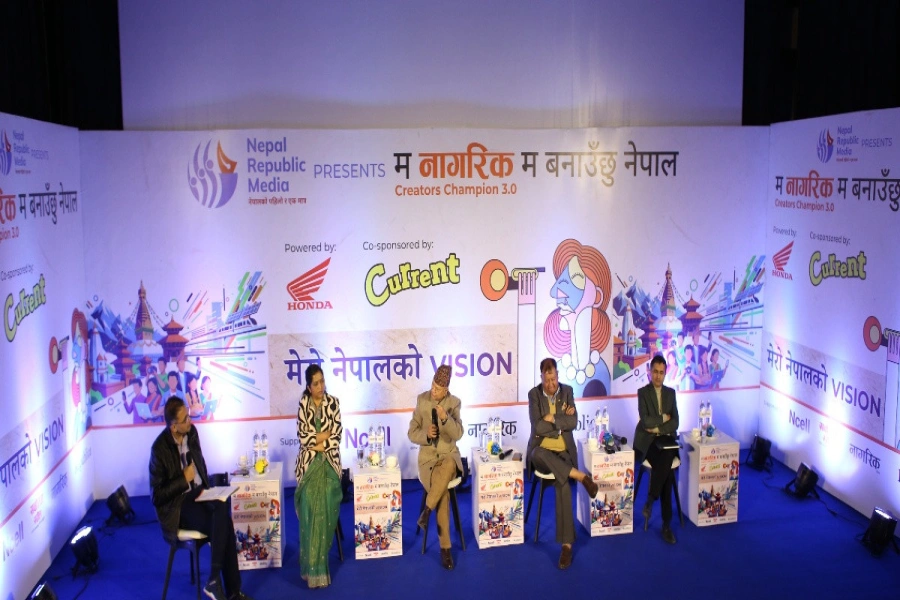
KATHMANDU, Feb 19: Leaders of Nepal’s major political parties and heads of the private sector have concluded that the country’s prosperity and self-reliance can no longer be achieved through traditional methods and political ideas alone. They unanimously expressed that politics and the economy now need to be linked with “high-value” production, investment security, and good governance.
Speaking at the “Creators Champion 3.0” program organized by Nepal Republic Media, leaders of CPN-UML, Nepali Congress (NC), Rastriya Swatantra Party (RSP), and representatives from the private sector shared their perspectives.
Leader Raghuji Pant of CPN-UML said that party manifestos should now include only practical and implementable plans rather than showcasing overly ambitious dreams. Speaking at Creators Champion 3.0, Pant stressed that parties must end the tradition of showing citizens ambitious dreams that cannot be fulfilled. He acknowledged that in the past, when no single party achieved a clear majority and coalition governments had to be formed, no party could fully implement its manifesto.

Raghuji Pant, leader, CPN-UML
"When citizens ask why our manifesto was not implemented, our ability to give clear answers has been somewhat limited," Pant said, "So now, our focus should be on things that can actually be implemented rather than showing grand dreams."
Freedom of press means freedom in country: NC General Secretary...

He emphasized that manifestos should provide a roadmap when a party comes to power and, when in opposition, allow for the same issues to be raised in parliament in a reasoned manner. He stressed that strengthening Nepal’s national identity and independence requires economic self-reliance. "Political freedom alone is not enough in the current era; economic freedom is also necessary," he said. "As long as we limit food sovereignty to slogans and fail to become self-reliant in agricultural production, our independence will not be complete."
At the program, Pratap Paudel, youth leader of Nepali Congress, concluded that Nepal’s economy needs youth entrepreneurship, digital transformation, and political integrity to thrive.

Pratap Paudel, youth leader, Nepali Congress
He said NC has recognized its past weaknesses and reformed itself. He made it clear that the party’s main focus is now the recently emerged Gen-Z uprising. "Citizens are seeking changes in conditions, not just in governance. To address the youth uprising observed in Bhadra, we have made good governance and anti-corruption our main issues," Paudel said. He emphasized that NC will now prioritize individual happiness, dignity, and progress alongside the slogan of “Prosperous Nepal, Respected Nepali,” not just physical development.
At the program, Samiksha Baskota, leader of Rastriya Swatantra Party, said Nepal cannot compete with India and China in traditional agriculture and must focus on high-value crops. "We talk about production, but growing rice and maize cannot compete with neighbors," Baskota said. "Now we must add value to items like tea, coffee, and medicinal herbs to increase exports." She accused older political parties of doing much political rhetoric but failing to deliver. "If ideas alone had provided good governance, ended corruption, created jobs, and strengthened the economy, our rise today would not have been necessary," she said. She also highlighted the necessity of voting rights and digital voting for Nepalis abroad.

Samiksha Baskota, leader, Rastriya Swatantra Party
Chandi Raj Dhakal, former president of the Federation of Nepalese Chambers of Commerce and Industry, pointed out serious problems in investment security and policy implementation in Nepal. He said the private sector has long endured conflict, earthquakes, blockades, and pandemics without receiving expected protection from the state. He recalled that around 2004/05 BS, Nepal’s export trade was in a very good condition. "Back then, exports including ready-made garments, carpets, and pashmina reached nearly Rs 8.4 billion," he said, "but during the conflict, these industries were completely destroyed. Subsequent governments failed to debate and manage their revival properly."

Chandi Raj Dhakal, former president, FNCCI
Even though the U.S. quota system has been criticized, he said the main cause was internal conflict and attacks on industries. He added that recent Gen-Z protests, which damaged private property and infrastructure, sent negative messages to international investors.
Referring to a conference in China, Dhakal said, "When I promoted Nepal as South Asia’s top investment destination, I was asked: How can we invest if international chain hotels are burned and security is not guaranteed? Unless the government commits to investment security, it will be difficult to attract foreign investment."
He emphasized that no project or policy succeeds without vision, but Nepal’s problem lies in attitude. "Even on matters we agree upon in principle, we never conduct serious dialogue or debate to implement them. That is why, even when political manifestos contain good plans, they fail in practice."
Samiksha Baskota said that old political parties’ failure to deliver economic transparency, governance, and development has created space for new parties. Politics has been limited to ideas and debate. Even highly experienced and talented leaders have failed to connect with the sentiments of ordinary citizens and the youth.
She added that for older leaders, politics is only about ideas, but ideas alone cannot ensure good governance, end corruption, create jobs, or achieve economic and social transformation. "If ideas alone had done all this, education, health, and public transport would have been affordable, and we wouldn’t be in the current situation."
Leaders collectively emphasized that the future of Nepal’s politics and economy depends on practical policies, high-value production, governance, investment security, and economic self-reliance, rather than slogans and unfulfilled promises.