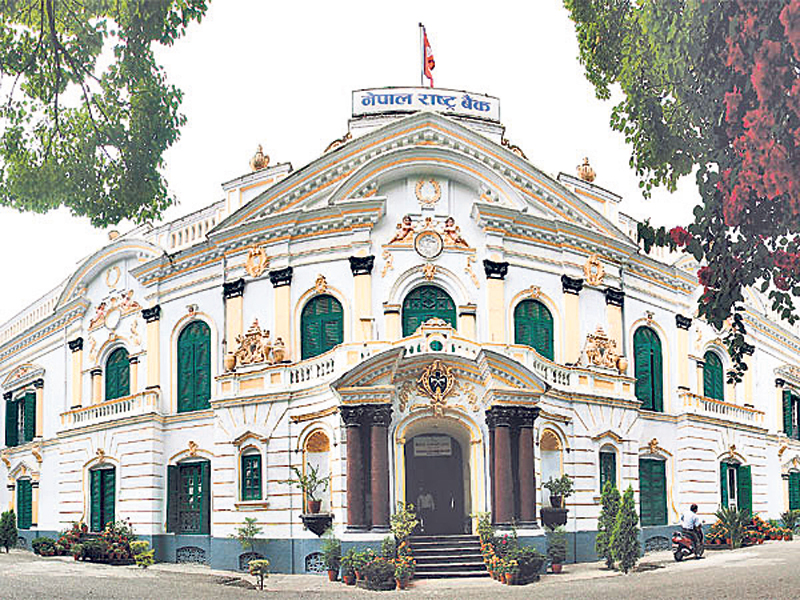
The four financial institutions received the central bank´s green signal on Thursday.[break]
Of these, Infrastructure Development, a category ´B´ financial institution with Rs 713 million capital, and Swastik, a category ´C´ financial institution with Rs 114 million capital, had previously received preliminary approval from the regulator for their proposed merger.
“A meeting of board of directors of NRB held on Thursday gave the final consent in this regard,” a reliable NRB source told Republica.
The same meeting also gave preliminary approval for merger of Premier Finance and Imperial Finance, which have paid-up capital of Rs 120.81 million and 149.73 million, respectively.
Twenty-six banks and financial institutions have either received preliminary or final approval to consolidate their units after the central bank formally started allowing banks and financial institutions to undergo merge some seven months ago.
Pairs of Kastamandap Development Bank and Shikhar Finance, and Business Development Bank and Universal Finance, for instance, have received final approval for merger.
Others like Machapuchhare Bank and Standard Finance, and Global Bank, IME Finance and Lord Buddha Finance, on the other hand, are on the verge of getting final approval from the central bank.
This is the same with Annapurna Development Bank and Suryadarshan Finance, and Pashupati Development Bank and Uddhyam Development Bank.
One of the reasons why increasing number of banks and financial institutions are combining their units is to raise their capital base, as it is mandatory for commercial banks, development banks and finance companies to raise their paid-up capital to Rs 2 billion, Rs 640 million and Rs 300 million, respectively, by mid-July 2013.
“Since many promoters do not want to or do not have the capacity to fork out the additional amount and the option of issuing rights shares is closed, they are opting for consolidation,” the source said.
Besides, banks and financial institutions promoted by the same business group or promoters are also applying for merger as the regulator has prohibited cross-holding. An example of this is the proposed merger between Global Bank, IME Finance and Lord Buddha Finance.
Because of this rush to meet different criteria of the regulator, NRB has set up a different unit to entirely focus on merger. And one of the officials of the unit said he entertains at least four or five calls related to this every day.
As per the Merger Regulation 2011, banks and financial institutions seeking merger first have to get an approval from shareholders through their annual general meeting. They then have to submit a letter of intent at the central bank incorporating details on capital adequacy, net worth, loan loss provisioning, liquidity, and market share and value, among others.
Based on the application, NRB conducts an analysis on whether the proposed merger has negative side effects like creation of monopoly. If no such faults are found, NRB then grants preliminary approval, after which a due diligence audit has to be conducted, which gives a detailed view of financial health and management aspects of the institutions.
At this state, parties to the merger also have to sign a legally binding comprehensive agreement on share distribution, ownership structure, and workforce, asset and liabilities management, among others, which has to be endorsed by shareholders through special general meeting.
The central bank then gives a final approval based on these documents.
Related story
Number of rare Cheer Pheasant rises in Myagdi’s Kaligandaki Bas...