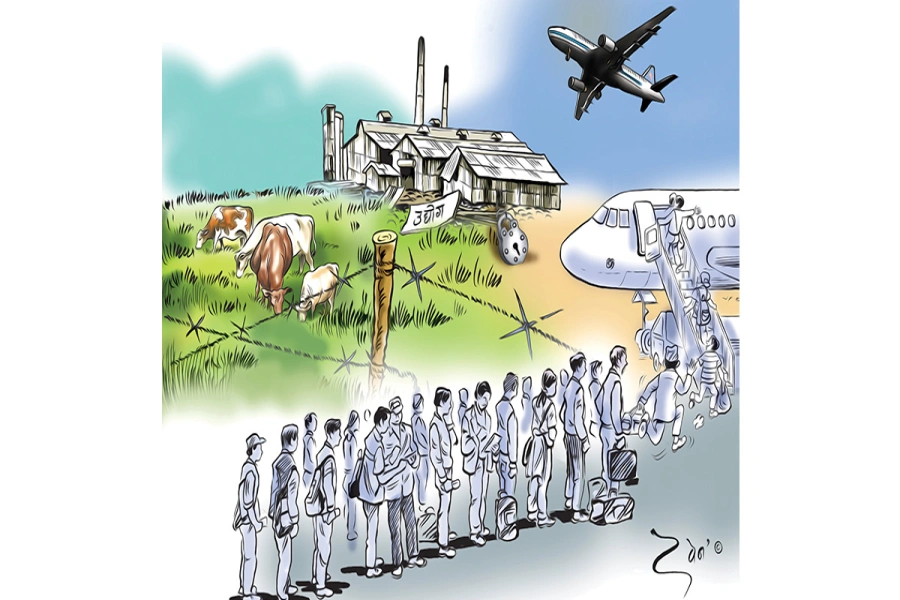
Nepal has failed to ensure a sufficient number of job opportunities within the country, pushing millions of Nepalis to seek employment abroad for better pay and improved living conditions. Many opt for greener pastures overseas due to low wages and limited prospects for career growth at home. Foreign employment has indeed brought substantial economic gains through remittances. However, its negative aspects, including brain drain, labor shortages in domestic industries, and social challenges such as debt, exploitation, divorce, and difficulties in the reintegration of returnees, cannot be ignored.
In the past two decades, Nepal’s social and economic landscape has changed rapidly, driven by the activities associated with migrant workers. But one crucial challenge remains prominent across communities: the reintegration of returnees. This process requires that returnee migrant workers be successfully supported to restart their lives economically, socially, and psychologically. The Foreign Employment Act 2007 also envisioned the Foreign Employment Board playing an effective role in reintegration by using the welfare fund for skill and entrepreneurship training, employment programs, and safe settlements for returnees. In many cases, however, Nepali migrant workers encounter various hurdles when trying to start businesses in their homeland. A lack of knowledge about the domestic market and bureaucratic obstacles appear to be major challenges in the reintegration process—a process that facilitates returnees' participation once again in social, cultural, economic, and political life.
Social Reintegration: Overcoming Stigma
Social integration in Nepal is subject to the influences of inequality, migration, conflict, and socio-cultural diversity. In earlier periods, there were numerous challenges and differing perspectives on social integration in Nepal due to caste, ethnicity, gender, and religious practices. However, society has not yet freed itself from these issues.
In Nepal, social integration is understood as a multidimensional process encompassing social inclusion, economic integration, political integration, and cultural integration. Caste discrimination is still prevalent, persisting over a long period. Capitalists still control and enjoy monopolies over the majority of the country’s public resources, leaving groups including many Dalits, women, and Janajatis, among others, without access.
The social integration of Nepali migrant workers appears more challenging due to family detachment, a lack of skill recognition, social stigma, mental health issues, and a high chance of unemployment. Despite acquiring skills abroad, these skills are often not recognized at the local level to foster entrepreneurship and create employment opportunities.
Nepal Telecom initiates transition from copper wire service to...

There are a notable number of returnees who have been unable to clear their debts due to a lack of proper guidance and unnecessary expenses on luxuries and a "hi-fi" lifestyle. Consequently, financial vulnerability exists as savings are completely exhausted, making reintegration even more difficult. Being away from family for long periods and facing an uncertain future can bring mental stress. However, mental health support systems for returnee migrants are limited in many situations.
Economic Reintegration: Missed Opportunities
Nepal’s socioeconomic landscape has been shaped by both migration and conflict. Following the 2015 earthquake and ongoing political instability, many youths were compelled to seek employment abroad. Economic reintegration must therefore receive greater attention from policymakers, local governments, and development partners.
The reintegration of former Maoist combatants after the 2006 Comprehensive Peace Agreement offers a relevant example. Their reintegration was not solely economic but was also linked to identity and community acceptance—an important lesson for migrant worker reintegration.
Migrant workers contribute nearly one-fifth to Nepal’s GDP. However, return and reintegration have remained the "unwritten chapter" of labor migration. In the case of reintegration support, traditionally less attention has been given, especially to economic and psychological support for returnees. The phase of return and reintegration in the migration cycle is a critical transition, and it is very difficult to certify their skills, savings, and experiences for sustainable livelihoods in their home country.
The Association of Southeast Asian Nations (ASEAN) members have made progress in recruitment regulation and migrant protection, but reintegration—particularly economic and psychological support—has traditionally received limited attention. The member countries have agreed to enforce the ASEAN Consensus on Migrant Worker Rights (2017) and the ASEAN Guidelines on Effective Return and Reintegration (2020/2021) to that effect.
Post COVID-19 Rehabilitation and Reintegration in Nepal’s Context
During the impacts of the COVID-19 pandemic, labor migration was largely interrupted and a large number of Nepali migrant workers returned due to job losses from workplace terminations and health risks abroad. Remittances consequently declined, exposing the vulnerability of migrant workers and their families. The post-pandemic period has underlined an urgent need for comprehensive rehabilitation and reintegration mechanisms for returnee migrant workers. Post-pandemic rehabilitation and reintegration of Nepali migrant workers is not only a social protection issue but also a strategic development priority.
Despite some programmatic initiatives, there is a significant gap in sustainable reintegration. Although the government has ratified several laws, policies, and directives focusing on foreign employment and remittances, there is a lack of a comprehensive reintegration policy. Weak coordination among federal, provincial, and local governments for service delivery, and a limited amount of reliable data on returnee migrant workers, including their skills and employment history, are among the underlying problems. Additionally, there is no systematic mechanism for the recognition and certification of returnee migrants, which obstructs their access to sustainable livelihoods.
Reintegration programs such as those for former Maoist combatants, the Nepal Peace Trust Fund (NPTF), the Prime Minister Employment Program (PMEP), the Foreign Employment Board’s Reintegration Program, Local Government–Led Community Reintegration Programs, and foreign employment bonds are among the initiatives forwarded by the government.
In recent years, the government has started putting in effort to make reintegration more comprehensive than just pilot projects. Local governments are empowered, properly funded, and supported to reach out to all returnees. However, many returnees are unaware of the available programs. There is a growing need for the government, civil societies, and local bodies to conduct awareness campaigns to share information on reintegration services, financial assistance, training, and health support. At the same time, it is necessary to enhance skill development and certification—including vocational training, technical and business skills—tailored to the needs of the country’s domestic market.
Furthermore, the financial sector must be facilitated to offer low-interest credit, business development support, and mentoring to encourage returnees to start small enterprises rather than re-migrate. Regular health screenings for returnees, dedicated healthcare access including mental health counseling, digital literacy, and inclusion in social security schemes at the local level cannot be underestimated.
Way Forward
As reintegration is a multidimensional issue, properly designed coordination policy frameworks enforced through local governance systems and comprehensive efforts can be sought in the economic reintegration process to make the sector contribute to Nepal’s sustainable development initiatives.
Reintegration must be treated as a long-term development priority rather than a temporary pilot project. There needs to be stronger collaboration between government agencies, the private sector, and communities for essential and sustainable reintegration outcomes. It is necessary to formally recognize the skills and experience of returnees so that workers can seamlessly integrate into domestic industries. A digital tracking system may also help to maintain a database related to returnee migrants and their reintegration status.
Rather than being labeled as a government program, reintegration must be realized as an issue of ownership at the community level. Foreign employment generates technical know-how apart from remittance inflows. But without an effective reintegration policy, its long-term significance cannot be realized. Apart from enforcing related laws, if the government properly coordinates reintegration by scaling it within economic, social, health, and psychological support systems, that could help recognize migrant returnees as strong assets rather than a mere recurring entity bound for outward migration. This aids in the transition to developing a resilient nation. Ensuring that every returnee, survivor, or rehabilitated individual is welcomed back to their homeland with dignity is key to building a country of opportunity and inclusion.
(The author is a freelance consultant)