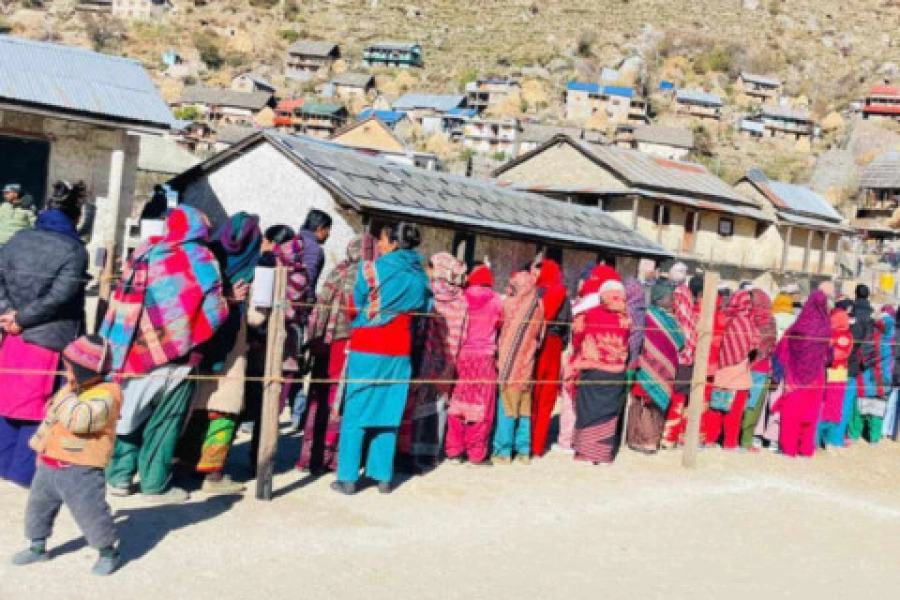
As the chill of winter begins its slow retreat, Nepal’s feverish election campaign has finally drawn to a close. From midnight on Monday, the legally mandated silent period came into effect, abruptly halting rallies, slogans, campaign vehicles, and social media appeals. Flags have stopped fluttering in organised processions, loudspeakers have fallen silent, and the posters that once covered walls and street corners now stand as fading reminders of weeks of political contestation. Today, the country votes to elect a new House of Representatives (HoR). In the past few weeks, the air had been thick with the colours of political parties—the crimson of the Nepali Congress, the red of the CPN-UML, the white star of the Nepali Communist Party (erstwhile CPN Maoist Centre), alongside other emerging forces. Social media brimmed with declarations, endorsements, and fervent, often fractious debates. In tea shops along highways, and in cities and villages alike, conversations revolved around a single question: who deserves the nation’s mandate?
Now, however, a different mood prevails. With the campaign noise silenced and the long-awaited voting day finally here, a space has opened for reflection. Beyond the spectacle of motorcycle rallies and grand promises, citizens are left alone with their thoughts and their ballots. Across the country, the atmosphere is less euphoric and more contemplative. There is cautious deliberation rather than loud enthusiasm. This moment demands not just participation, but introspection. The silent period is not merely a legal formality; it is a democratic pause—an opportunity for voters to weigh competing claims without pressure or persuasion. Before we ink our fingers today, we must engage our minds and consciences.
A History Marked by Struggle and Sacrifice
To understand the gravity of the mark we make on the ballot, we must glance over our shoulder. Nepal’s political evolution has been neither linear nor gentle. It is a tapestry woven with threads of immense hope and profound sacrifice. The 1990 People’s Movement restored multiparty democracy, breaking the absolute hold of the Panchayat system. The fiery and traumatic decade of armed conflict that followed sought to uproot deep-seated structural injustices, but at a terrible human cost. The 2006 People’s Movement culminated in the historic abolition of the 240-year-old monarchy—a truly revolutionary feat. The Madhesh Andolans of 2007 and beyond forcefully placed the issues of federalism, inclusion, and identity at the heart of the new Nepal.
Each of these seismic shifts was powered by the extraordinary will of the people. Citizens poured into the streets, driven by aspirations for rajya punarsamrachana—a restructuring of the state itself. Their demands were fundamental: equality (samanata), recognition of identity (pahichan), dignity (atmasamman), and a fair share in the nation’s opportunities (awasar). Ultimately, the state was compelled to listen. We promulgated a visionary Constitution in 2015, establishing a federal democratic republic—a framework intended to decentralise power and empower marginalised communities.
However, translating this hard-won framework into tangible change in the lives of ordinary Nepalis has proved problematic and disappointing. The dreams articulated in rallies and peace agreements appear to have stagnated. The question haunting the national psyche is clear: “Ke hami le janata ko jeewanma kehi farak lyayeka chhaun ta?” — Have we truly made a difference in people’s lives?
The reality on the ground reveals a worrying gap. Quality education and accessible healthcare remain distant dreams for millions outside urban centres. The promise of employment for youth has translated into a heart-wrenching spectacle: long queues at the Department of Foreign Employment, as our sons and daughters embark on risky journeys to the deserts and construction sites of the Gulf and Malaysia. Our justice system is overburdened and often influenced, resulting in delayed justice. Corruption has become an institutional menace, siphoning off resources meant for roads, schools, and hospitals. The bitter irony is that the political class, which once championed the people’s cause, now often appears as a closed elite, disconnected from the daily struggles of the very janata it vowed to serve.
A wise academic transition

A Generation That Questions, Not Waits
Into this complex scenario steps a powerful new demographic force—Gen Z—who make up a significant portion of the electorate. This generation, digital natives born after the peace process or during the federal transition, views politics through a distinctly different lens. They are heirs to past struggles but refuse to be prisoners of those narratives.
They do not dismiss the sacrifices made for democracy and the republic. However, they are increasingly impatient with politics that trades on past glories while failing to deliver a viable present and future. For them, the martyrs’ sacrifices demand accountable governance, not ceremonial remembrance. Their rallying cry is for visible action, not just nara (slogans). They seek jimmewari (responsibility) over bhawana (sentiment). Armed with smartphones, they are connected to global standards of transparency, efficiency, and innovation. They see how other nations progress and rightly ask, “Hamro deshma kina hundaina?” — Why can’t it happen in our country?
Their aspirations are clear: meaningful employment within Nepal, a system where merit triumphs over connection (afno manchhe), clean and transparent administration, and leaders who are accessible and accountable. When these aspirations are met with familiar patterns of patronage and paralysis, frustration manifests in a silent but powerful verdict: emigration. The mass departure of bright young Nepalis is not merely economic migration; it is a devastating vote of no confidence in the system. This brain drain threatens the nation’s foundation. Their departure is a warning siren for the political establishment.
A Politics of Uncertainty and Its National Consequences
Current politics offers little reason for hope. Since the adoption of the new Constitution, Nepal has witnessed a carousel of governments. Prime ministers have changed with bewildering frequency. Coalition governments—often forged not on shared ideology or common programmes but on seat-sharing arithmetic—have proven inherently unstable. This politics of calculation and shakti santulan (power balancing) has exacted a heavy price: policy paralysis.
A government focused on its own survival has little energy for long-term national priorities. Crucial development projects stall midway. Foreign direct investment hesitates amid regulatory uncertainty. Mega infrastructure projects face endless delays. The vision of “Samriddha Nepal, Sukhi Nepali” risks becoming an empty slogan. Chronic instability erodes economic confidence, strains the social fabric, and diminishes Nepal’s standing in a competitive world.
The global context is equally turbulent. Geopolitical tensions reshape alliances, climate change threatens our Himalayan ecosystem and agriculture, and economic volatility affects remittances and trade. In such an environment, a politically volatile and strategically uncertain nation is profoundly vulnerable.
Why Informed Citizens Matter More Than Ever
In this high-stakes context, the voter’s role shifts from ritual participant to sovereign architect of the nation’s future. Each vote is a small but potent fragment of national will. Voting must therefore follow conscious reflection.
We must move beyond ethnicity, region, or family tradition and rigorously evaluate candidates and parties:
• Track Record, Not Rhetoric: What have they delivered? Were they accessible? Did they contribute meaningfully in Parliament?• Character and Integrity: Are they implicated in corruption? Do they represent sewa (service) or entitlement?
• Vision and Plan: Beyond promising bikas (development), do they present realistic, costed solutions?
• Commitment to Rule of Law: Do they respect democratic institutions and constitutional bodies?
A vote must not be traded. It is not a commodity to be exchanged for money, liquor, or fleeting favour. Nor should it be surrendered under fear or coercion. A vote is a sacred trust—a hak (right) granted by the Constitution, accompanied by jimmewari (responsibility).
Democracy After Election Day
Citizenship does not end when the ballot drops into the box. That is when sustained engagement must begin. The relationship between representative and public cannot be a five-year transaction; it must be continuous dialogue.
We must practise khabardari—vigilant citizenship—monitoring performance and demanding accountability. These elections are more than a mechanical process to form a government. They are a national dialogue between our painful yet proud past, our challenging present, and our uncertain but hopeful future.
As campaign drums grow louder, let us create a quiet space for reflection. Let us weigh our choices with reason and determined hope.
The power to break the cycle of underachievement, to demand better, and to steer politics from opportunism toward nation-building lies in that single, deliberate mark on the ballot paper.
Let us choose wisely. Let us choose thoughtfully.
For in that thoughtful choice lies the seed of the New Nepal we have long fought for—and still await.
The author is a governance analyst. Views expressed are personal.