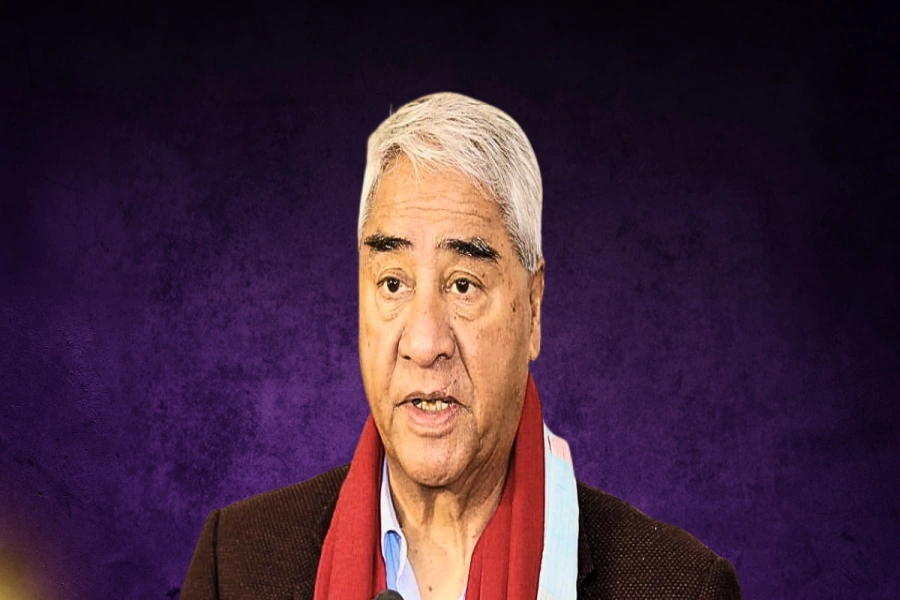
“This country’s been suppressed for a long time, slam poetry is what I’d call expression over suppression,” said Yanik Shrestha, one of the judges of QC Awards: The Poetry Slam. [break]
The finale of the inter-school poetry slam organized by Quixote’s Cove bookshop and Word Warriors, the first slam poetry group of Kathmandu, in collaboration with the US Embassy was held on Saturday at Lincoln School, Ravi Bhavan.
The competition was divided into four phases starting from submissions of original poems, a one-day workshop held at Ullens School, Khumaltar on February 18 followed by auditions and competition.

Photos: Keshab Thoker
Organizers received over 70 submissions and after the workshop, which focused on writing, performing and editing poetry, auditions were conducted on February 23 at three different venues - Kathmandu International Study Centre (KISC), Dhobighat; Thames International College, Old Baneshwar and Lincoln School.
21 participants were short-listed for the finale which had two consecutive rounds of competition. Top 10 scoring participants proceeded on to the last round of the competition.
Apart from the requirement for the poems to be less than or up to three minutes, participants also had to perform different poems in each of the last rounds. Top five scoring participants - Shreya Dhital from Lincoln School; Birat Shrestha from GoldenGate International College; Shiva Bhusal from IOE, Pulchowk Campus; Janam Maharjan from Nepal Engineering College and Anuja Khadka from Kathmandu University were awarded the QC Awards 2013.
Sanket Shrestha, 18, was one of the top 10 finalists and said he first started writing poems when he was studying in Buddhanilkantha School but stopped for a while when he joined Rato Bangala School. “I attended one of Ujjwala didi’s workshops last year and it made me resume writing poetry,” he shared.
Program Coordinator Ujjwala Maharjan is a member of Word Warriors and was also one of the top five winners of the first edition of the slam poetry contest back in 2010.
Talking about how slam poetry has helped her become more confident, Maharjan said, “It has helped me know that I matter; my voice, presence and existence. It has helped me discover myself not just as a poet but also as a teacher,” referring to conducting slam poetry workshops in different schools of Kathmandu.
For Sanket, slam poetry is a means of expression that helps him bring out the alternate part of him residing inside. “It helps you talk about things you’re usually afraid to discuss and say things you wouldn’t otherwise,” he said, adding that he rarely sits down to write poems. “I usually talk to myself and jot things down; most of my poems have been written in that manner but if I sit down with an idea, I try to make it as personal as possible so people listening can relate to it,” he shared.
This was the first time Shreya and Birat tried their hands at slam poetry and they were amongst the five winners. “My English teacher told me about the competition and I love the stage so I decided to give it a try,” shared Shreya, for whom slam poetry is also a means to express.
Similarly, Birat is used to writing lyrics for his metal band, Fractions, but this was his first attempt at poetry. “I work more on my sounds and rhythmic flow but writing comes easily. It resonates a person’s being,” he said.
Ambika Giri, scriptwriter and director of BBC’s Katha Mitho Sarangi Ko; Rabi Thapa, editor of online literary magazine La.Lit; Yuyutshu RD Sharma, renowned poet and translator; Yanik Shrestha, a poet and the Director of Passage International, a study-abroad facilitator; and Susan Parker-Burns, Head of Public Affairs at the US Embassy in Kathmandu judged the finale of the contest.
Nepal’s nascent slam poetry scene
KATHMANDU, March 3 (REPUBLICA): Suvani and Pranab Singh of Quixote’s Cove talk about the growing scene of slam poetry in Nepal and its future prospects.
How has the scene grown since 2010?
Pranab: A lot more people know what slam poetry is now. Nepal is a poetry-based country and we have traditions of oral story-telling like Swasthani. With slam poetry, we are basically trying to revive this culture.

What topics are mostly covered by the young spoken word poets?
Pranab: We have been working with the same age-group for two years now so topically, it has been consistent. Participants usually write about teenage issues like not having their say, love, break-ups and politics and general situation of the country.
Suvani: The topics young poets choose to write on tells you what youths are reading and are influenced by. Many write about current events not just of national but regional level. It tells you what impacts them and in what degree.
Is the slam poetry scene getting better with each passing year?
Pranab: From the time when we started to now, a lot more people are involved in slam poetry. The Facebook page of Word Warriors has been an interactive medium between aspiring spoken Word poets of Kathmandu. It has provided a platform for young minds to put their voice forward which is why a lot of schools have agreed to host workshops and events like this one.
Related story
Young widow shoulders family responsibilities after husband kil...