

None of the images, including Everest and Buddha, are developmental symbols despite being significant exotically, naturally, and historically. You would like to identify the nation with expressions of the contemporary: The highways reaching up to the edges of the great mountains, rivers falling and rising into energy, cities thriving with sites of dazzling cleanliness, and politicians thinking as economists. But many of our symbols have museum values. While the tourists enjoy, the common people suffer.
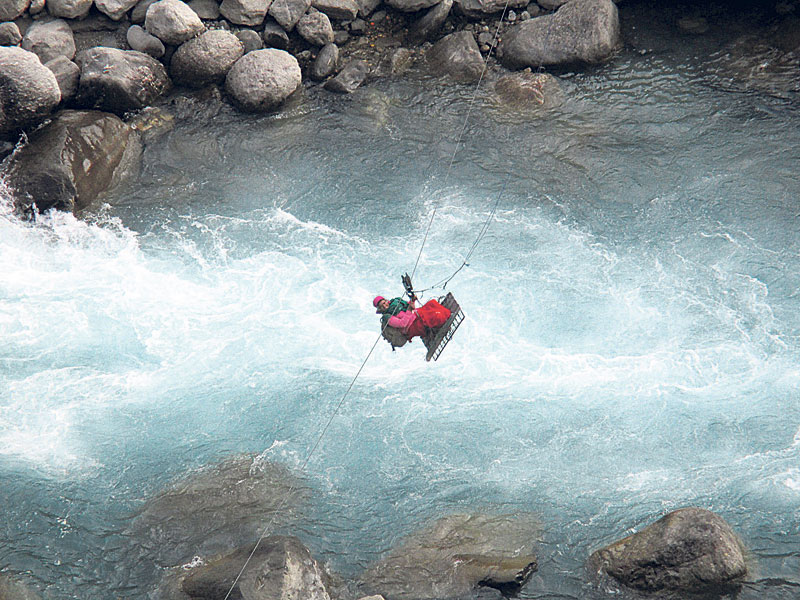
The ‘death’ of five people while crossing by the make-shift cable contraption called Tuin in Dadhing district is not shocking but shameful. There are people who cross the river daily by hanging between life and death. The Jaymire Ghat-Ghyal Chowk incident begins the tales of this year’s monsoon.
Tuin, a mark of extreme adventure, must not carry the children to schools in a modern world. They should have been museumized. How does a rational Nepali react to the falling of people into the river because of human-cable-transport? We used to cross Tinau in Butwal on make-shift bridges or wait for the currents to subside. We crossed the Trisuli on the bus pulled upon the rafts. I remember holding a big rope and crossing a Tarai river which has strong currents during the monsoon. My family almost drowned once when the elephant was unable to withstand the rushing waters of a river called Surahi in Kapilabastu.
They were adventurous sites and experiences but you do not live with them. You sing songs about them, paint, museumize, but they are the markers of shame for a modern nation if they remain the working identities of our daily lives. How do you respond to yourself when you read that villagers fell from the Tuin in Dhading!
The Dhading incident got prominence in the news because the district is nearby the capital. There are many such deaths in the remote corners of the mountains and the plains. The forced adventure of crossing the river still remains as the mark of struggle in Nepal. There are historical tales about such journeys from the Rana times. There was a Hulaki in our village who had abundance of river stories from the monarchical regimes. Hulakis were administratively powered postmen of the kingly days.
The ‘death’ of five people while crossing by the make-shift cable contraption called Tuin in Dadhing district is not shocking but shameful. There are people who cross the river daily by hanging between life and death. The Jaymire Ghat-Ghyal Chowk incident begins the tales of this year’s monsoon.
The Hulaki from my village was a priest also. I have documented the factuals about his works when he was a postman during the Rana times. He crossed dangerous jungles and raging rivers from Rupendehi to Dang. I still am filled with thrill when I remember his adventures. He disappeared while crossing Banganga river to go to Taulihwa, the administrative center of Kapilabastu. There is a famous Hulaki road which connects old market town Bahadurganj with the center.
They are the elements of tales and adventures, memories, fears and joys, but they should not be the experiences of contemporary times. Such images, elements, factuals have not changed in many parts of Nepal. They are not tales but facts.
The head of Central Department of English Dr Amar Raj Joshi loves to go to Bajhang whenever he gets time from the urban ugliness of political universities and stinking lanes of Kathmandu. While going home, he still crosses jungles and tracks with the images of utter natural wilderness. He holds a book of American Indian myth when he goes to Bajhang, and an anthology of environmental poetics in his bag. When he returns he tells the tales of his countryside which have resisted the travels of time.
My market village too has multiple travel-signs of the past. Things have not changed much. But my village-times and Amar’s rugged track-times of the presenceness of the past can be the materials of stories but when students die falling from the Tuins, the symbolism of Everest diminishes into developmental shame.
From my village the Buddhist sites of Tilaurakot are not far, but in a funny way there are places where arguably Buddha-times still remain. Nation has not moved much amidst fierce revolutions, international aids, and INGO sympathies and that is why students fall into the rivers while going to schools.
“Learn the management of demolition from our politicians,” laments a shopkeeper in Swayambhu. “How can they ruin a beautiful country so fast and with anatomical accuracy?” He wonders. “I have crossed the Trishuli on Tuin but I have promised never to go to the districts anymore,” he offered me a cigarette and I declined.
Let me make a shame-list of darker nationalist symbols, the reversed images of pride. ‘Tuin’ tops the list. Where would you put rivers of immense energy source? A student suggested me the names of some politicians to head the list, I humbly declined.
orungupto@gmail.com
Related story
Shame! Shame! Shame! Shame on Nepal













-1200x560-1779450784.webp)


