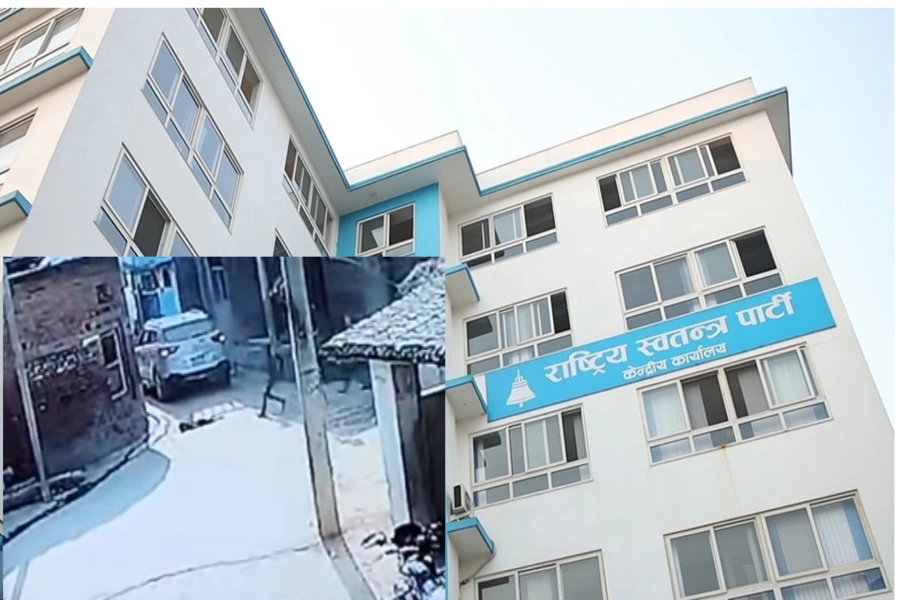
It is often argued that widespread unemployment, instability, constitutional crisis and lack of political accountability are pushing the country to the brink. True. But this excludes the endemic that is taking the country toward complete statelessness: politically sanctioned criminal underworld. Nepal’s future prospects largely depend on whether it will be able to tackle it. [break]
Perhaps CK Lal is right in calling CPN-UML “the party under the control of... underground dons” (“The future red,” Feb 11). Nothing supports this claim better than the result of the recently concluded general convention of Youth Association Nepal, UML’s youth wing. Predictably, Mahesh Basnet, who contested the polls on the platform of establishing YAN as the organization of raharlagdo, bharlagdo and darlagdo (enviable, reliable and fearsome) youths, has been reelected for the second term with a number of central committee members with criminal backgrounds.
YAN and crime have become synonymous. (A crime reporter affiliated with this daily told me of an incident that sounds like dark humor. At a YAN function, a new entrant to the group went up on the stage to be welcomed among the ranks with vermillion and garland. He, however, refused to take off his helmet. He later told the person doing the honors that he was in the police’s most wanted list and if he had taken off his helmet, he would have been arrested.) It is hard to tell when crime started becoming the defining feature of YAN. But YAN’s muscle-politics began to surface after its then Morang district vice-chairman Parshuram Basnet—who has now been elected to YAN central committee even though a case against him is sub-judice at Morang district court—masterminded an attempted murder on a Biratnagar-based journalist affiliated with Nagarik in 2011. Details of what followed could be shocking for who have not experienced Nepal’s statelessness first hand.
Related story
Dark underbelly

File photo/Republica
Journalists took to the streets demanding Basnet’s arrest. Mahesh Basnet took Parshuram under his wings and challenged the police to arrest him if it could. He launched a counter-protest against the media fraternity in Biratnagar and declared YAN the organization of underworld dons from across the country. He threatened to shut the office of Nagarik and jail then Editor-in chief Narayan Wagle. All along, the government looked on as a helpless spectator. The issue had deeply divided UML. KP Oli openly spoke in favor of Basnet. Leaders from the rival faction protested. Politburo member Surendra Pandey even registered a case against Oli at the party secretariat for protecting goons, but in vain. He had to later apologize for daring to question the malice. Two years down the line, YAN continues to control the party, rather than other way round.
I do not intend to single out YAN. Virtually every party harbors dons and criminals. But most of the notorious dons (Dinesh Adhikari “Chari,” Chakre Milan and Ramesh Bahun, to name a few) are associated with UML and its youth wing. Unsurprisingly, YAN has come to consider itself above the law. In February 2012, YAN cadres in Dang forced cops on duty who had cautioned them not to drive their motorbikes without helmets to apologize in front of hundreds. While criminal elements defy the state authority, political leaders abet them from behind the scenes.
A youth from my hometown, Bahrabise, who has accumulated a fortune through red sandalwood smuggling (see: “Gathering storm,” Nov 1, 2012) got married last month. He celebrated the occasion by throwing a lavish party at perhaps the most expensive five star hotel in Kathmandu. What was remarkable about the whole occasion was that despite his dubious reputation, high-profile leaders from NC, lawyers and police officers attended his wedding.
By doing so, they have all but legitimized his smuggling racket. Now it will be much easier for this youth to consolidate his empire. If his consignments are seized, he will use his political and police connection to get them across the border to China. Such a blessing from high profile politicians is the reason why red sandalwood, pangolin parts, sea horses, tiger hide, rhino horn and red panda skin continue to be smuggled through Araniko Highway—with all of its 16 police check points!
Worse still, the government itself is intent on protecting smugglers and dons. In 2012, the Anti-Money Laundering Department and Nepal Police announced a plan to freeze the assets of the valley dons who have amassed immense wealth through illegal land dealings, coercion, smuggling and extortion. But the investigation hangs in limbo because Ganesh Lama—who is one of the most notorious valley dons with illegal properties worth above Rs 50 million—is reportedly a darling of home minister Bijaya Kumar Gachchadhar. Gachchadhar is said to have transferred officials at Central Investigation Bureau to halt investigation so that Lama remains off the hook. Gachchadhar is mired in many such controversies. He is also blamed for protecting chief suspect in the disappearance of Chhorimaiya Maharjan, Nikki Singh. Despite this he remains a kingmaker in Baburam Bhattarai government.
Such is level of criminalization of politics in Nepal. But instead of trying to tackle the real issues, the government is engaged in a shambolic publicity stunt by running roughshod over the youths whom it calls “hooligans.” At the same time, to show the international community that it is committed to controlling organized crimes, the government had the President endorse an ordinance on organized crime which is expected to help the country avoid being blacklisted by the global anti-money laundering body, the Financial Action Task Force. While the international community may or may not call our bluff on organized crimes, such an ordinance is but a thin veil to hide the flourishing underworld nexus.
What brings youths to underworld crimes? With the state failing to grant them jobs and to maintain law and order, prospects in the underworld start luring them. They see that criminals and underground dons are above the state. There, they enjoy easy money, muscle power and political connections—three elements that ensure their rise up the ranks of criminals. But whatever the appeal, rising criminalization of politics will ultimately breed Frankensteins who will one day eat up their own progenitors. Politicians may rear them at their own peril.
Criminal elements become most active during elections. Come election time (whenever that is), leaders will try to cash in on the loyalty of the underworld actors. The million-dollar question is: Will Khil Raj Regmi, the first non-political PM hopeful in Nepal’s democratic history or any other executive head, be able to crack down on this underworld regime, which is a prerequisite to free and fair elections?
mbpoudyal@yahoo.com